Farewell to a Museum
On the Platonic Love of Ukrainian Cultural Heritage

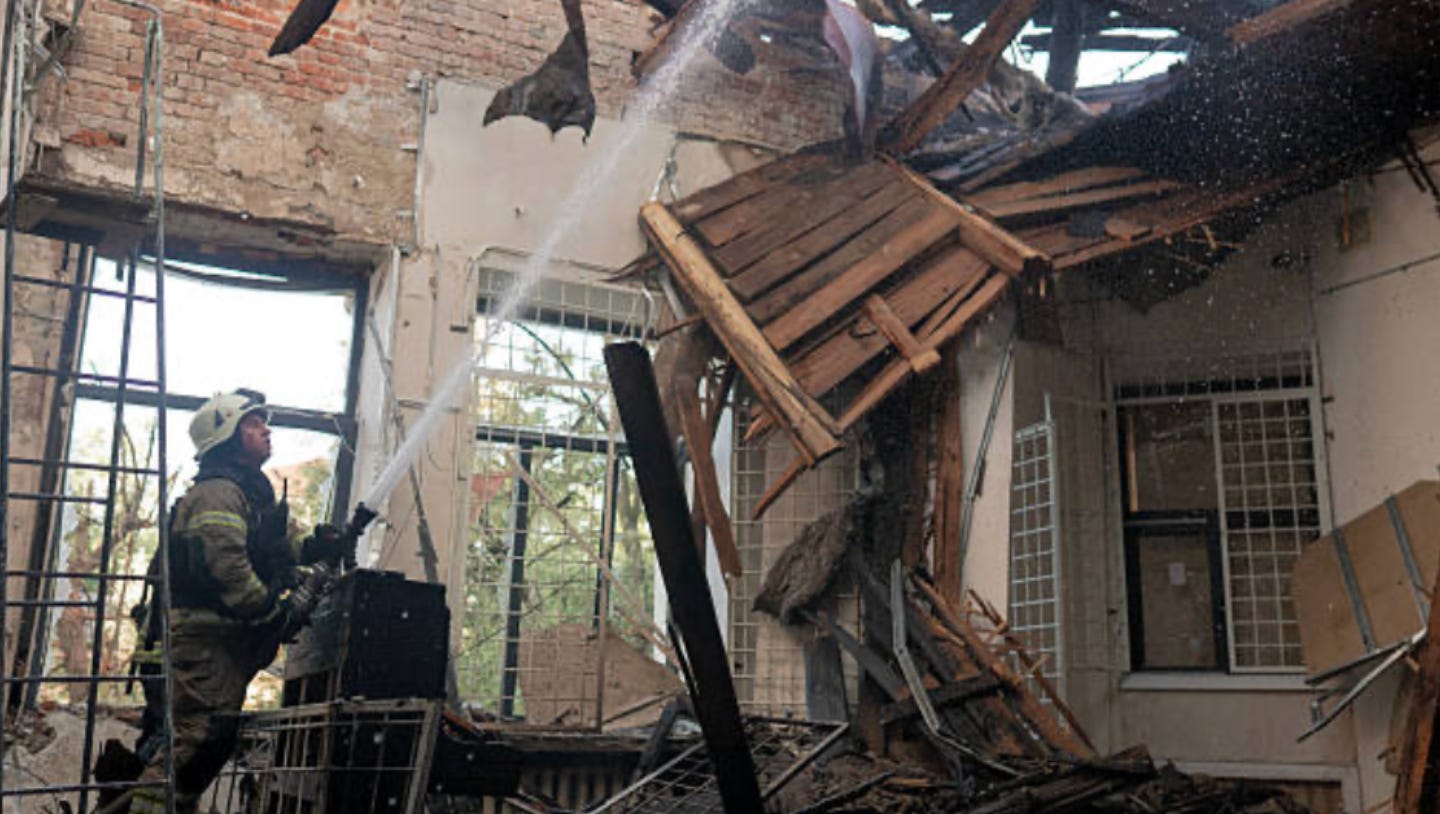
A firefighter battles a fire of the roof of the Kharkiv Art Museum after the building was struck by a Russian drone. Kharkiv, 14 June 2026.
On June 14, during a Russian attack on the city of Kharkiv, the Kharkiv Art Museum was struck by a drone. Six people, including a child, were killed. The resulting fire damaged roughly 1,200 square meters of the building. It is too early to assess the full extent of the destruction. We do not yet know the scale of the damage to the collections. Yet the photographs emerging from the museum are telling. Firefighters, curators, and journalists rushed to the scene. Even Ihor Terekhov, the mayor of the city, can be seen running through the smoke-filled corridors of the burning building, desperately trying to carry artworks to safety. Images of scorched and smoldering paintings leave little doubt that serious damage has been done.
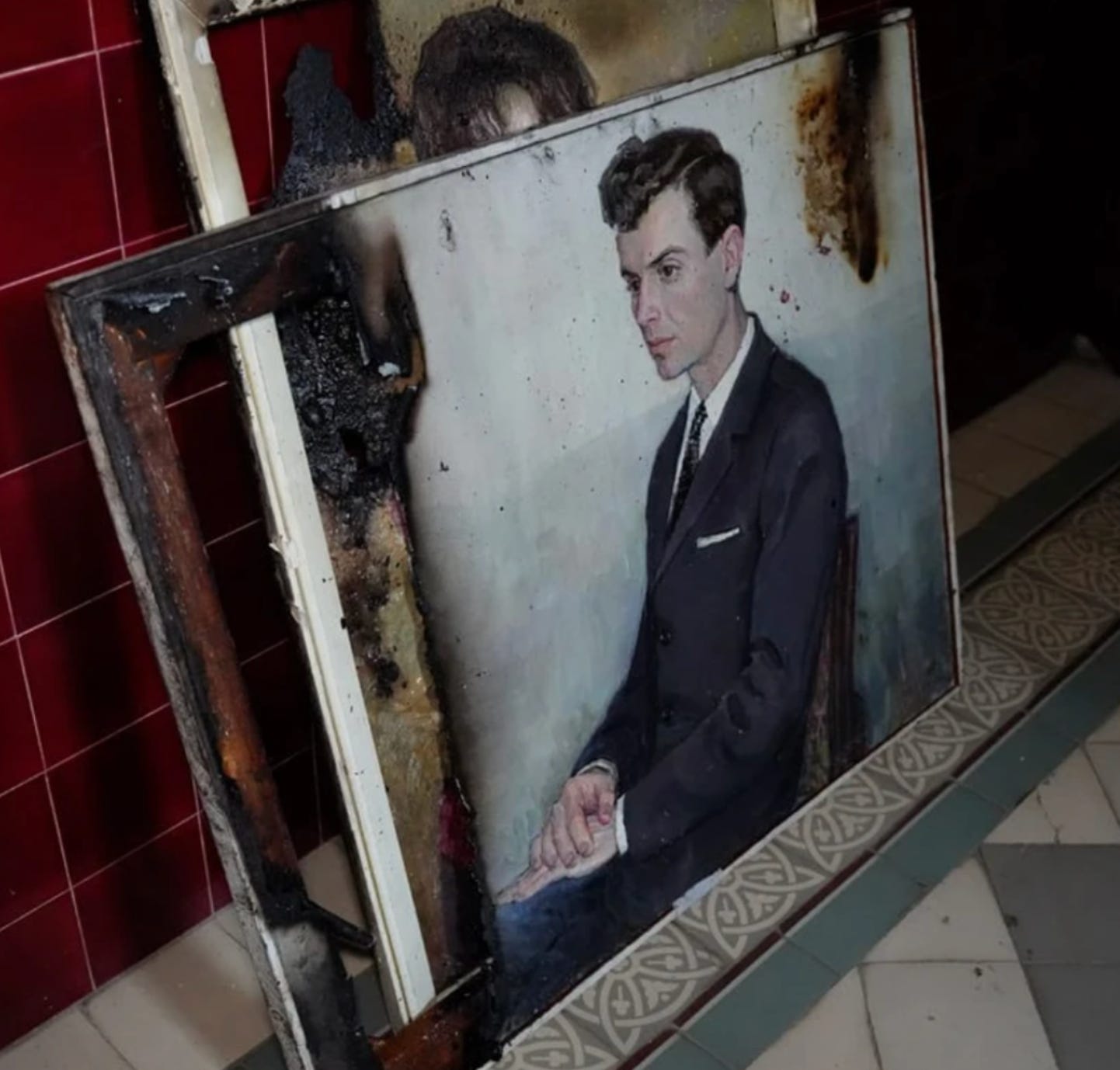
A portrait damaged during the Russian drone strike on the Kharkiv Art Museum. Kharkiv, Ukraine, 14 June 2026.
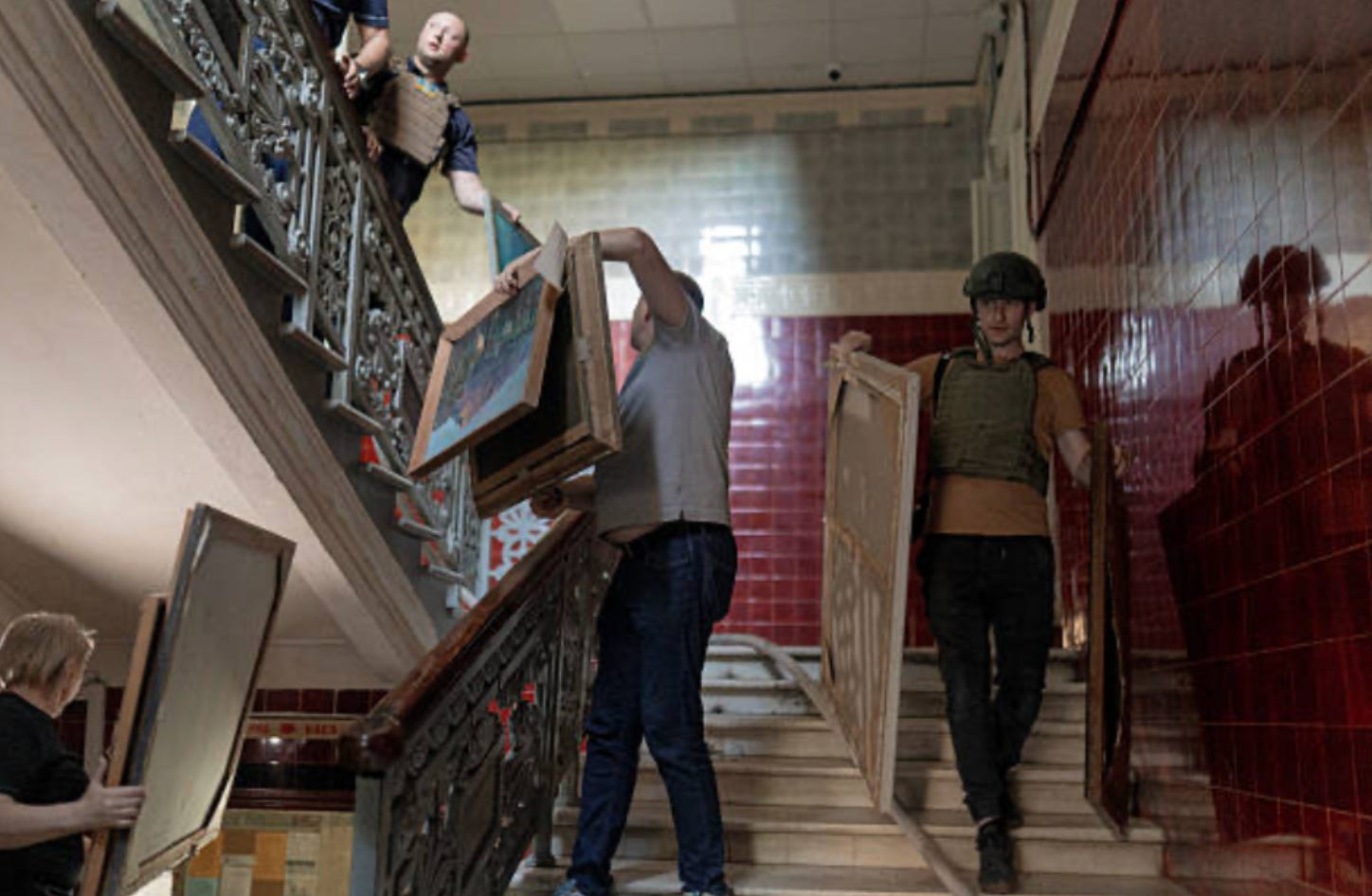
Saving the paintings. Kharkiv Art Museum, 14 June 2026.
For anyone familiar with the history of the city, the feeling of déjà vu is unavoidable. Before the Second World War, the museum’s collection comprised approximately 75,000 objects, including major holdings of Ukrainian, Russian, and Western European art. Yet, like many museums in Ukraine, only a small portion of the collection was evacuated before the Nazi occupation. During the occupation, the museum was partially looted, and the majority of the stolen works have never been recovered. Documentation of these losses is fragmentary because, in 1943, before retreating from the city, German forces poured gasoline throughout the museum and set the building on fire, destroying the remaining collections and the museum archive. Of the approximately 75,000 artworks once held by the museum, only the 4,700 objects evacuated before the occupation survived. Now, eighty-three years later, the museum building is burning once again. The only emotions I can summon are rage and helplessness. This tragedy was entirely predictable. The constant game of Russian roulette—in both the literal and metaphorical sense—that Ukrainian museums have been forced to play since 2022 could hardly have ended differently. The writing on the wall has been visible for four years. Especially now, at this particular moment, when the Kremlin leadership, endlessly invoking the rhetoric of “de-Nazification,” appears willing to tolerate levels of cultural destruction that inevitably evoke comparisons with the crimes committed against cultural heritage during the Second World War. The warning signs appeared long before. On March 24, the historic Bernardine Monastery complex, located within the UNESCO-protected center of Lviv, suffered fire damage as well as damage from blast waves and shrapnel during a Russian attack carried out in broad daylight. On May 24, the historic center of Kyiv came under heavy bombardment, leaving dozens of museums, theaters, and architectural monuments damaged. The National Museum of Chornobyl was virtually destroyed. The blast wave from an Iskander missile explosion also damaged the building of the National Art Museum of Ukraine. On June 14 the Dormition (Assumption) Cathedral of Kyiv-Pechersk Lavara Monastery was aimed by Russian drone. The roof of the cathedral burned out. By a lucky chance the situated nearby Museum of Historical Treasures of Ukraine, Museum of Theatre, Music and Cinema of Ukraine, Museum of Books and Printing of Ukraine, and National Museum of Ukrainian Decorative Folk Art were not damaged. However, the building of situated on the other side of the Lavra wall was aimed by drone and damaged by fire.
Kharkiv was no exception. It was part of a broader pattern of escalation, and such an outcome was entirely foreseeable. I am leaving aside, for the moment, the questions of why despite of partial evacuation artworks were still located in the museum galleries; why they had not been removed and stored in the basement—which, admittedly, would offer little protection in the event of a direct missile strike, but at least some minimal safeguard; and why such measures were not taken in a museum that had already been damaged by Russian shelling in March 2022 during the Battle of Kharkiv, when the blast wave shattered most of its windows, damaged stained glass, and affected parts of the façade. I
nstead, I want to address a different issue. In February 2022, when the full-scale war began, the evacuation of Ukrainian museum collections abroad was briefly discussed by Ukrainian authorities but quickly rejected for numerous reasons (One of which obviously was the aftertaste of the Russian claims for the Scythian objects sent by Ukraine to the Allard Pierson Museum in Amsterdam for the exhibition Crimea: Gold and Secrets of the Black Sea. The case was won by Ukraine but lasted for nine years – from 2014 to 2023.)
Under those circumstances, we proposed in 2022 a different solution: to bring to Europe an exhibition of masterpieces from the modernist collections of the National Art Museum of Ukraine and the Museum of Theatre, Music and Cinema of Ukraine. The project In the Eye of the Storm: Modernism in Ukraine, 1900–1930s became possible thanks to the extraordinary efforts of Yulia Lytvynets, Director General of the National Art Museum of Ukraine, her staff, and Francesca Thyssen-Bornemisza, who provided every possible—and often seemingly impossible—form of support and persuaded the Museo Nacional Thyssen-Bornemisza in Madrid to host the exhibition. It became the first museum exhibition to leave Ukraine after the start of the full-scale invasion. The story of our adventures attracted considerable media attention and has been recounted in detail elsewhere. (https://www.nytimes.com/2022/11/23/arts/design/ukraine-art-exhibition-madrid-eye-of-the-storm.html)
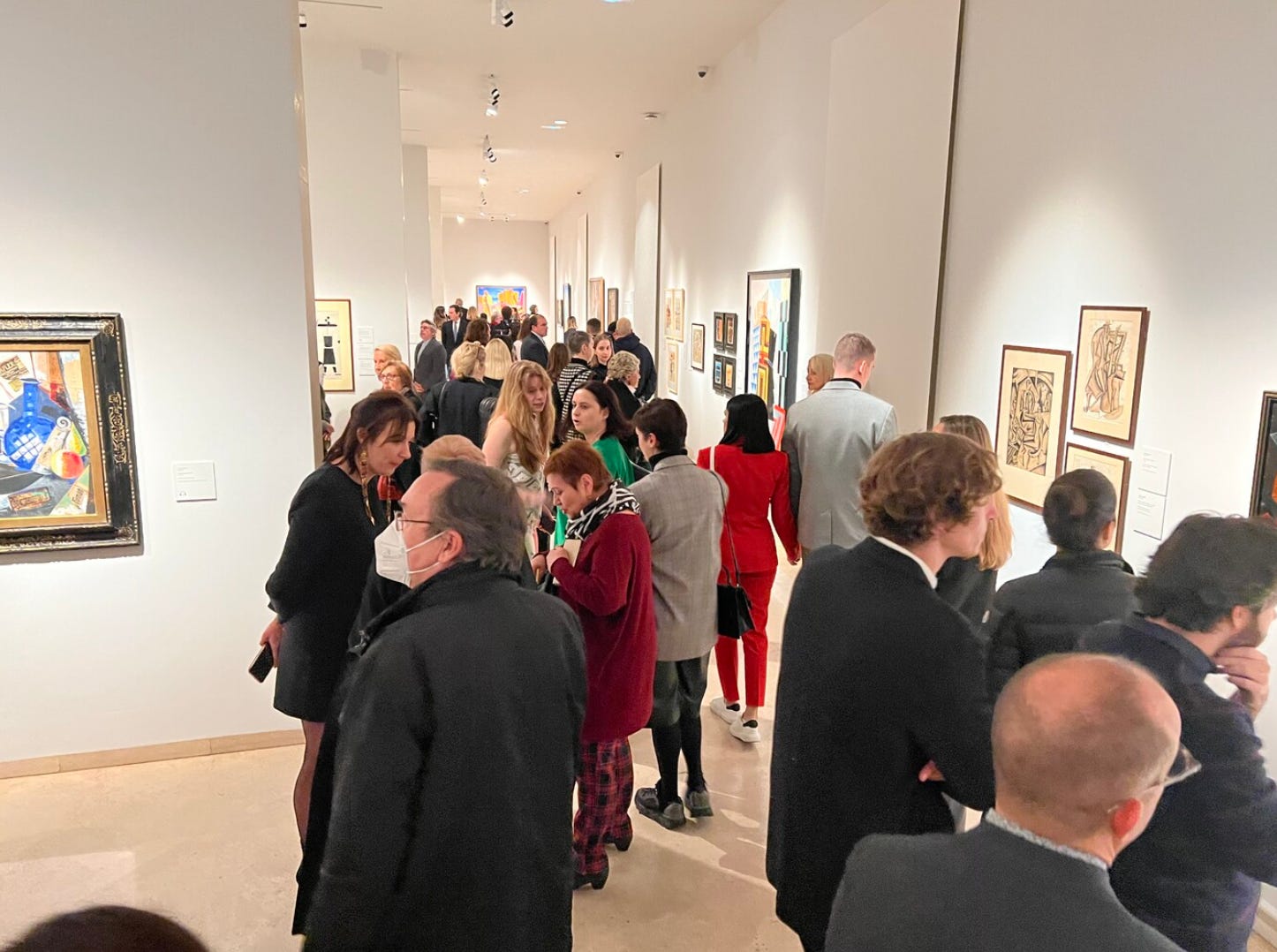
Opening of the exhibition In the Eye of the Storm: Modernism in Ukraine, 1900–1930s at the Museo Nacional Thyssen-Bornemisza, Madrid, November 2022.
The exhibition received the prestigious Apollo Award as the International Exhibition of the Year in 2023 and subsequently travelled to Cologne, Brussels, Vienna, Bratislava, London, and Łódź. In We were ecstatic. We had succeeded in bringing these collections to the safety of European museum galleries while at the same time introducing European audiences to masterpieces of Ukrainian modernism that had remained almost entirely unknown outside their homeland.
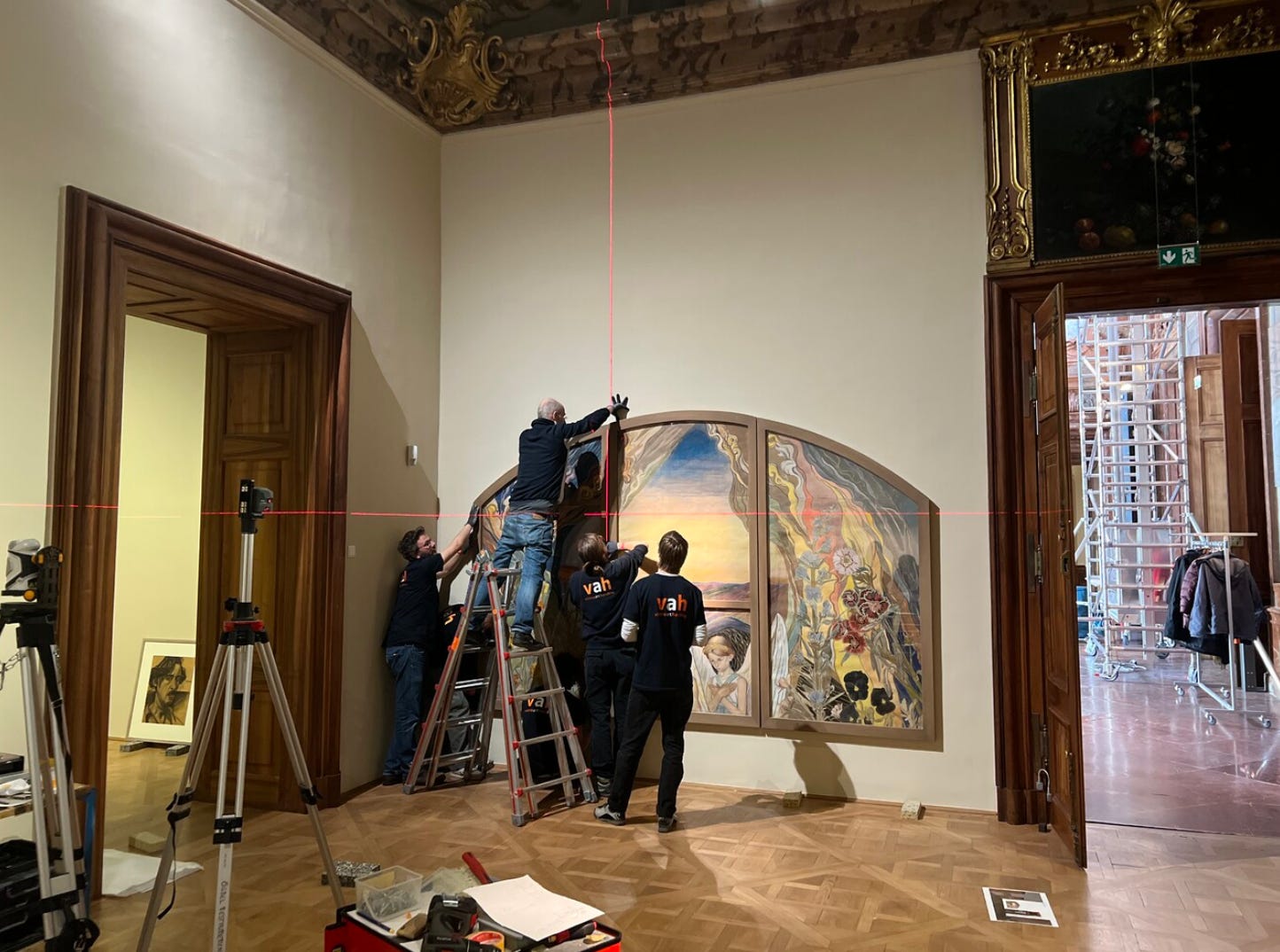
Installation of the exhibition In the Eye of the Storm: Modernism in Ukraine, 1900–1930s at the Belvedere, Vienna, 2024.
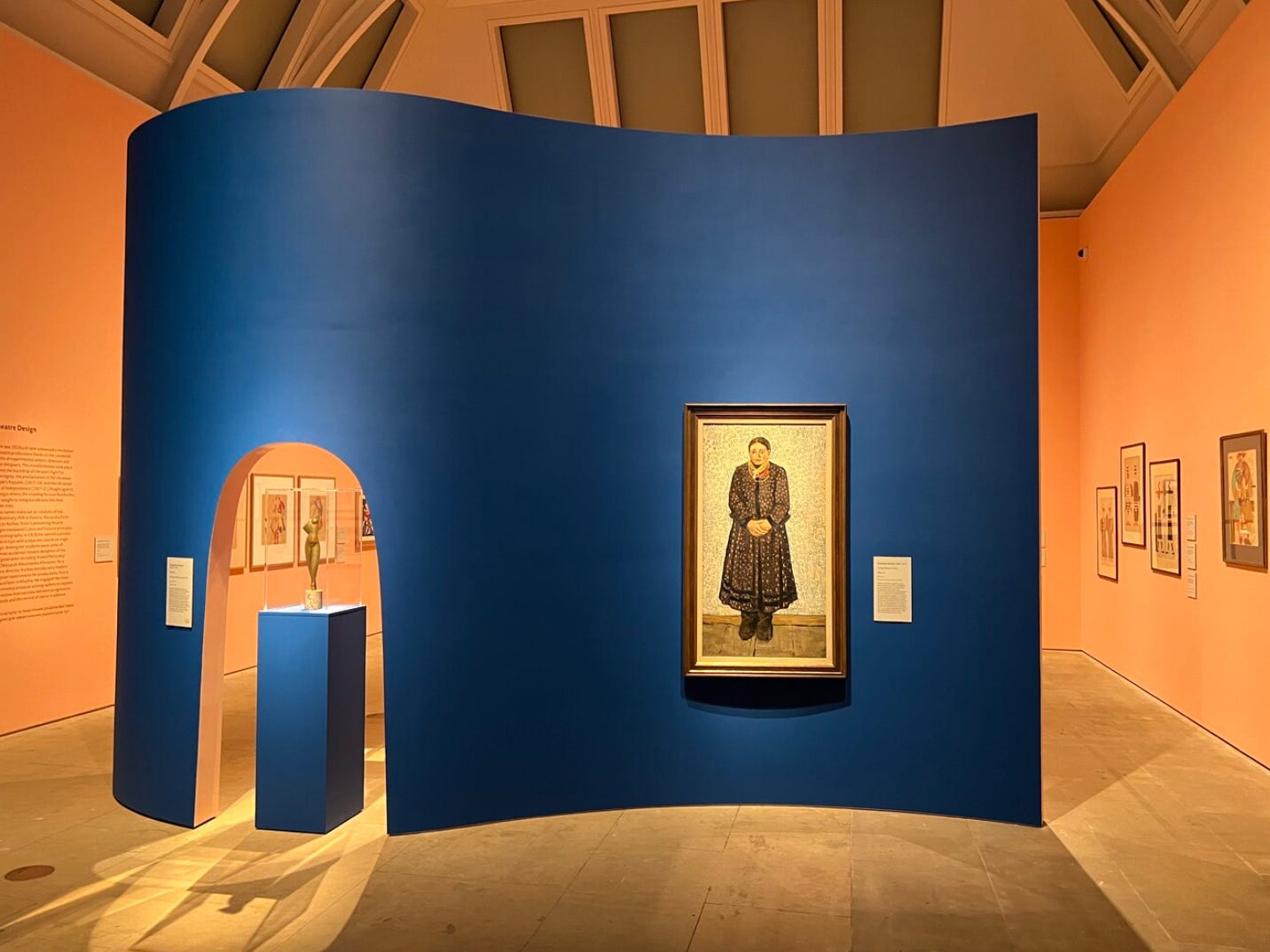
The exhibition In the Eye of the Storm: Modernism in Ukraine, 1900–1930s at the Royal Academy of Arts, London, 2024.
Soon others followed, and exhibitions drawn from Ukrainian museum collections began to mushroom across Europe, from Poland to Estonia.
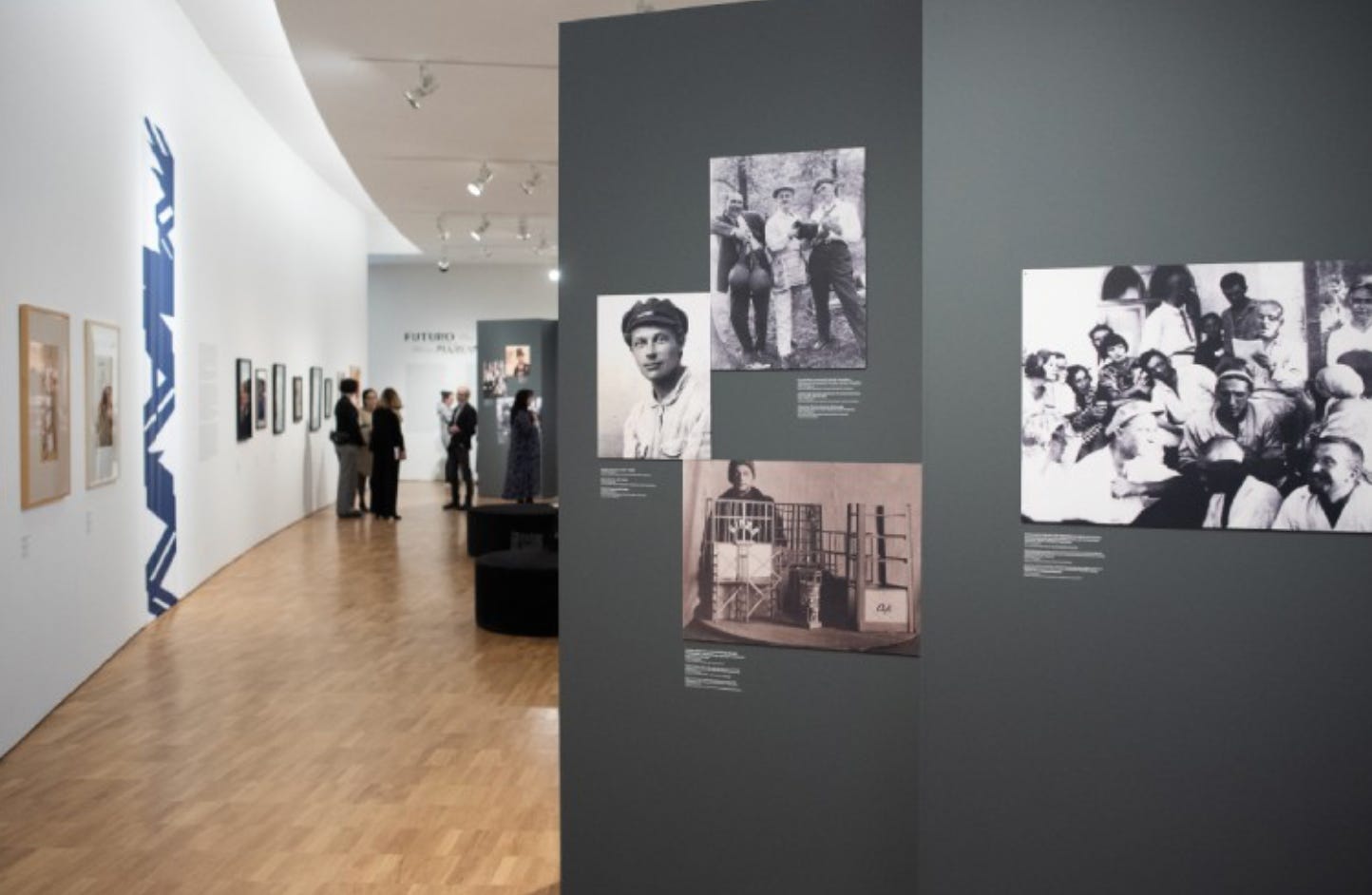
Futuromarenia: Ukraine and the Avant-Garde from the collection of the Mystetskyi Arsenal National Art and Culture Museum Complex, Kumu Art Museum, Tallinn, Estonia, 2023.
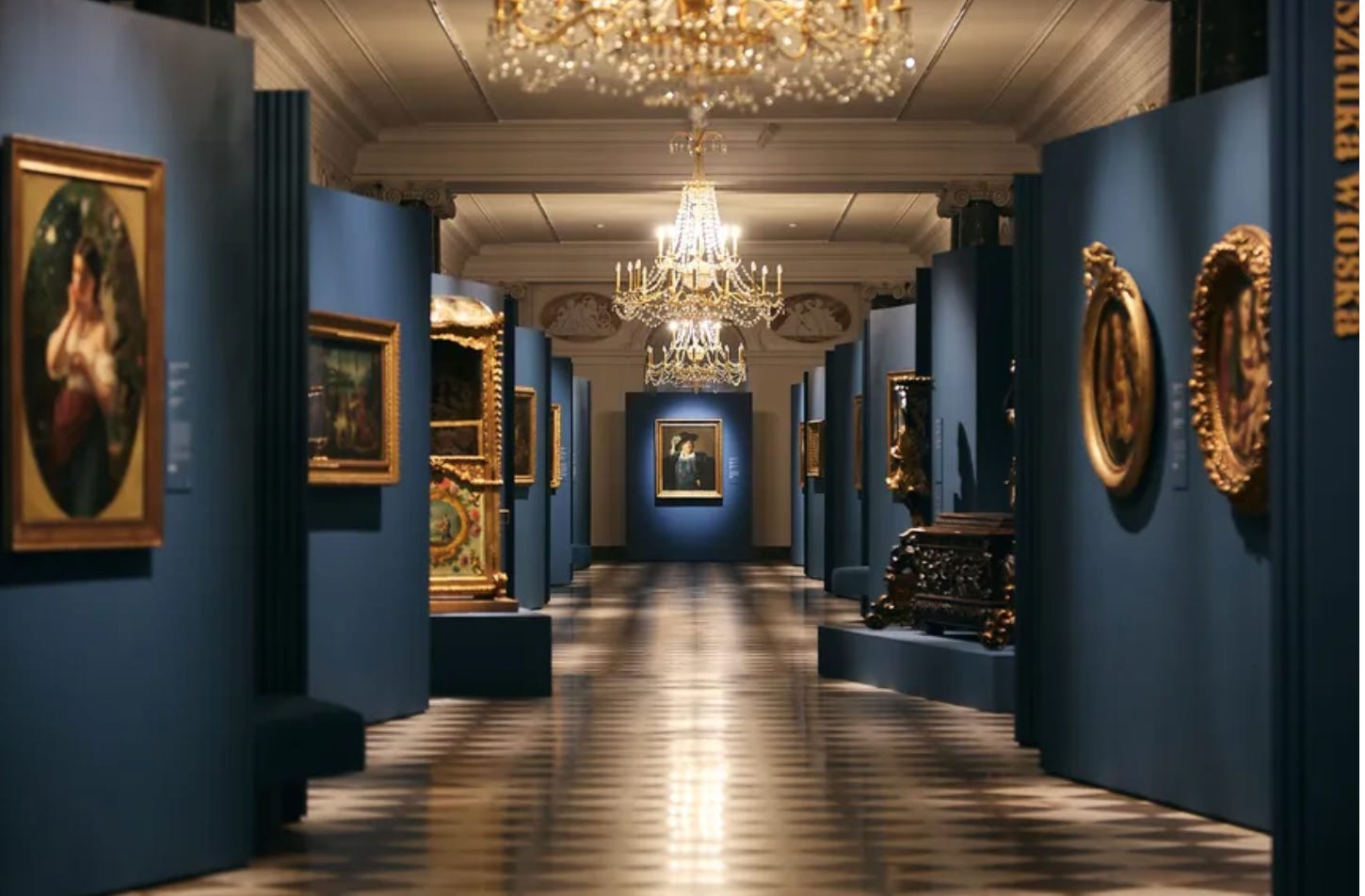
The Cabinet of European Art: Masterpieces from the Bohdan and Varvara Khanenko National Museum of Arts in Kyiv at the Royal Castle in Warsaw, 2024.
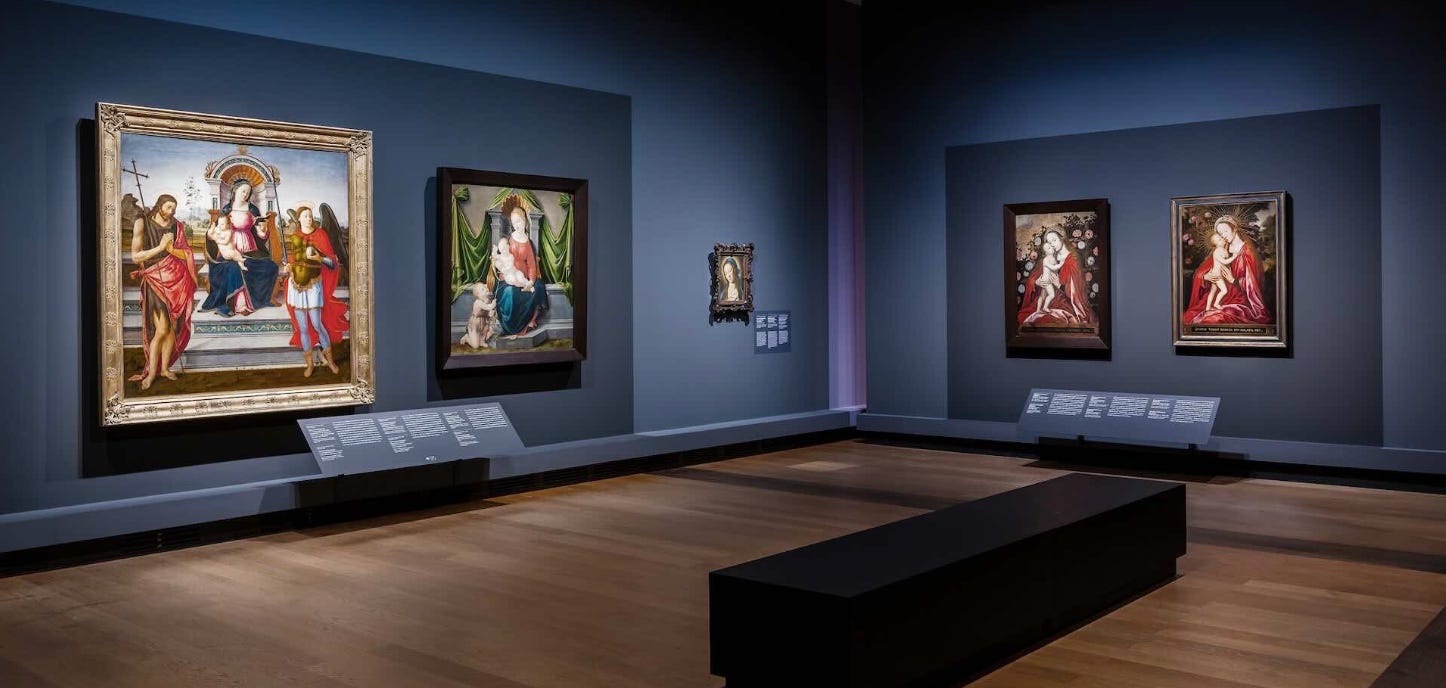
The exhibition From Odesa to Berlin: European Painting of the 16th–19th Century at the Staatlichen Museen zu Berlin, Berlin, 2025.
The only mistake we made was that none of us could imagine that this war would last longer than the First World War and would soon approach the duration of the Second. We assumed that the emergency would be temporary.
Between 2022 and 2025, we were fortunate to work with museum directors and curators who were willing to alter long-established plans and, in some cases, even temporarily remove parts of their permanent displays in order to make room for works from Ukraine. We collaborated with people who not only wanted to present outstanding Ukrainian art to their audiences but also understood that they were participating in its preservation.
For that, we remain endlessly grateful. We are particularly indebted to the museum community of the Republic of Poland, which assumed a disproportionately large share of this effort among our European partners. For years, Polish museums hosted, safeguarded, and facilitated the circulation of objects from Ukrainian museum collections, providing an essential lifeline at a moment of existential danger.
At the same time, many European museums—which I prefer not to name—continue to behave as though they were negotiating an exhibition project initiated in Switzerland rather than responding to a cultural emergency unfolding in the midst of a war. It is understandable that museum institutions, much like the former Soviet Union, often operate according to five-year plans. In our case, however, we can guarantee everything except that the collection in question—or, indeed, the country itself—will still exist by the distant date being proposed.
What Ukraine needs now is for more exhibitions to leave the country. And we are not speaking merely of symbolic displays, but of collections of the highest quality: Scythian archaeological treasures, European Old Masters, Ukrainian Baroque paintings, and masterpieces of modernism from the first half of the twentieth century. The exhibitions that have already travelled to Europe have proven remarkably successful, attracting large audiences and significant media attention. European museums understandably operate within financial constraints. Yet perhaps national governments, private sponsors, and institutions of the European Union could play a more active role in supporting such projects.
So far, among Europe’s major museums, only the Louvre has undertaken the long-term safeguarding of important works from Ukraine. Perhaps other museums could follow this example. By accepting one or two significant works on long-term loan, they would not only place them in safety but also draw public attention to the plight of Ukrainian museums and the dangers faced by their collections. Such an arrangement would, in my view, be a genuine win-win situation: preserving cultural heritage while educating audiences about a crisis that is far from over.
Over the last two years, endless conferences on the protection of cultural property in military conflicts in general, and during Russia’s war against Ukraine in particular, have taken place across Europe. I have attended several of them and listened to many highly professional presentations, often of a theoretical character. Yet no one has so far been able to answer my questions about intra-EU evacuation protocols, emergency storage facilities, or practical mechanisms for safeguarding museum collections threatened by war.
I do not dismiss the importance of theory. But while experts debate scenarios, Ukrainian museums are living through reality. The problem is no longer hypothetical. Museums are being hit, collections are being damaged, and buildings are burning. I still hope for practical solutions. I imagine the superb Baroque sculptures of Johann Georg Pinzel in the Vatican Museums, the Scythian pectoral in the halls of the Kunsthistorisches Museum in Vienna, or the masterpiece by Georges de La Tour from the Lviv National Art Gallery hanging on the wall of the Alte Pinakothek in Munich. Not as trophies of war, but as temporarily safeguarded ambassadors of a culture under attack.
The attack on the Kharkiv Art Museum should serve as a warning. Tomorrow it may be another museum. The day after, another collection. Every Ukrainian museum director understands this. The question is whether their European colleagues understand it as well. The time for expressions of solidarity has not passed, but solidarity alone is no longer enough. What is needed now are loans, transport, storage facilities, insurance guarantees, emergency funding, and the political will to act before the next museum catches fire. Evacuation is not cultural exile. It is preservation. It is the difference between protecting a collection until peace returns and risking its irreversible loss. Ukrainian museums are burning. They need help now, while there are still collections left to save. The alternative is to watch, once again, as art works that survived one war disappear in another.