Synagogue over Venice
Nabatele: A Warning in the Sky, A Memory of Yiddishland

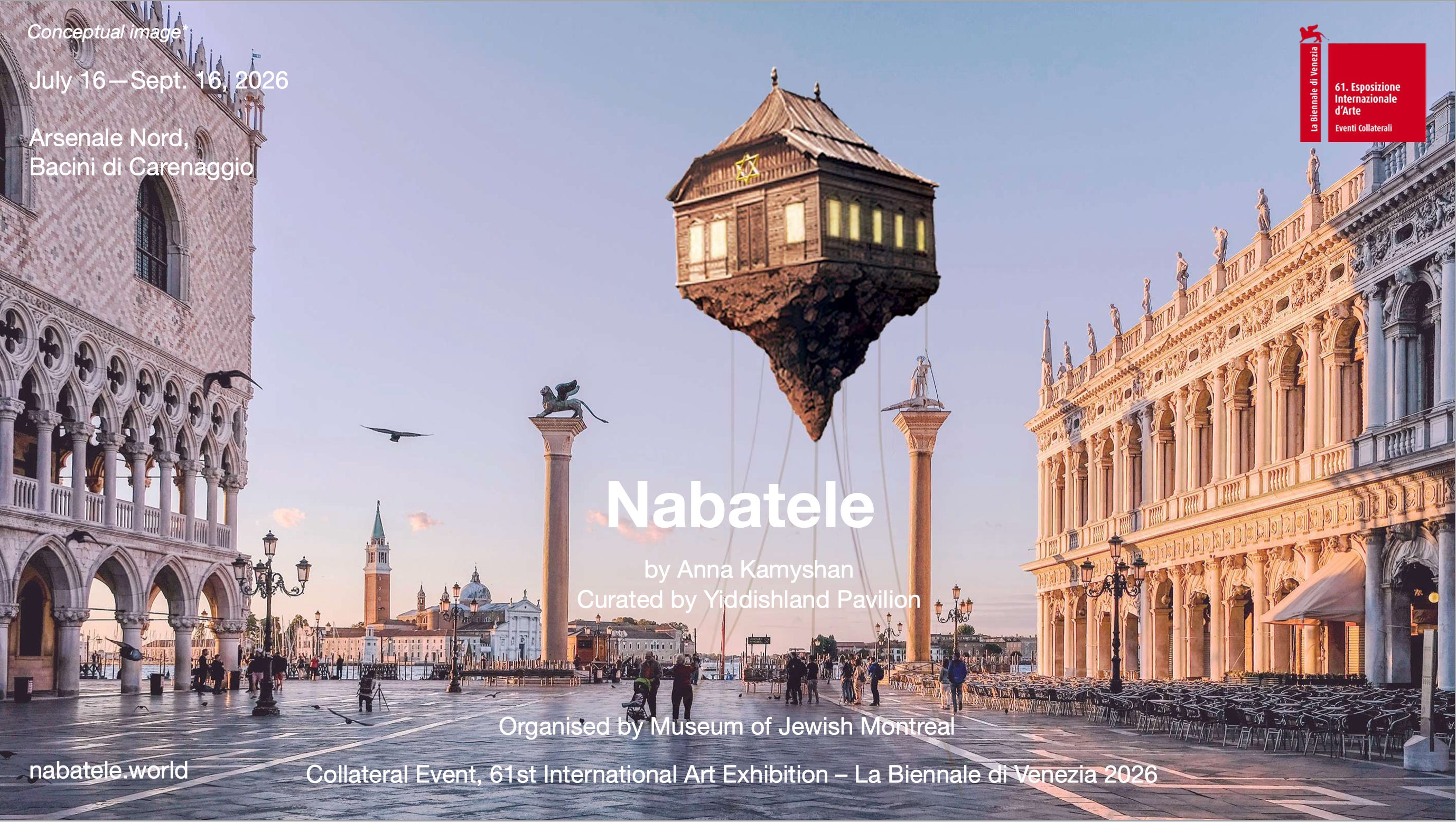
On 16 July, a wooden Galician synagogue will float above the Venetian Lagoon. That day will mark the inauguration of Nabatele, a project by Anna Kamyshan, a London-based Ukrainian-Jewish architect, artist, and curator originally from Lviv.
Nabat, a Slavic word that entered Yiddish in the early twentieth century, means an alarm, a warning bell, or a call to vigilance. According to the project’s description, “the Yiddish diminutive -ele softens nabat, transforming a warning into a quiet, gentle presence rather than an urgent alarm.” To me, however, the title is best understood as a tender signal of remembrance.
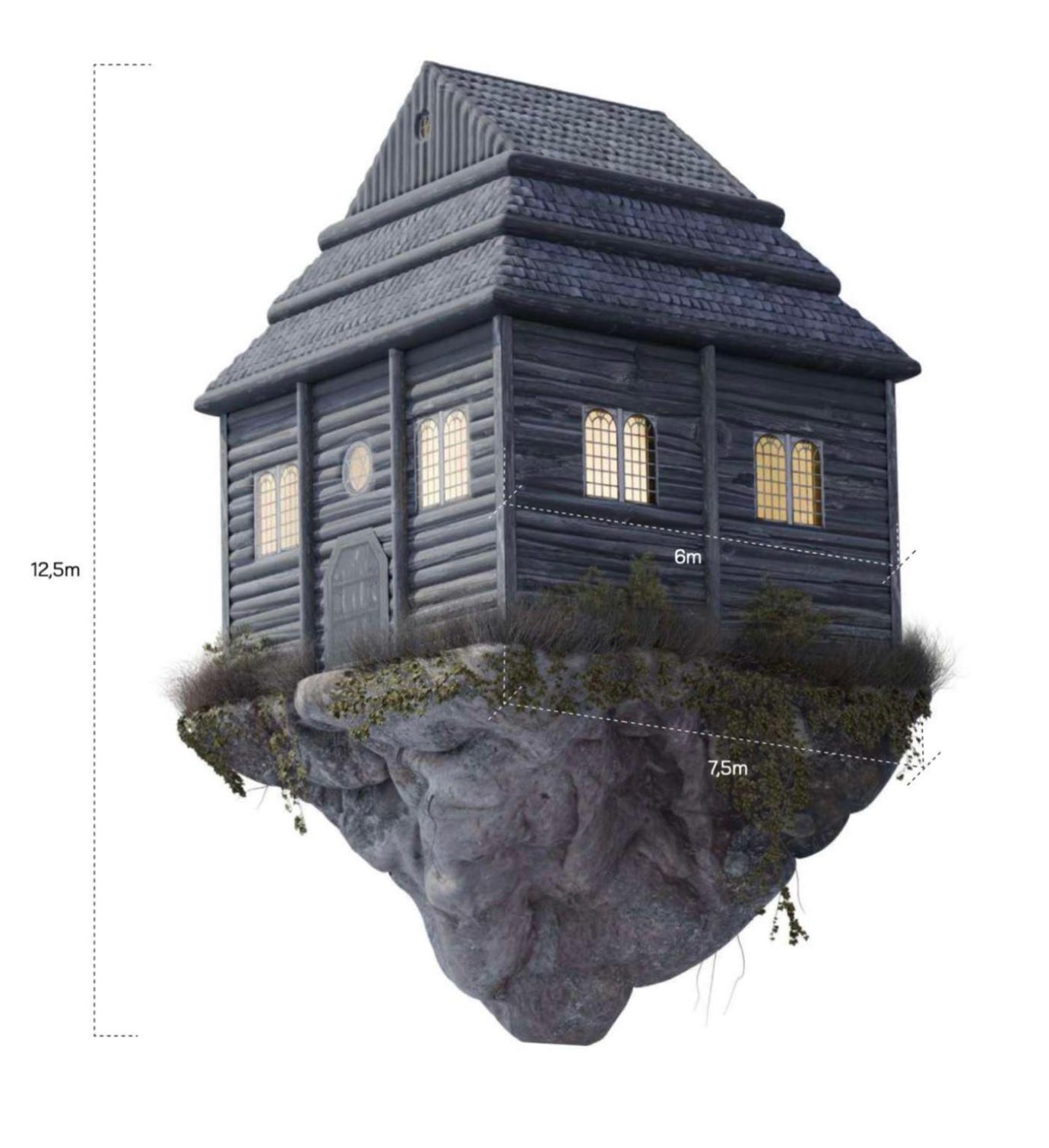
The project of the flying synagogue.
The model of the flying synagogue.

The roof of the flying synagogue is now complete.
The flying synagogue is presented within the framework of the Yiddish Pavilion, an independent initiative founded by Maria Veits and Yevgeniy Fiks, which debuted at the 2022 Venice Biennale.
The Yiddish Pavilion has never been able to boast extensive funding. I participated in its discussion on Refugee Modernism in 2022, when this initiative—which represents no nation-state—found temporary refuge in the Latvian Pavilion. A Yiddish Pavilion without a physical pavilion perfectly reflected the very essence of Yiddish culture: a culture that was, by definition, without a homeland. With equal logic, one might imagine a Pavilion of Atlantis among the Biennale’s collateral events.
The remarkable Yiddish civilization that flourished during the explosion of modernism at the beginning of the twentieth century was largely annihilated in Ukraine, Poland, and Belarus by the Nazis and, later, by the Soviet regime. Wooden synagogues were burned to the ground or demolished; those that survived in the Soviet Union were often stripped of their religious function, disfigured, and repurposed. One such example was the nineteenth-century synagogue in Boyarka, where, according to local tradition, Sholem Aleichem worshipped during his years in nearby Sofiivka. In the 1920s, it was converted into a Palace of Culture.
Poets, artists, and writers perished in Nazi concentration camps or were executed on Stalin’s orders. Those who survived joined the ranks of what might be called Refugee Modernists, eventually finding their way—if they were fortunate—to New York or Tel Aviv.
Yet even in Tel Aviv, Yiddish was not fully welcome. Many Zionists regarded it as the language of the Diaspora, associated with exile and political weakness, while Hebrew symbolized national rebirth and the creation of a sovereign Jewish state.
During my childhood I witnessed the slow death of Yiddish. In the Soviet Union it survived largely as a ritual gesture of official cultural policy in the form of the literary magazine Sovetish Heymland, published in Moscow and, I suspect, read mostly by its own contributors. The magazine served as an alibi for the Soviet leadership, allowing it to claim that antisemitism did not exist in the USSR while simultaneously promoting Yiddish as a counterweight to Hebrew—the language of the Israeli “enemy.”
I also heard Yiddish spoken in the homes of some of my friends. Ironically, they themselves did not understand a word of it. Their parents used it as a secret language, allowing them to discuss family matters in the children’s presence without being understood.
Today, the United States is the last outpost of that vanished Atlantis, with approximately 250,000 Yiddish speakers, roughly 80 percent of whom belong to Hasidic communities.
It is striking that the pavilion of the non-existent nation of Yiddishland—an independent transnational project challenging the nation-state model of the Venice Biennale at a moment of its own structural crisis—has chosen to present perhaps the most visible (in the literal sense of the word) manifestation of Jewish culture precisely at a time when antisemitism is once again on the rise in both Europe and North America.
I do not wish to dwell on the technical aspects of the project or explain how the flying synagogue is engineered. George Nelson has already explained this admirably. (https://www.theartjournal.com/articles/a-synagogue-floating-above-venice)
What interests me far more is the archaeology of vanished Yiddishland as interpreted by Anna Kamyshan.
Rather than reproducing one of the celebrated wooden synagogues of the former Polish–Lithuanian Commonwealth, the artist has created a composite architectural model—a synthesis, so to speak, of the wooden synagogues of Galicia and Volhynia. The synagogue that will float above Venice has a tiered hipped roof reminiscent of the synagogue in Hvizdets (Polish: Gwoździec), built around 1650 and known today above all through the reconstruction of its magnificent painted interior at Warsaw's POLIN Museum of the History of Polish Jews.
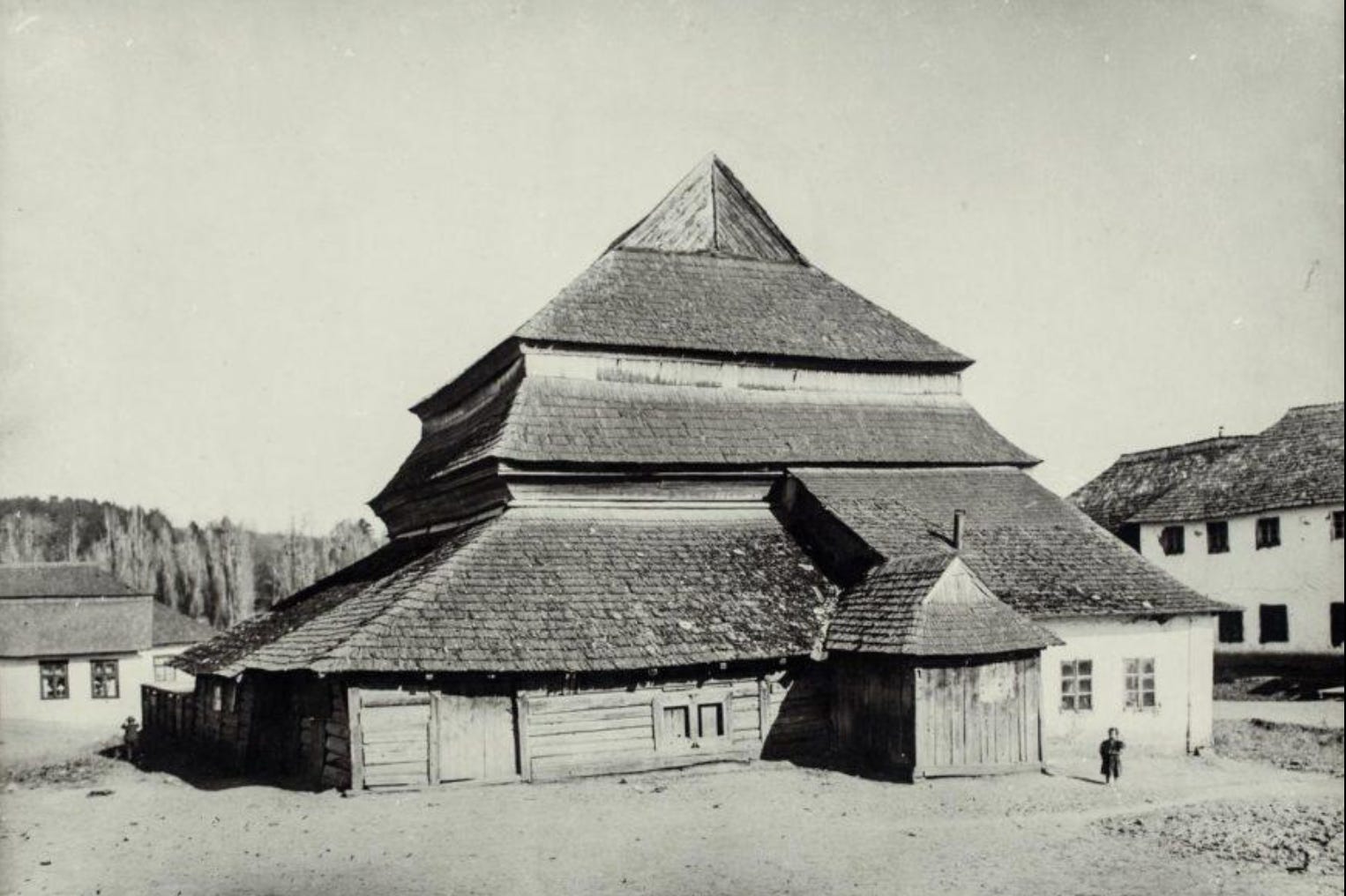
Synagogue in Hvizdets (Polish: Gwoździec), built around 1650.
The massive upper roof and compact, almost cubic body recall the synagogue in Khodoriv (Polish: Chodorów), erected in 1652.
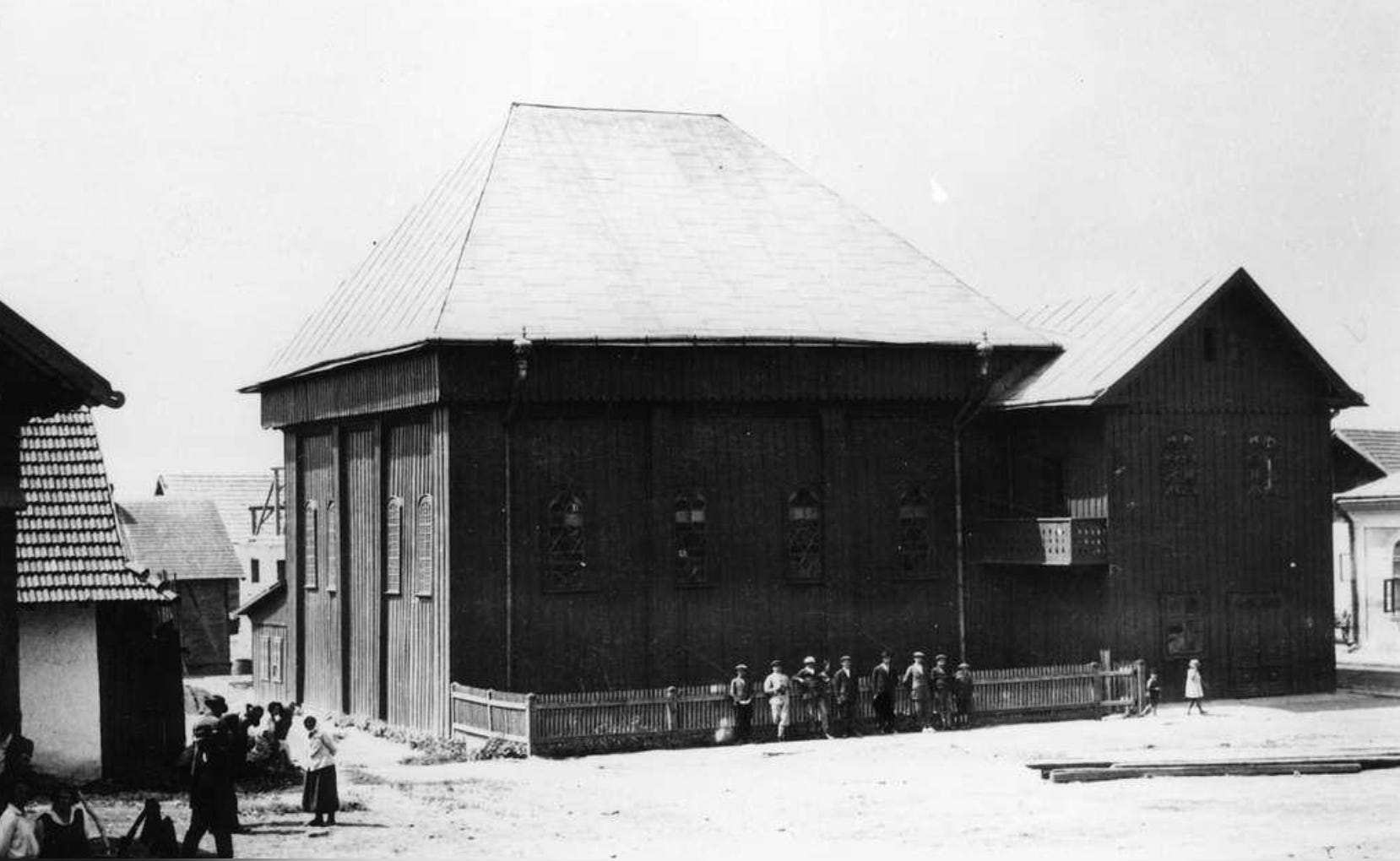
Synagogue in Khodoriv (Polish: Chodorów), erected in 1652.
. At the same time, the project evokes the synagogues of Yabluniv (Polish: Jabłonów) and Zabłudów.
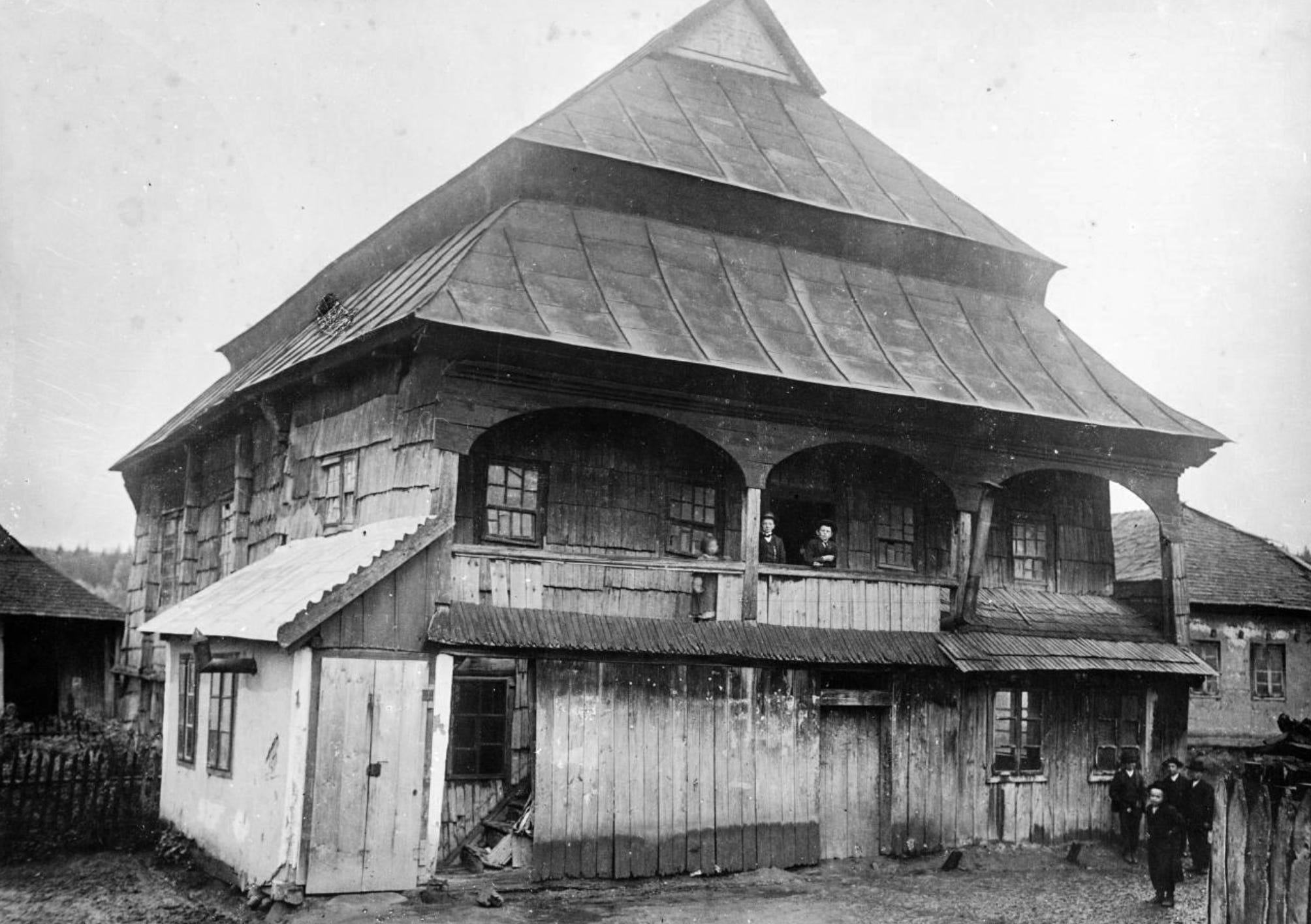
Synagogue of Yabluniv (Polish: Jabłonów), the second half of the 17th century.
n creating this architectural synthesis, Kamyshan has fashioned a monument to all the great wooden synagogues that no longer exist. Every one of these buildings was destroyed during the Second World War, most of them burned by the Nazis in 1941.
Kamyshan has acknowledged that her project was inspired by René Magritte’s The Castle of the Pyrenees. Yet her flying synagogue evokes an even stronger sense of the surreal. Whereas Magritte’s castle remained suspended in the imaginary space of a painting, Nabatele will literally float above the Venetian Lagoon.
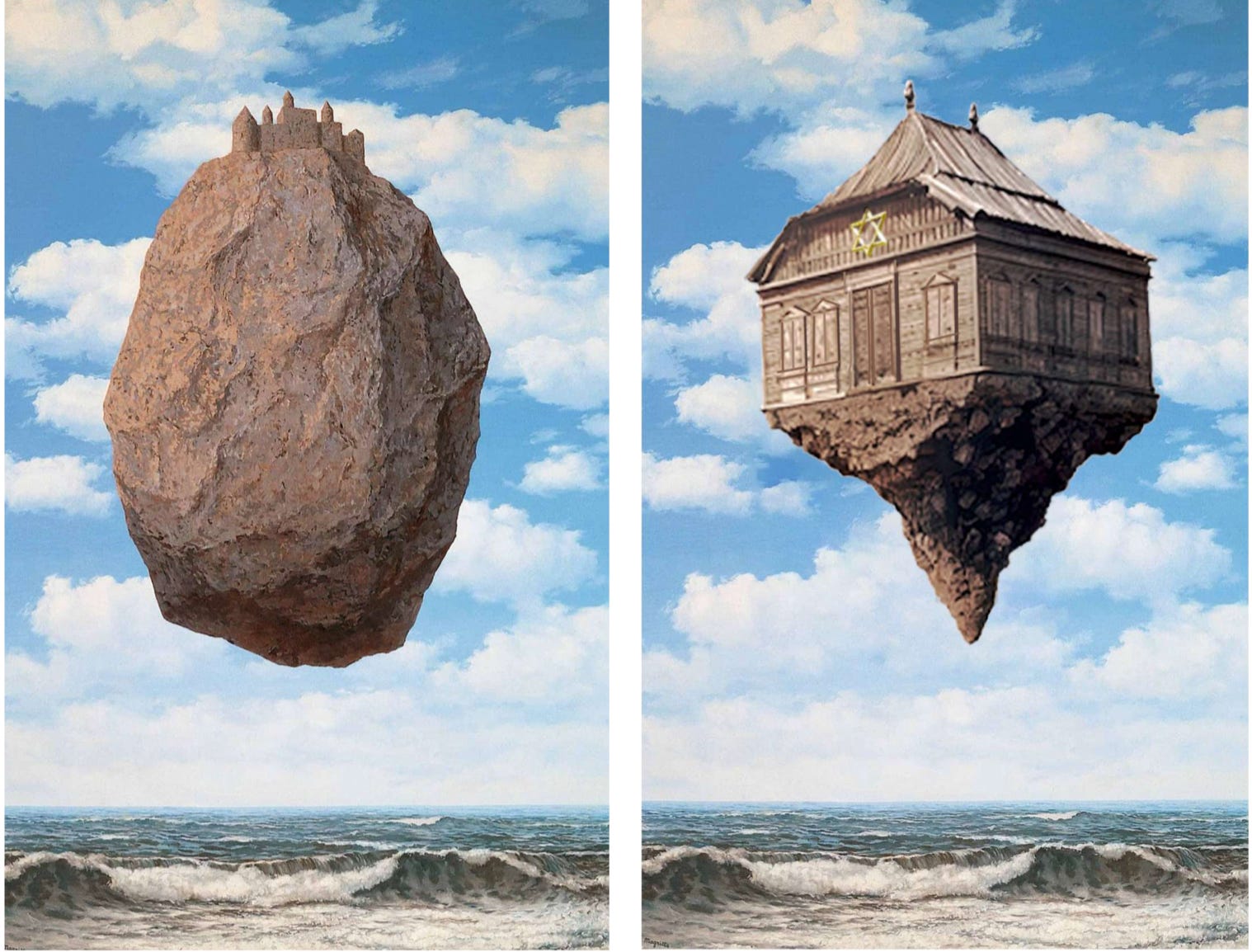
The Castle and the Synagogue: Magritte versus Kamyshan.
Kamyshan, however, has distinguished predecessors who transformed the wooden synagogue into the supreme symbol of the vanished world of Yiddishland.
The emergence of Jewish modernist painting was closely connected with the rediscovery of Jewish folk culture. Inspired by the pioneering work of S. An-sky (Shloyme-Zanvl Rappoport), the founder of modern Jewish ethnography, who between 1912 and 1914 organized three major expeditions across the Pale of Settlement, a new generation of Jewish artists discovered a rich and largely forgotten artistic tradition. An-sky and his collaborators documented dozens of wooden synagogues in Volhynia and Podolia, photographing and recording their extraordinary painted interiors populated by Leviathan, Behemoth, griffins, eagles, lions, and other mythical and biblical creatures.
In 1916, Issachar Ber Ryback and El Lissitzky undertook their own ethnographic expedition under the auspices of the Jewish Historical and Ethnographic Society. Travelling through present-day Ukraine and Belarus, they documented synagogue murals, wooden architecture, ritual objects, and Jewish folk art. The sketches and studies they produced became the foundation of a new Jewish modernist visual language. In Ryback's work, the monumental synagogue dominating the skyline of the shtetl was transformed into a symbol of a disappearing civilization. This vision found expression in masterpieces such as The City–Shtetl (1917, National Art Museum of Ukraine) and The Old Synagogue (1917, Tel Aviv Museum of Art). Even in The Big Synagogue (1917, Tel Aviv Museum of Art), sometimes identified as The Synagogue in Dubrouna, the Cubist-Expressionist image becomes less a depiction of an actual building than a symbolic vision of the lost world of Yiddishland.
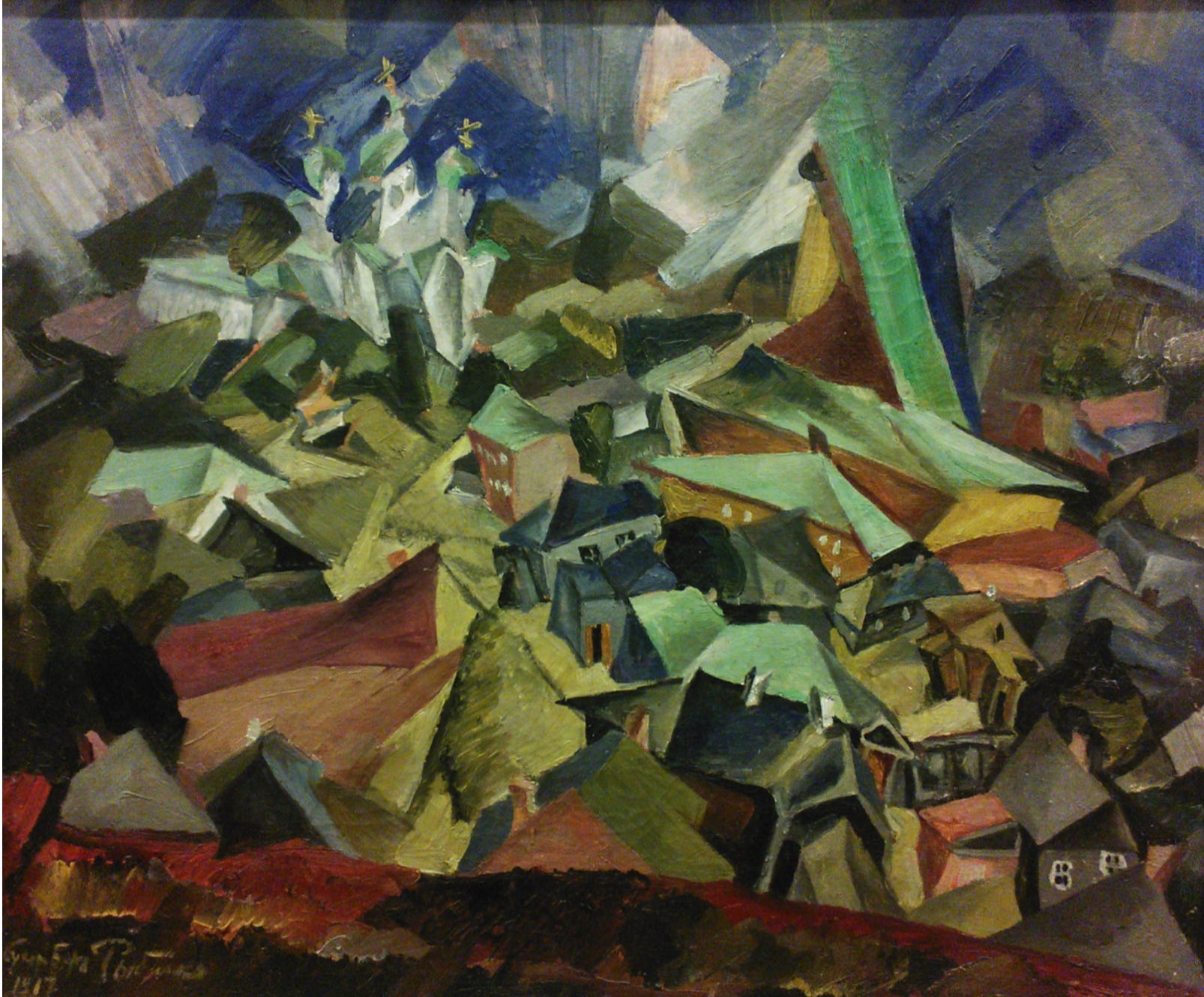
Issachar Ber Ryback. The City–Shtetl. 1917. National Art Museum of Ukraine.
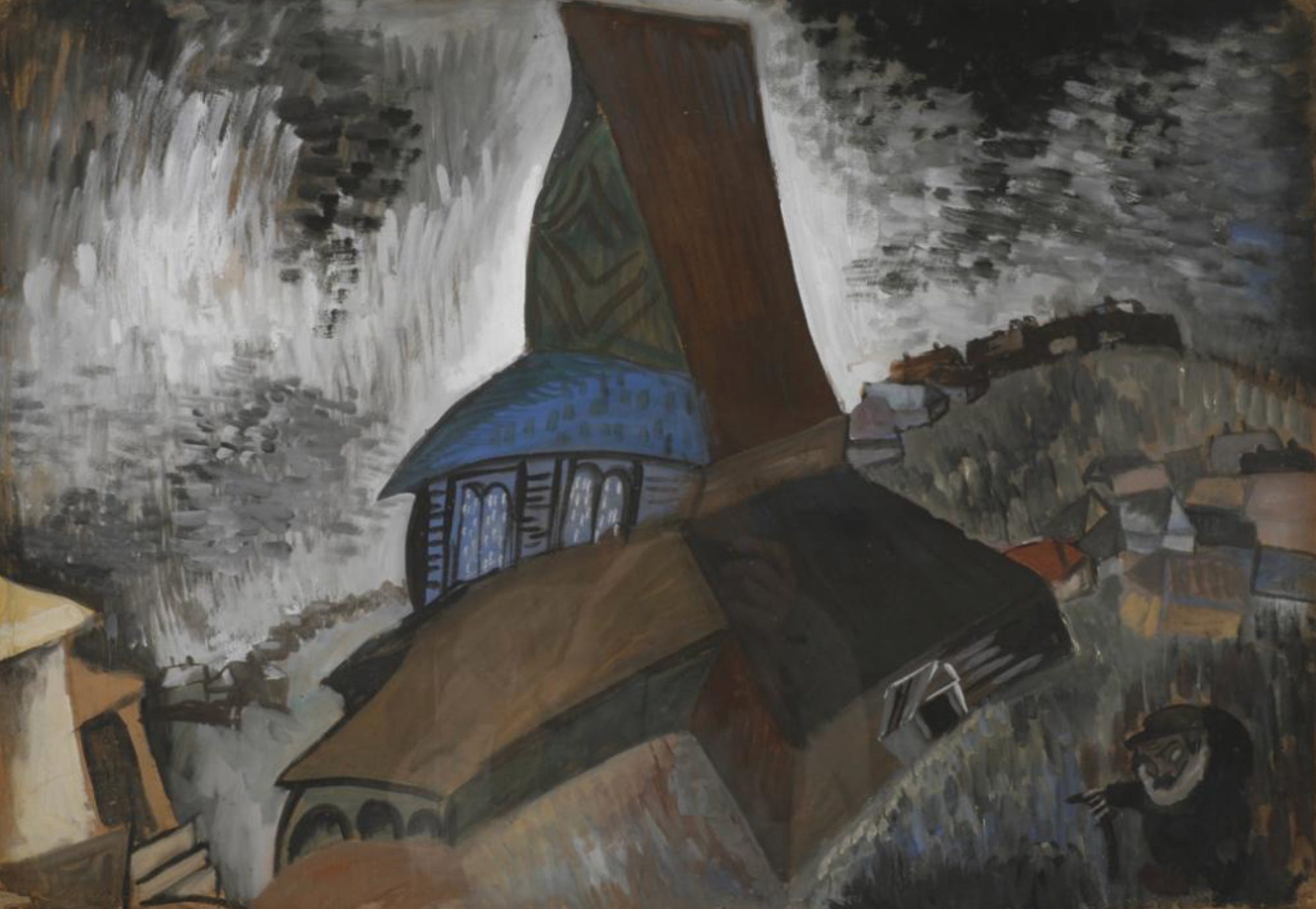
Issachar Ber Ryback. The Old Synagogue. 1917, Tel Aviv Museum of Art.
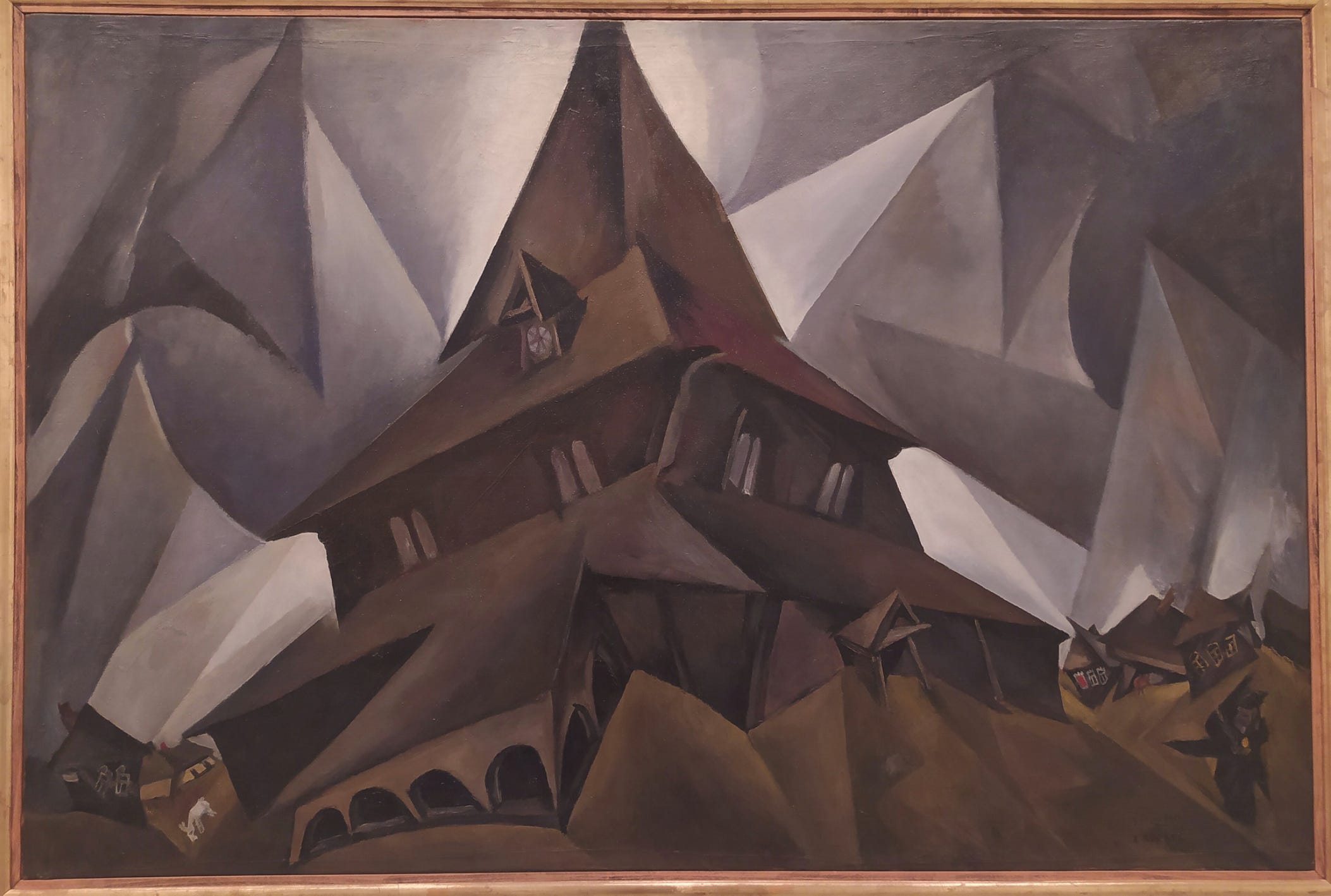
Issachar Ber Ryback. The Big Synagogue. 1917. Tel Aviv Museum of Art.
Perhaps the most moving requiem for that vanished world was painted by Abram Manevich. His large canvas, generally known as The Destruction of the Ghetto, Kiev (1919), now in the Jewish Museum in New York, was created while the artist was mourning the death of his only son, Mstislav, who was killed while serving in the Bolshevik Army during fighting against the forces of Danylo Terpylo, better known as Otaman Zeleny, near Boyarka on the outskirts of Kyiv.
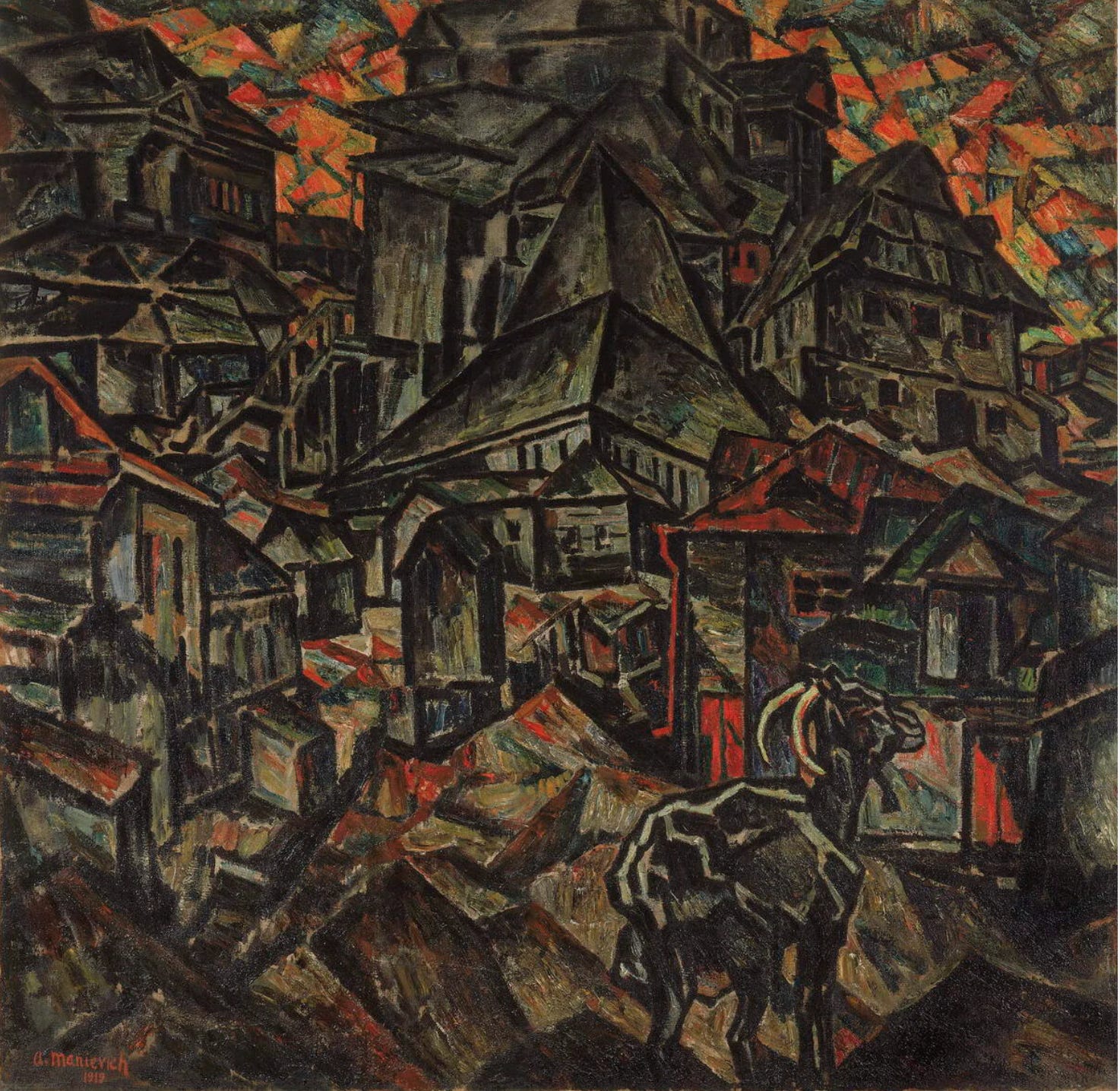
Abram Manevich. The Destruction of the Ghetto, Kyiv. 1919. Jewish Museum, New York.
The Jewish Museum’s website states that Mstislav was killed while fighting “against Ukrainian nationalists, who were opposed to Jewish emancipation.” This description is historically misleading. Zeleny’s forces were responsible for numerous anti-Jewish pogroms—as were, to varying degrees, virtually all the major military formations involved in the Ukrainian War of Independence—but they fought not only against the Bolsheviks, but also against the White Army and, at different times, against the forces of the Ukrainian People’s Republic. Terpylo himself belonged to the left wing of the Ukrainian Social Democratic Workers’ Party (Independentists), making it inaccurate to characterize his movement simply as one of “Ukrainian nationalists.”
The title of the painting is itself historically problematic. In 1919 there was no Jewish ghetto in Kyiv. Although Jews were concentrated in districts such as Podil and Lukianivka, these were ordinary urban neighbourhoods rather than legally segregated Jewish quarters. Equally important, although anti-Jewish violence occurred repeatedly in Kyiv during 1919, there was no single catastrophic pogrom that could account for the scene depicted by Manevich.
The Jewish Museum describes the work as portraying “the tumbledown buildings, the empty streets, and the abandoned synagogue of Kyiv’s once-great Jewish community.” Yet the cluster of small wooden houses and the monumental synagogue with its steep, tiered roof bear little resemblance to the cityscape of one of the Russian Empire’s largest cities. By 1914, Kyiv had approximately twenty synagogues, almost all built of brick or stone in the late nineteenth and early twentieth centuries in the Moorish Revival, Romanesque Revival, or other eclectic styles.
What Manevich depicts is not Kyiv but an archetypal city-shtetl, dominated by a monumental wooden synagogue. Whereas in Ryback’s paintings the houses and synagogue seem almost to dance in the rays of the sun, Manevich presents a shtetl of death—a vision of the violent destruction of Yiddishland.
Ryback, Manevich, and now Kamyshan all employ the wooden synagogue as an archetype. In each case, the building ceases to be a specific historical monument and becomes a metaphor for the lost civilization of Eastern European Jewry.
An-sky documented the wooden synagogue as an ethnographer. Ryback elevated it into a symbol of Jewish modernism. Manevich turned it into a requiem for the destruction of Yiddishland. Kamyshan has now reimagined it as a postmodern monument floating above Venice.
There is another parallel that is difficult to ignore. Ryback, who eventually settled first in Paris, and Manevich, who emigrated to the United States, became true representatives of what might be called Refugee Modernism. Kamyshan, who has made her home in London, belongs to a new generation—one that could perhaps be described as Refugee Postmodernism.
I generally distrust historical analogies, yet it is difficult to escape the feeling that the twenty-first century often appears as a distorted reflection of the 1920s and 1930s. It is perhaps for this reason that a wooden synagogue has once again taken flight—not as a relic of the past, but as a warning addressed to the present.