Terrible Twins
It is a translation of an article originally published on May 28, 2021, in the Russian online magazine Colta

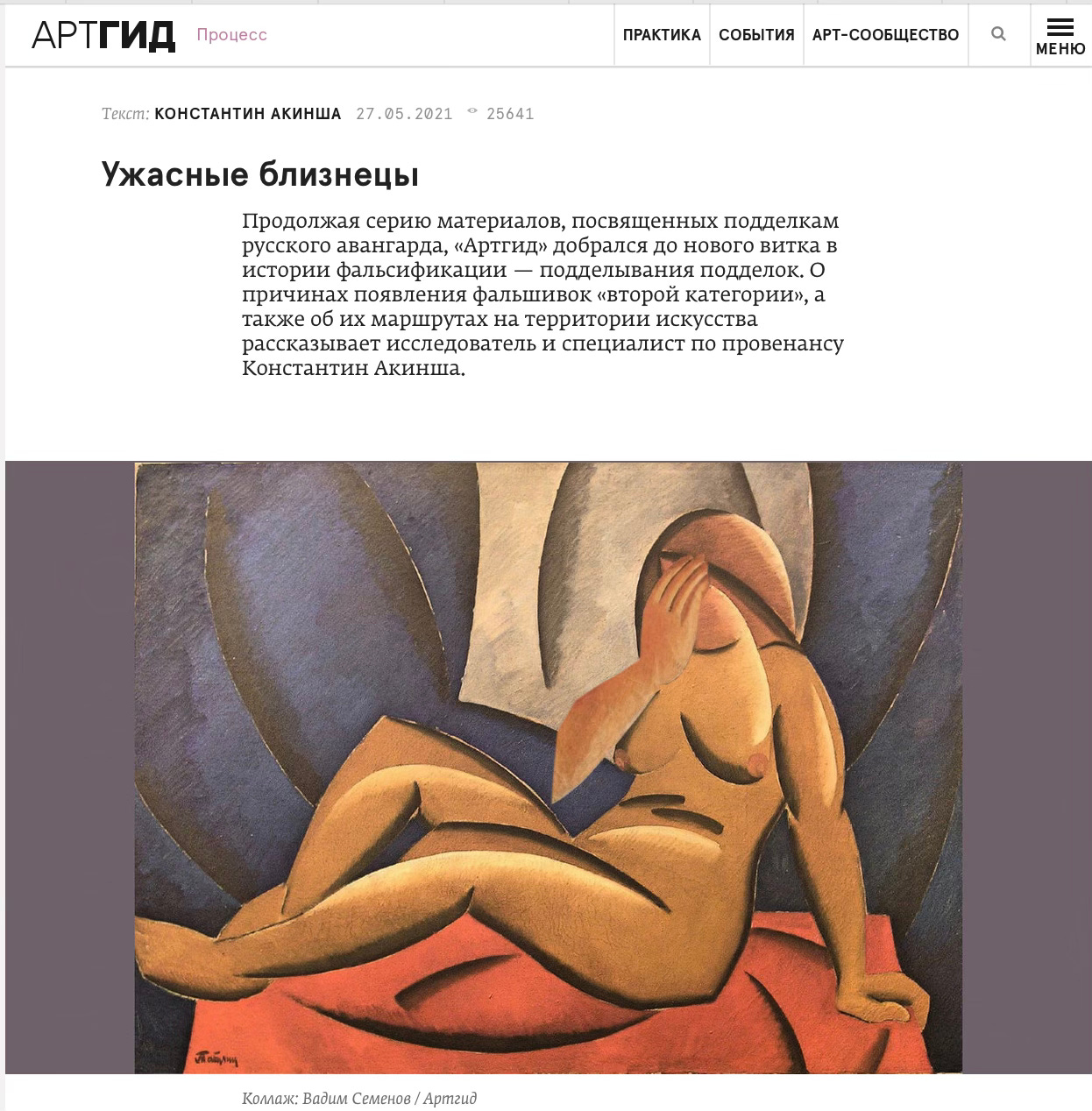
The endless stream of fake Russian avant-garde works that flooded the art market in the early 1990s - and turned into a true deluge in the first half of the 2000s - gave rise to the curious phenomenon of forgeries of forgeries. These "second tier" fakes cease to be forgeries in the classical sense of the word and come close to becoming Baudrillardian simulacra. In most cases, their appearance is the result of a mistake. Successful forgeries, reproduced in exhibition catalogues - and sometimes even on their covers - are often perceived by naïve counterfeiters as originals worthy of imitation. The question is: why are these works, rather than actual originals, used as source material for variations of varying quality and inventiveness?
This situation has no direct analogues in the history of art. Unlike Renaissance artists, modern-day artisans are not trying to prove that they can match the skill of the masters of antiquity. The goal of those forging the Russian avant-garde is to find a stereotypical image that corresponds to the average consumer’s idea of the art of the "great experiment."
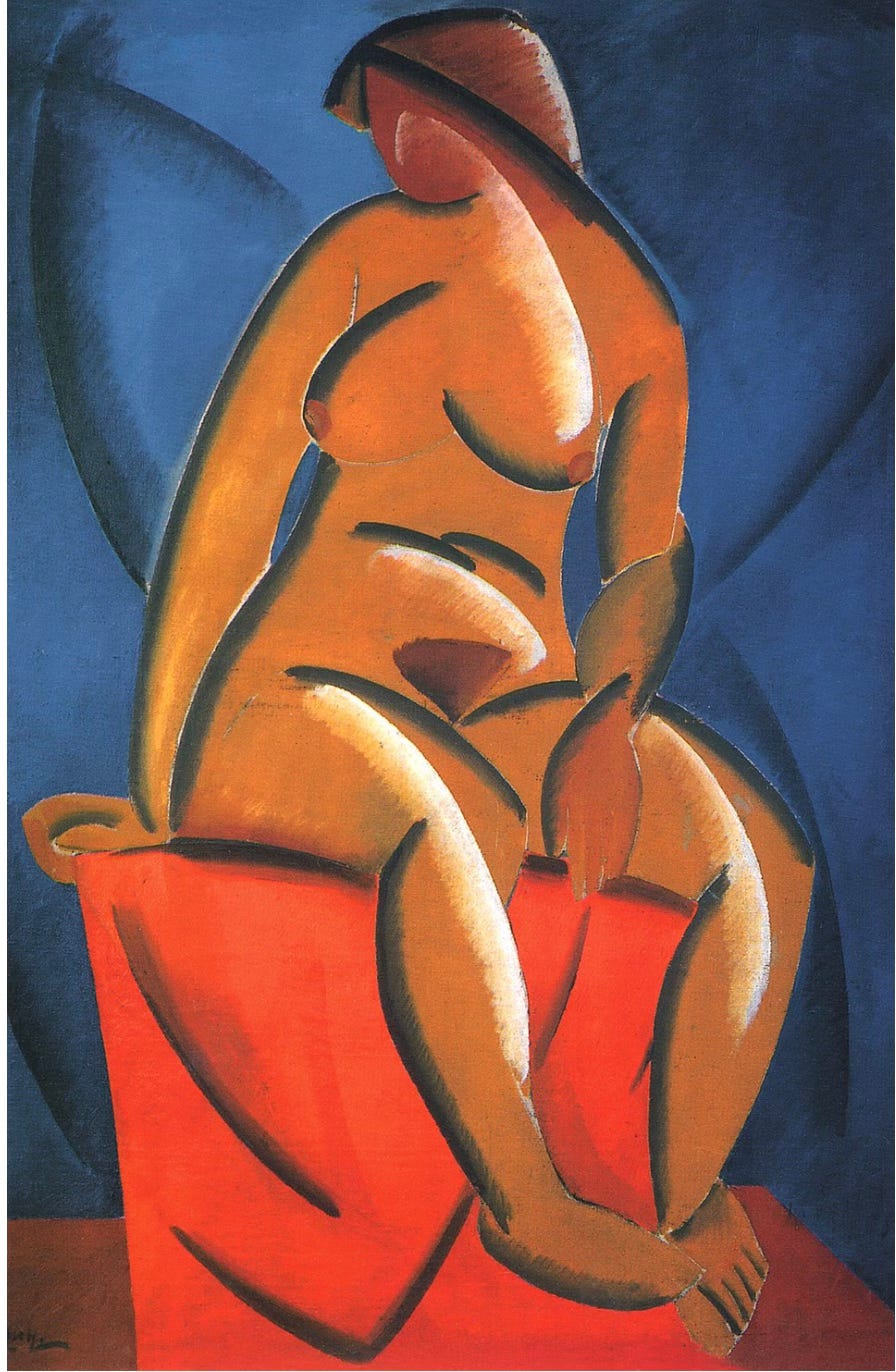
Vladimir Tatlin. Female Nude. 1913. Oil on canvas. 143 × 108 cm. The State Tretyakov Gallery, Moscow.
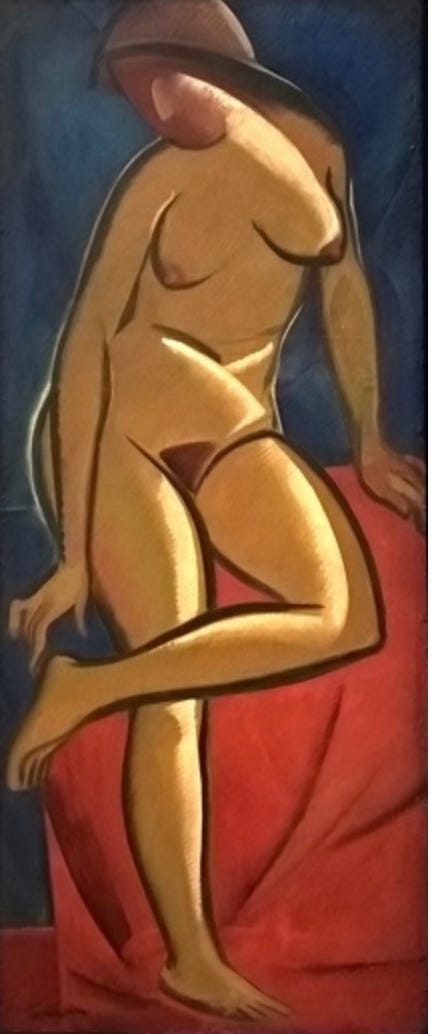
Attributed to Vladimir Tatlin. Female Nude. Undated. Oil on canvas. 135 × 54.8 cm. Collection of Igor Toporovsky.
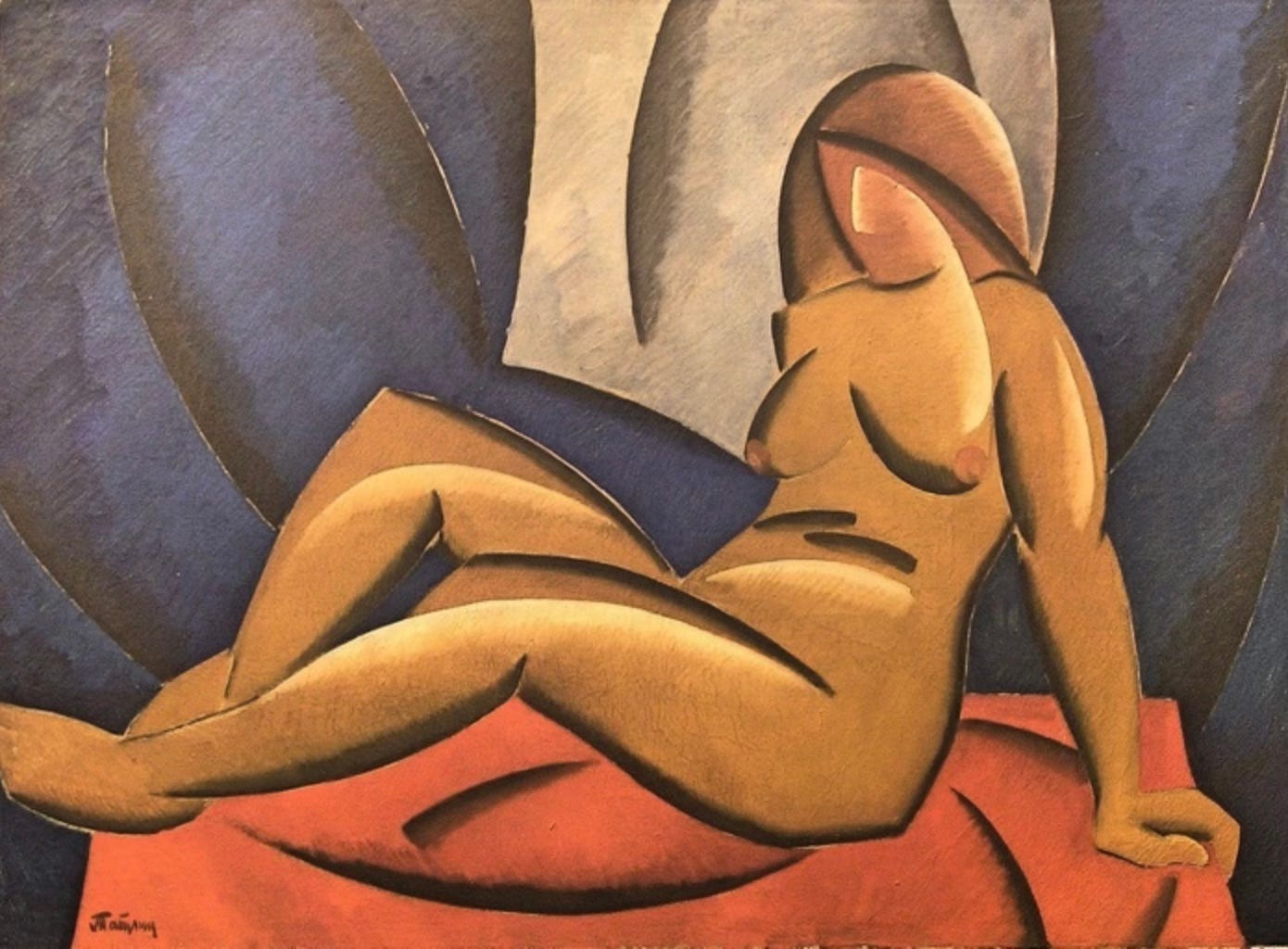
Attributed to Vladimir Tatlin. Female Nude. 1913 (?). Oil on canvas. 100 × 73.5 cm. Collection of Edik Natanov.
Forgers attempting to mimic the style of the past end up multiplying contemporary clichés. Their works often resemble failed attempts to create an animated film, in which the artist’s models strike various poses reminiscent of the photographic exercises of chronophotography pioneer Eadweard Muybridge, while the geometric elements of abstract paintings swirl in endless Brownian motion, undermining the very concept of composition. In this imaginary world of the Russian avant-garde, the artist is reduced to a machine capable only of endless self-repetition.
The forgery of forgeries reveals itself not only in the mindless copying of fake works, but also in the imitation of a fake style. Today, we are beginning to construct a chronology of Russian avant-garde forgery that reflects the dominant tastes of different eras. A vivid example of such an invented style is the "creative legacy" of Nina Kogan, fabricated in the mid-1980s and perfectly capturing the aesthetic of its time. Modern forgers who still dare to expand this legacy are now forced to stylize it in accordance with the early phase of the watercolor forgery campaign centered on Malevich’s unfortunate pupil - recreating, again and again, a 1980s vision of the Russian avant-garde.
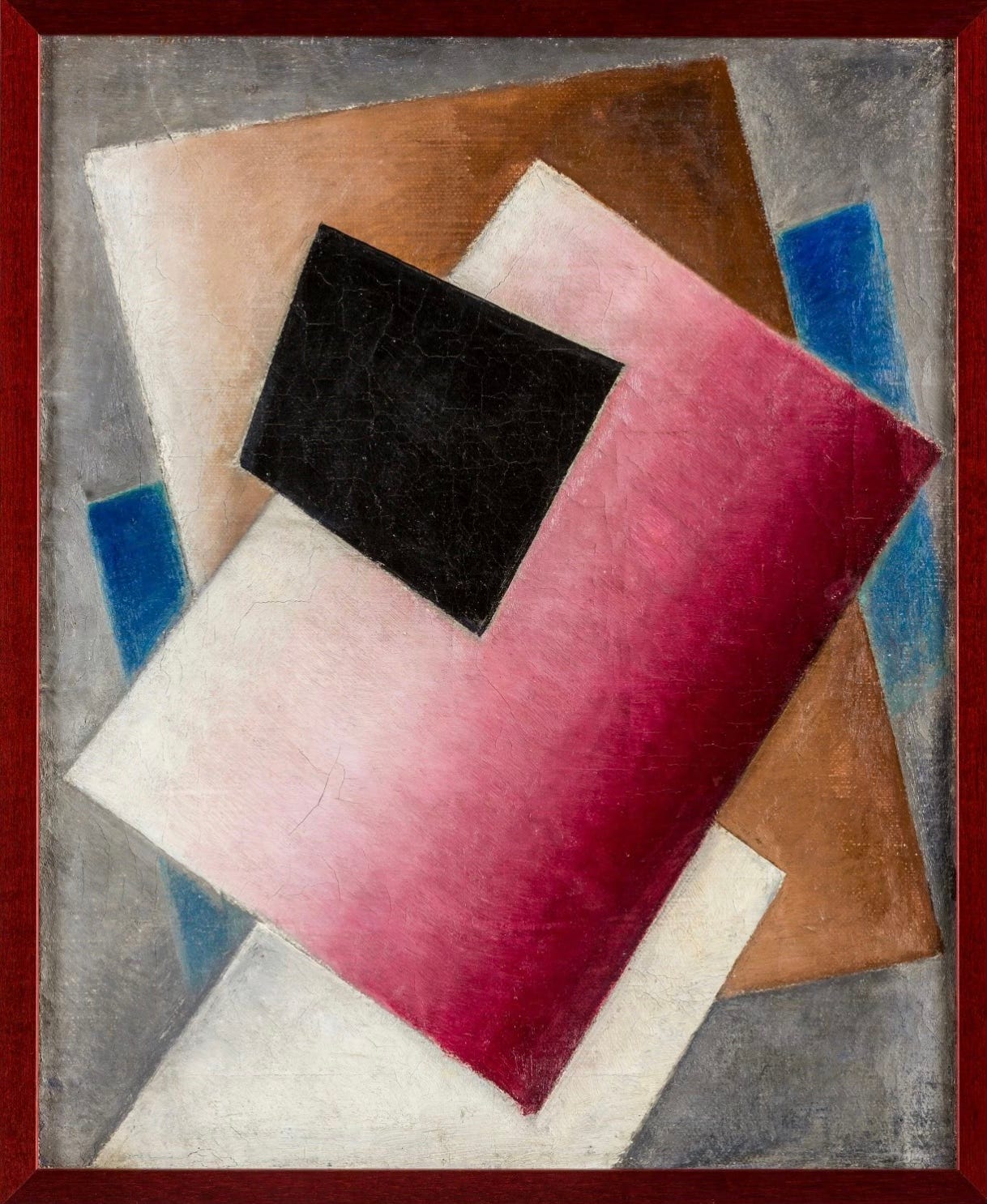
Aleksandr Vesnin. Non-Objective Composition. Late 1910s. Oil on canvas. 53.5 × 43 cm. State Museum-Reserve "Rostov Kremlin".
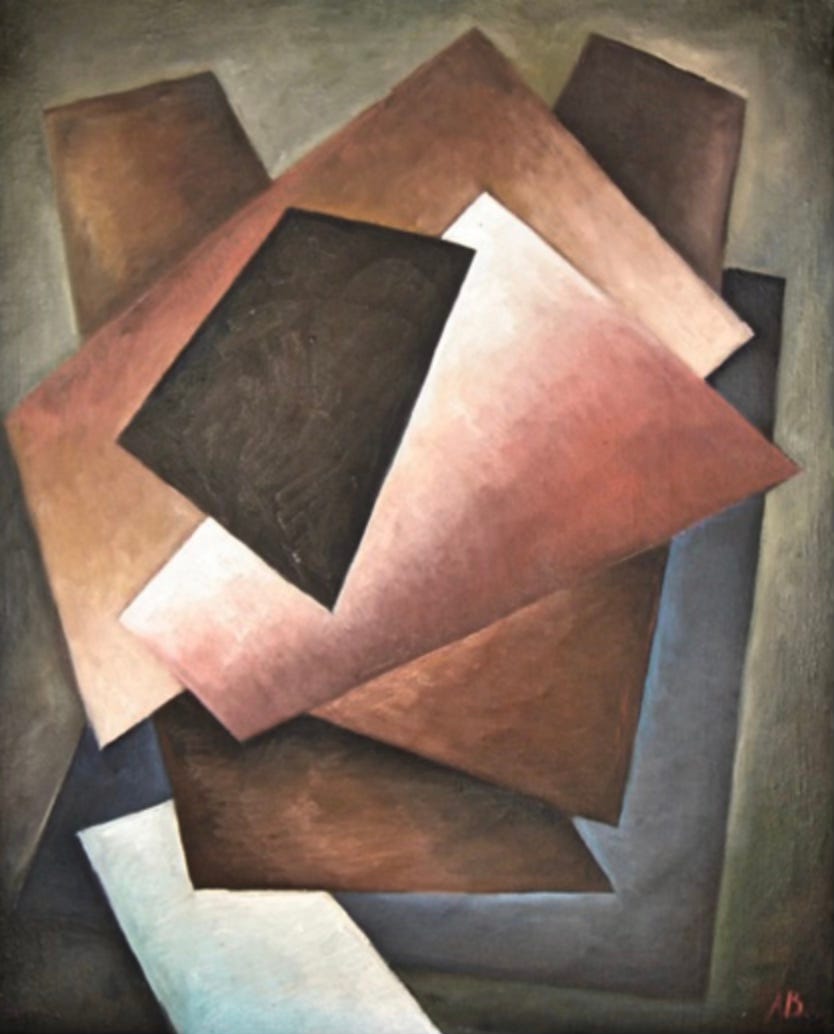
Attributed to Aleksandr Vesnin. Non-Objective Composition. 1917–1918 (?). Oil on canvas. 70 × 55 cm. Property of Itzhak Zarug.
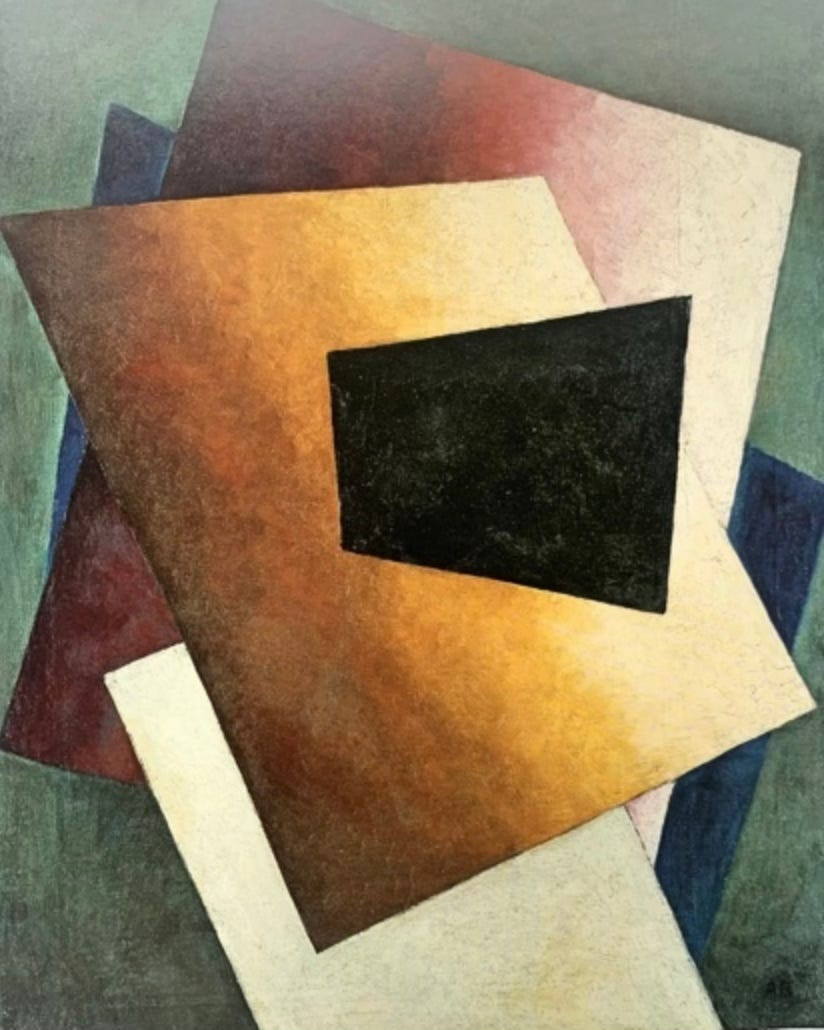
Attributed to Aleksander Vesnin. Architectonics (Composition). 1919 (?). Oil on canvas. 70 × 55 cm. Exhibited at Geburt der Moderne, 2006. Orlando Gallery, Zurich.
Forgeries of forgeries, which have become a cultural phenomenon of contemporary art life, deserve close study and analysis. The triumph of the simulacrum is a symbol of our time, in which the very concept of authenticity ceases to be “politically correct.” To see which way the wind is blowing, one need only flip through the book Against Aesthetic Exceptionalism by Arne De Boever, a professor at the California Institute of the Arts, inspired by the Toporovsky case. [1] This remarkable salad of texts by the two Karls—Marx and Schmitt—as well as Giorgio Agamben and other pillars of critical theory, is chopped up to argue that in “an art world that is not built on aesthetic exceptionalism, the Toporovsky case... would be nearly unimaginable.” [2] At the same time, the California professor tries to defend Catherine de Zegher, director of the Museum of Fine Arts in Ghent, who organized the exhibition of the Toporovsky collection: “…the works shown in the museum may not have been what they were claimed to be… Nevertheless, they could have been interesting pieces.” [3]
Within this system of values, the forgers of the Russian avant-garde—clearly without reflecting on their historical role—ended up at the forefront of the struggle against “aesthetic exceptionalism.” The forgery of forgeries is undoubtedly a radical method for overthrowing the “monarchical politics of art.” This article is nothing more than a brief sketch of the history of twin-forgeries and their contribution to the ultimate triumph of cultural relativism.
The Russian Muse’s Twins…
The emergence of one of the first pairs of terrible twins is connected to the legendary collection of Kurt Benedict, which was put up for sale by Christie’s auction house in London in 1990. [4] According to the legend surrounding the provenance of the collection, the paintings belonged to Kurt Benedict, co-owner of the Galerie van Diemen, where the “First Russian Art Exhibition” was held in Berlin in 1922. Allegedly, Benedict had traveled to Russia to purchase old masters paintings and, along the way, acquired some canvases by avant-garde artists.
After the Nazis came to power, the art dealer emigrated to France, leaving the Russian artworks in the basement of a house in Berlin. After the war, he reportedly met a Swiss citizen named Walli Koretzky, to whom he reviled the story of the treasure hidden in the basement. By a stroke of fate, the sturdy crates filled with paintings had survived the devastation of war-torn Berlin. These miraculously preserved masterpieces of the Russian avant-garde were acquired by Koretzky and offered for sale.
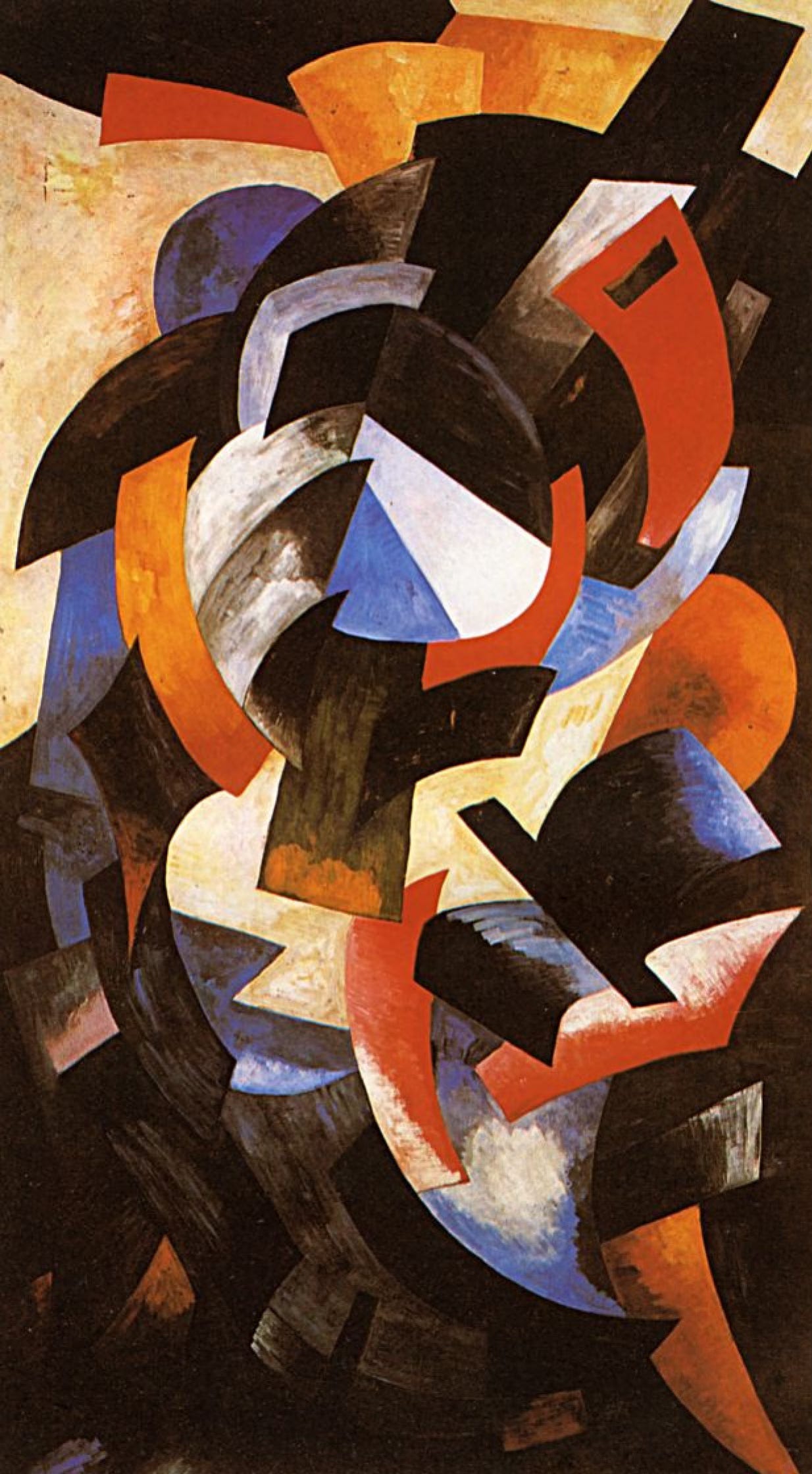
Attributed to Alexandra Exter. Color Dynamics. 1916 (?). Oil on canvas. 148 × 82 cm. According to provenance legend, from the collection of Kurt Benedict. Private collection.
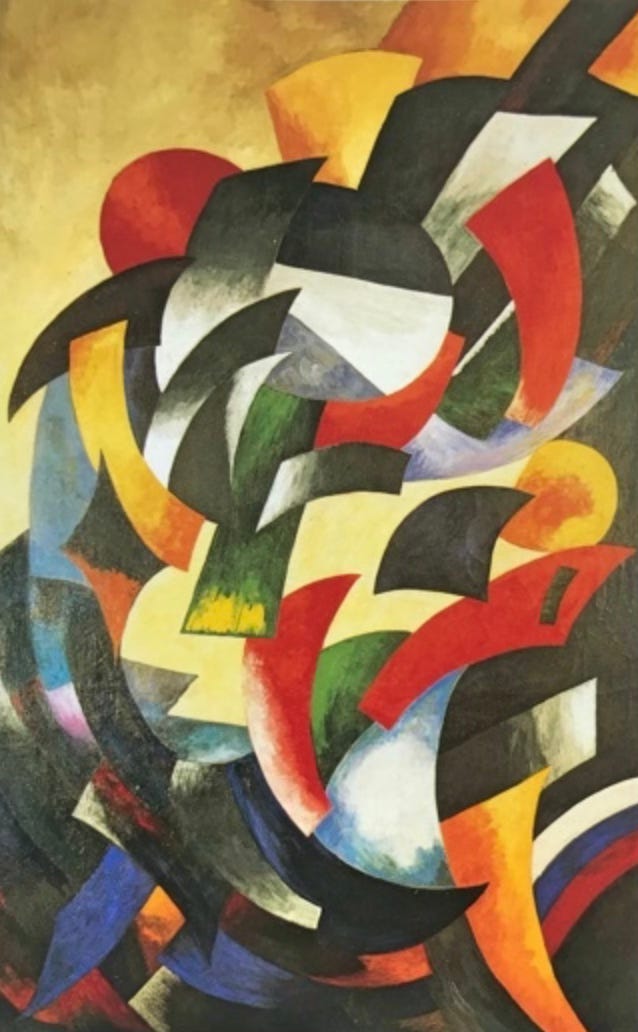
Attributed to Alexandra Exter. Color Dynamics. Circa 1916 (?). Oil on canvas. 226 × 15 cm. According to provenance legend, from the collection of Kurt Benedict. Private collection.
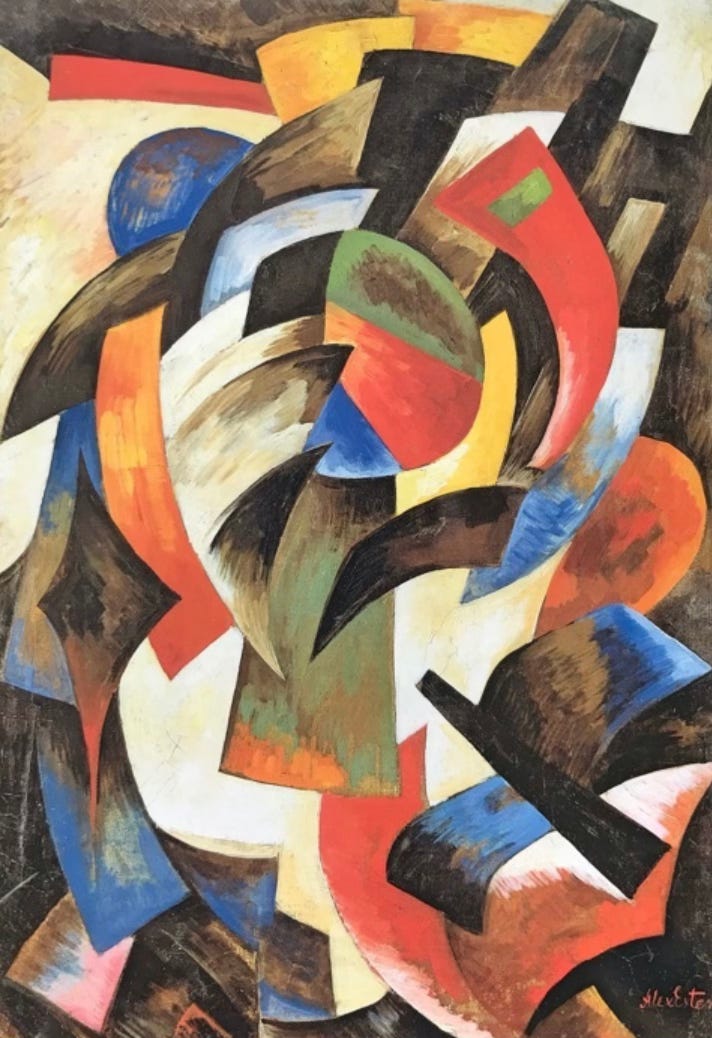
Attributed to Alexandra Exter. Color Dynamics. 1916–1917 (?). Oil on canvas. 57 × 40 cm. Exhibited at the show Dos Mujeres De Vanguardia. Exter — Popova, 2004, Manuel Barbie Gallery, Barcelona.
The Christie’s auction, which offered 15 works that had allegedly spent many years in a Berlin basement, was a resounding success—unlike the Sotheby’s auction of works from the Costakis collection held around the same time in New York. [5] However, suspicions about the Kurt Benedict collection began to surface soon afterward. Among the paintings sold at Christie’s, the greatest doubts surrounded a canvas attributed to Alexandra Exter, titled Color Dynamics. The work was unusually large for the artist—148×82 cm. Reproduced on the cover of Valentina Marcadé’s 1990 book Art of Ukraine, the Exter painting was accompanied by a certificate from Georgy Kovalenko, who claimed he had seen documents confirming the canvas had been exhibited at the 1922 Berlin show.
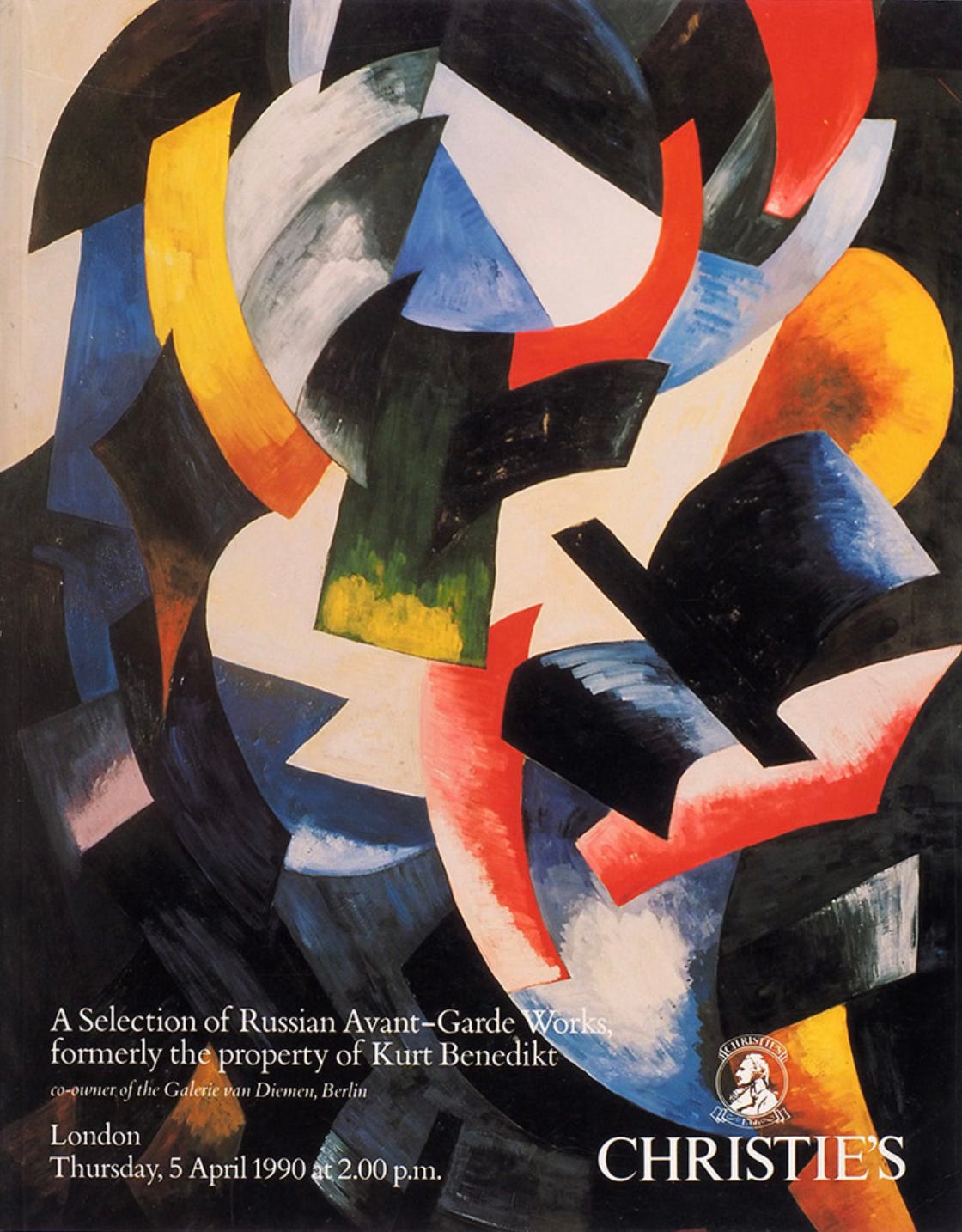
Russian avant-garde works, formerly the property of Kurt Benedikt, co-owner of the Galerie van Diemen, Berlin. London: Christie, Manson & Woods, 1990.
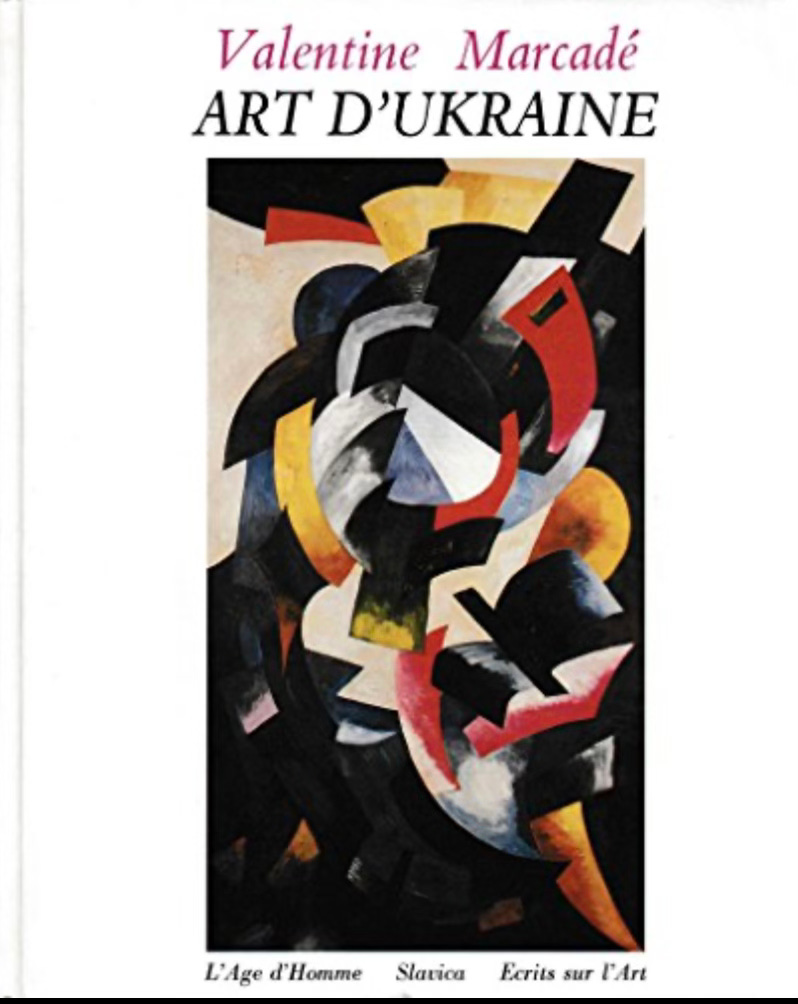
Valentine Marcadé. L'art d'Ukraine. Lausanne: L'Age d'homme, 1990.
In fact, the painting had never been exhibited in Berlin. Of the three Exter paintings sent to the “First Russian Art Exhibition,” only View of Venice was sold and is now in the collection of the Moderna Museet in Stockholm. City and Non-objective Composition were returned to Russia after the exhibition.[6] Non-objective Composition - the only one of the three that could theoretically be Color Dynamics - is now part of the Krasnodar Museum collection. Its size is quite typical for Exter's work from that period: 71×53 cm.
The story of Color Dynamics did not end at the Christie’s auction. Few years later, its first twin appeared. The twin was revealed to the public in 1995 at the exhibition Berlin — Moscow. 1900–1950 at Martin-Gropius-Bau and immediately became the subject of controversy. The show included a number of works from the Walli Koretzky collection, which Irina Antonova, the director of the Pushkin Museum justifiably refused to show during the Moscow edition of the exhibition. Among these was Color Dynamics, which closely resembled the painting sold at Christie’s but exceeded it in size (226×150 cm). [7] Why Kurt Benedict would have needed to purchase two nearly identical canvases from Exter remains a mystery.
Fourteen years after the London auction, a second twin of the painting appeared in Barcelona. Another version of Color Dynamics, this time much smaller (57×40 cm), was shown at the Manuel Barbié gallery during the exhibition Women of the Avant-Garde: Exter - Popova, curated by Elena Basner. [8] The painting’s provenance was not listed in the catalogue, but it did include a comparison with the Color Dynamics sold at Christie’s and curiously claimed that the painting from the Kurt Benedict collection was in fact housed in the Ludwig Museum in Cologne—an assertion that was not true.[9] The second Color Dynamics was not mentioned in the catalogue.
The quality of the third twin - like that of most of the works shown in Barcelona - left much to be desired. Compared to its grander elder sisters, this pastiche resembled an ugly duckling. Elena Basner could not have been unaware of the scandals surrounding the first two versions of Color Dynamics, yet that did not stop her from including the third twin in the exhibition - a composition whose authenticity had already been seriously questioned.
A classic example of the “forgery on a catalogue cover as source of inspiration” scheme is the story of the 1991 exhibition of works by Alexander Rodchenko and Varvara Stepanova at the Museum of Applied Arts (MAK) in Vienna. The cover of the exhibition catalogue featured a reproduction of a forged Rodchenko painting titled Composition, dated 1919, from a private collection. The painting was based on a linocut by the artist. [10] Rodchenko’s grandson, Aleksandr Lavrentiev, warned the museum’s director, Peter Noever, of his suspicions, but Noever stood by his decision.[11] However, in the second edition of the catalogue, the painting was removed from the cover and replaced with a reproduction of the authentic canvas Line from 1920.
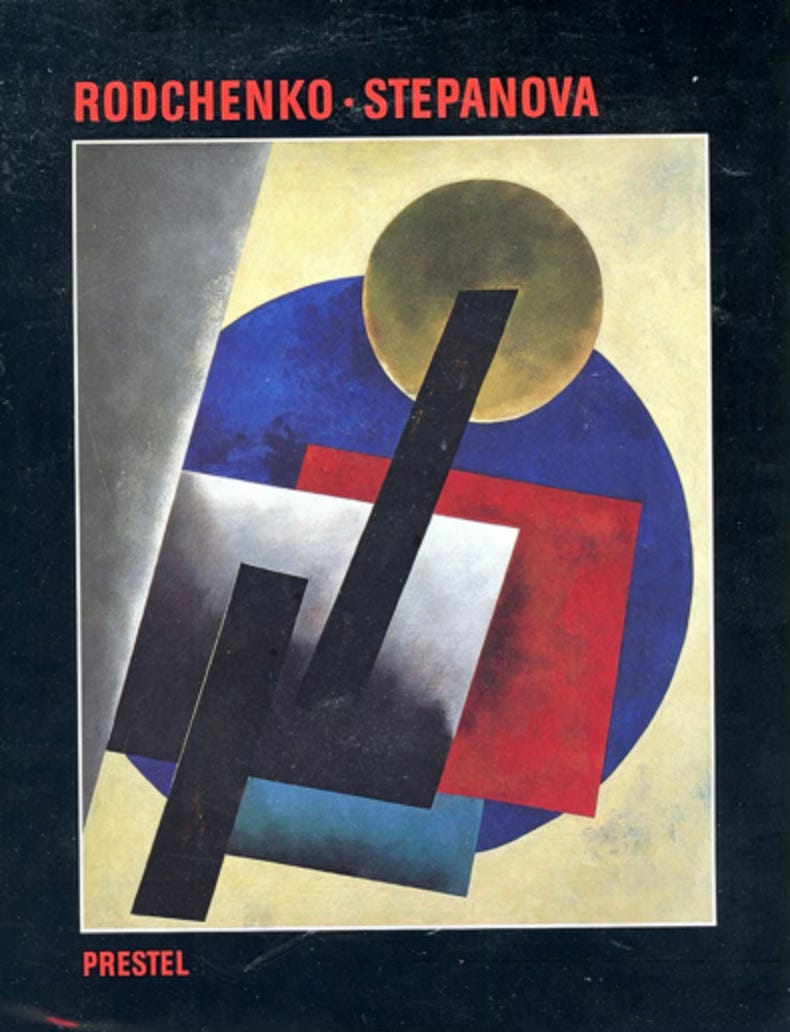
Cover of the catalogue The Future Is Our Only Goal. Aleksandr M. Rodchenko, Varvara F. Stepanova. Munich: Prestel, 1991. First edition.
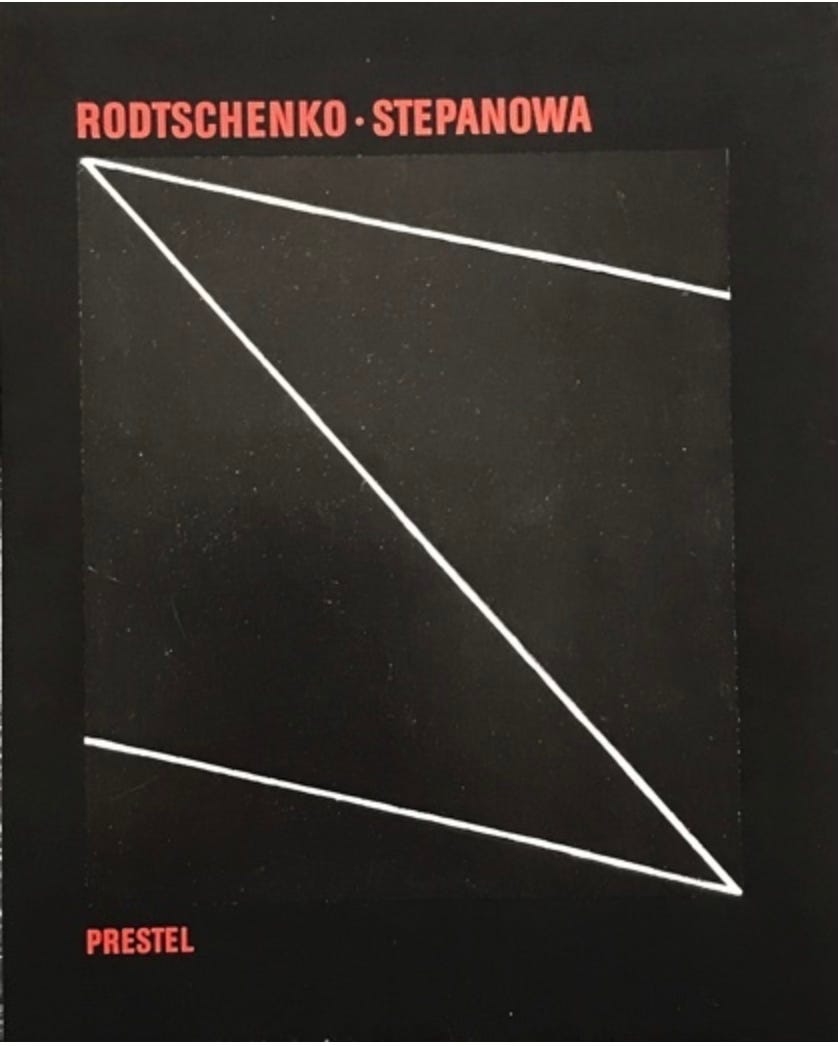
Cover of the catalogue The Future Is Our Only Goal. Aleksandr M. Rodchenko, Varvara F. Stepanova. Munich: Prestel, 1991. Second edition.
The canvas, once displayed in Vienna with such fanfare, now gathers dust in the counterfeit storage facility of Berlin’s Landeskriminalamt (a division of Germany’s criminal police). Yet the Composition itself continues to live on in numerous reincarnations, which regularly appear on the art market. These reincarnations stretch wider and taller, geometric elements shift across the picture plane, but the kinship with the canvas reproduced on the 1991 catalogue cover remains visible and undeniable.
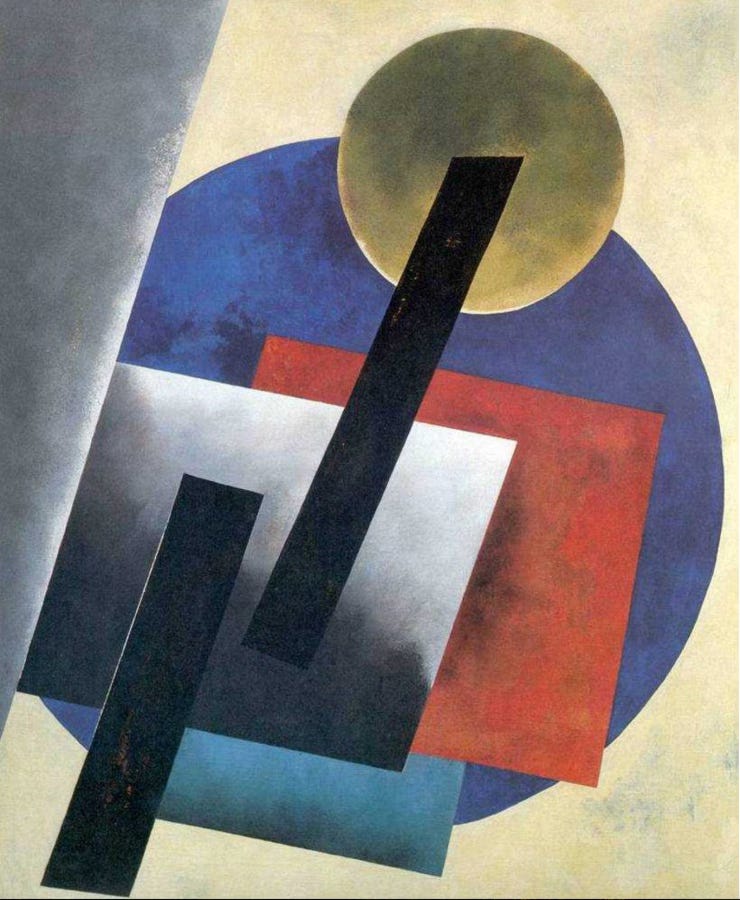
Attributed to Aleksandr Rodchenko. Composition. Date unknown. Oil on canvas. 61×50 cm. Landeskriminalamt, Berlin.
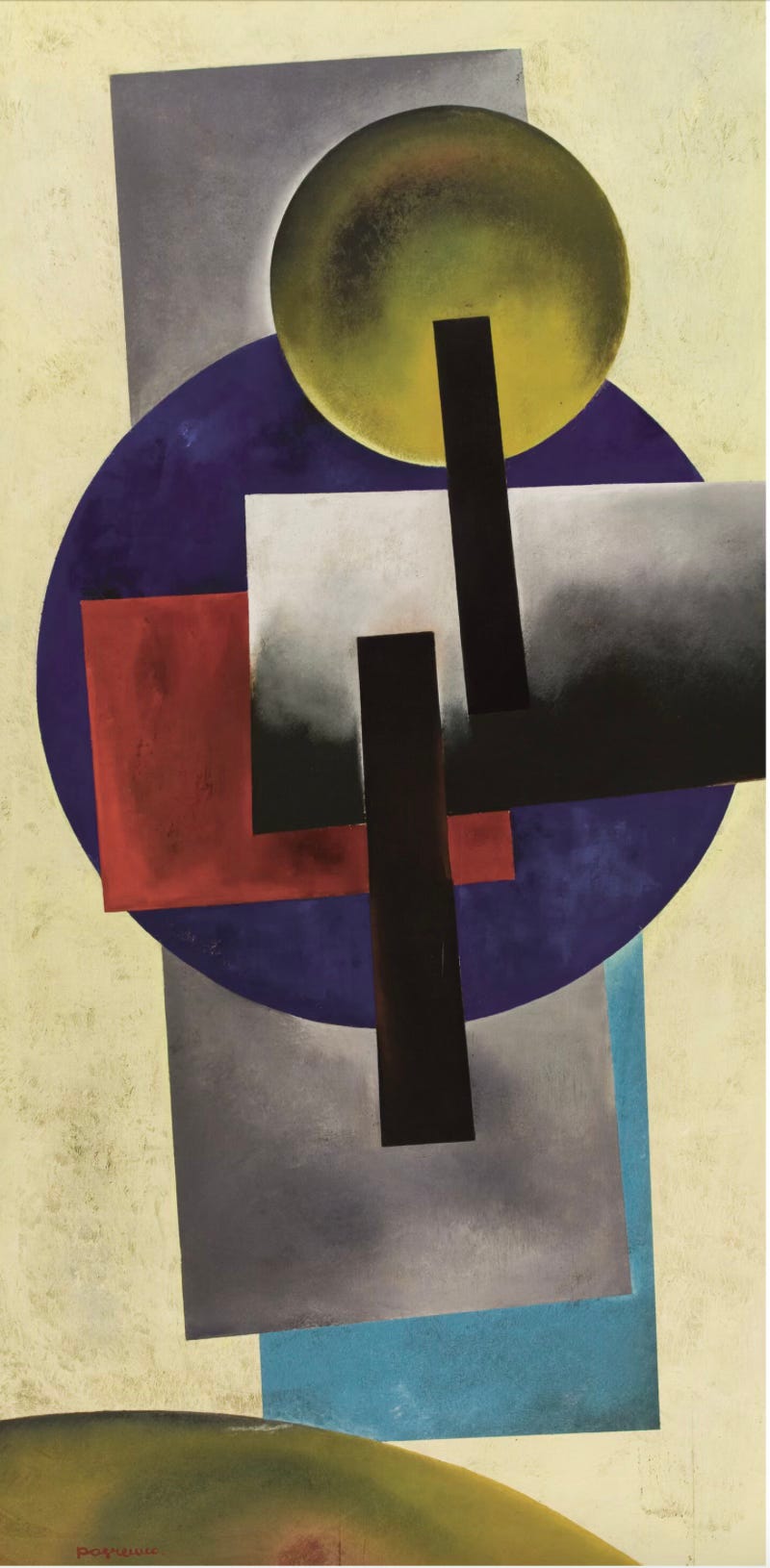
Attributed to Aleksandr Rodchenko. Composition. 1919 (?). Oil on wood. 182.3 × 62.2 cm. Private collection.
On of these restless Rodchenko twins (reproduced above) aimlessly wanders through the American art market. Offered for sale but unsold in Dallas (Heritage Auctions) in 2008, the composition had by 2012 made its way to New Jersey, where again, despite a modest estimate of $35 – 45 thousand, it failed to sell at the David Rago auction. [12] We will return to the twins of the painting attributed to Rodchenko in another section of our article, but for now, let us note the following: if the phantoms of the Vienna composition provoke you to play the childhood favorite game “find five differences,” then other doppelgängers differ only by their birthmarks.
Another example: at the previously mentioned exhibition at the Barbier Gallery in Barcelona, a Still Life with Violin attributed to Liubov Popova was shown. [13] This remarkable work could more aptly be called Still Life with Guitar Turning into Violin. At the center of the composition, there is a guitar sound hole—which has nothing to do with violins—with strings stretched above it. The undeniable source for the Barcelona still life was Violin (1915) from the Tretyakov Gallery collection.
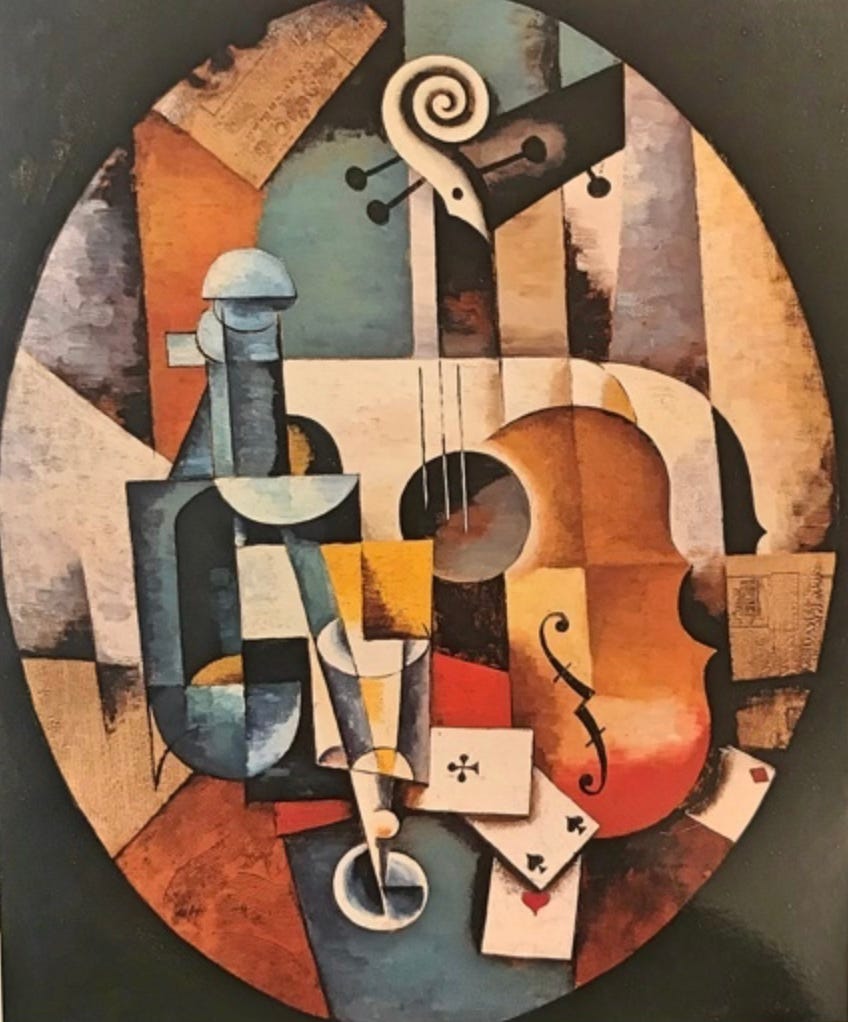
Attributed to Liubov Popova. Still Life with Violin. Oil on canvas. 89.4 × 73.3 cm. Exhibited at the show Dos Mujeres De Vanguardia. Exter — Popova, 2004, Manuel Barbie Gallery, Barcelona. Held in the collection of Nikolai Shchukin.
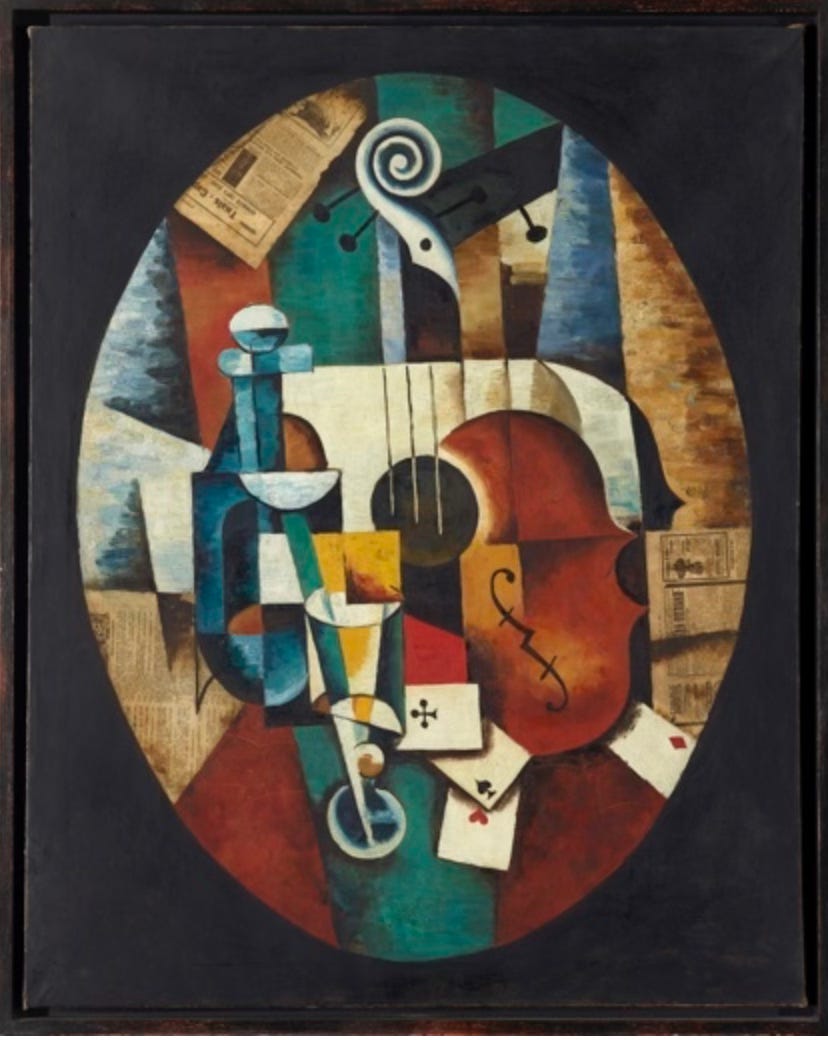
Formerly attributed to Liubov Popova. Still Life with Violin. Undated. Oil on canvas. 100 × 79 cm. Private collection.
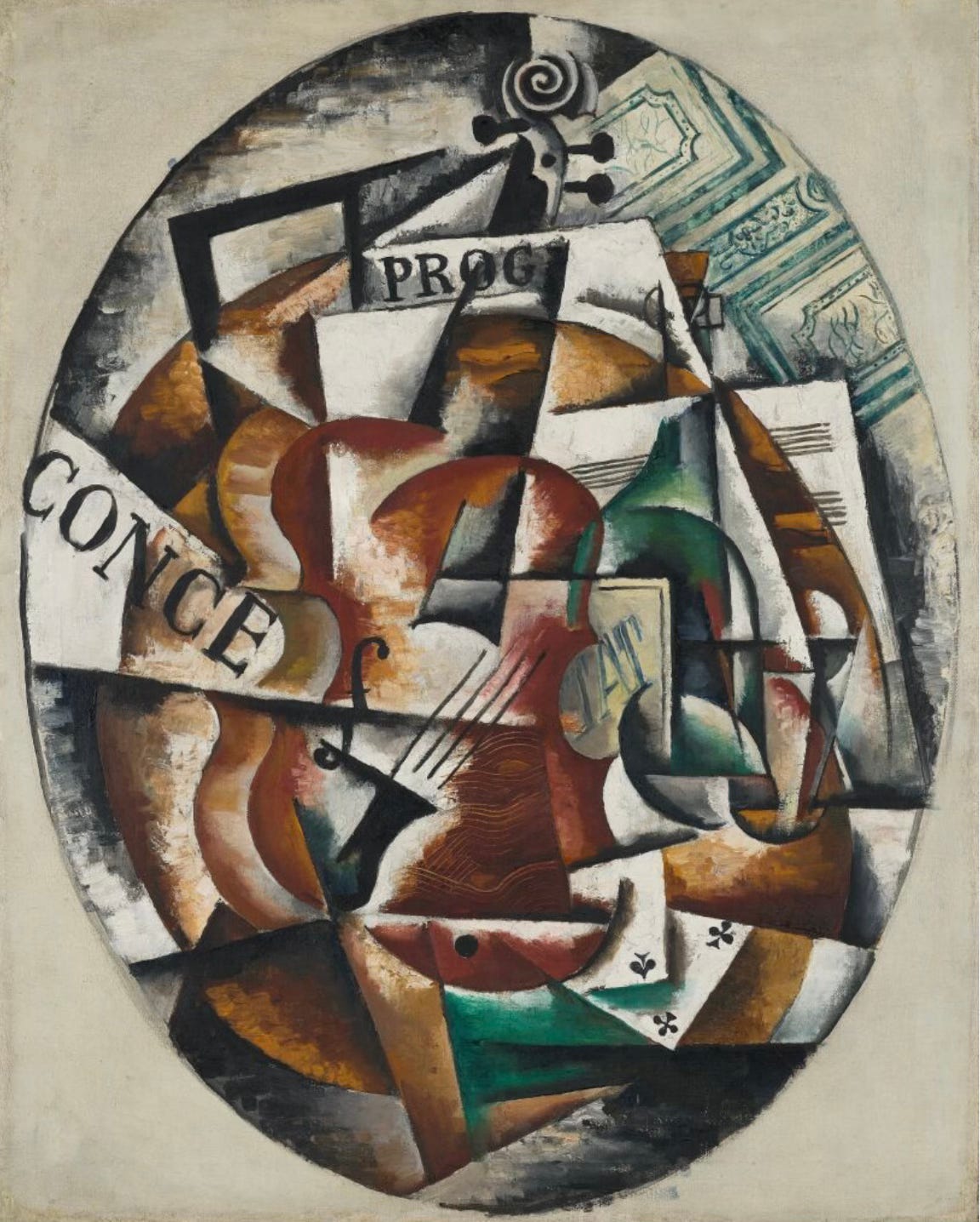
Liubov Popova. Violin. 1915. Oil on canvas. 88.5 × 70.5 cm. The State Tretyakov Gallery, Moscow.
The Tretyakov canvas has been forged dozens of times: the violin turned into a guitar, glasses and bottles were added, sometimes musical instruments disappeared altogether, but playing cards always remained. However, the peculiarity of this particular forgery was that it immediately had a twin. The exhibition at the Barbier Gallery took place in 2004, and already in 2005 the Orlando Gallery in Zurich sold the doppelgänger of the Barcelona still life, differing only in the selection of the playing cards. The still life sold in Zurich was accompanied by a certificate from Elena Basner, who was the curator of the Barcelona exhibition. [14] It is surprising that the appearance on the market within one year of two almost identical works attributed to Popova did not raise doubts for the St. Petersburg expert.
Today, the painting sold by the Orlando Gallery is in a private collection, whose owner is aware that it is a forgery. The Still Life with Violin exhibited in Barcelona belongs to the late art dealer Nikolai Shchukin, who attracted global press attention due to a scandalous court case in the US. [15] Last year, the painting was attempted to be sold in New York, with the owner’s name removed from the provenance just in case.[16]
Popova’s work often provokes manifestations of decalcomania. In 2007, the Orlando Gallery sold to collector Herbert Batliner the monumental Pictorial Architectonics, attributed as a work by Popova. The painting supposedly came from the collection of the Leningrad artist Yevsey Friedman, a name associated with many dubious items circulating on the market. The model for imitation was Pictorial Architectonics from the Tretyakov Gallery collection, significantly reworked and “improved.” [17] The Orlando Gallery catalog lists six certificates intended to confirm the authenticity of the canvas. Among their authors are Yevgeny Kovtun and the frequently mentioned Elena Basner. [18] After Batliner’s collection was transferred to the Vienna Albertina Museum, the Russian part of the collection began to raise doubts among curators. In 2012, it was decided to conduct a serious technological study of the avant-garde collection. Soon, the canvas attributed to Popova, like many others, disappeared from the museum halls.
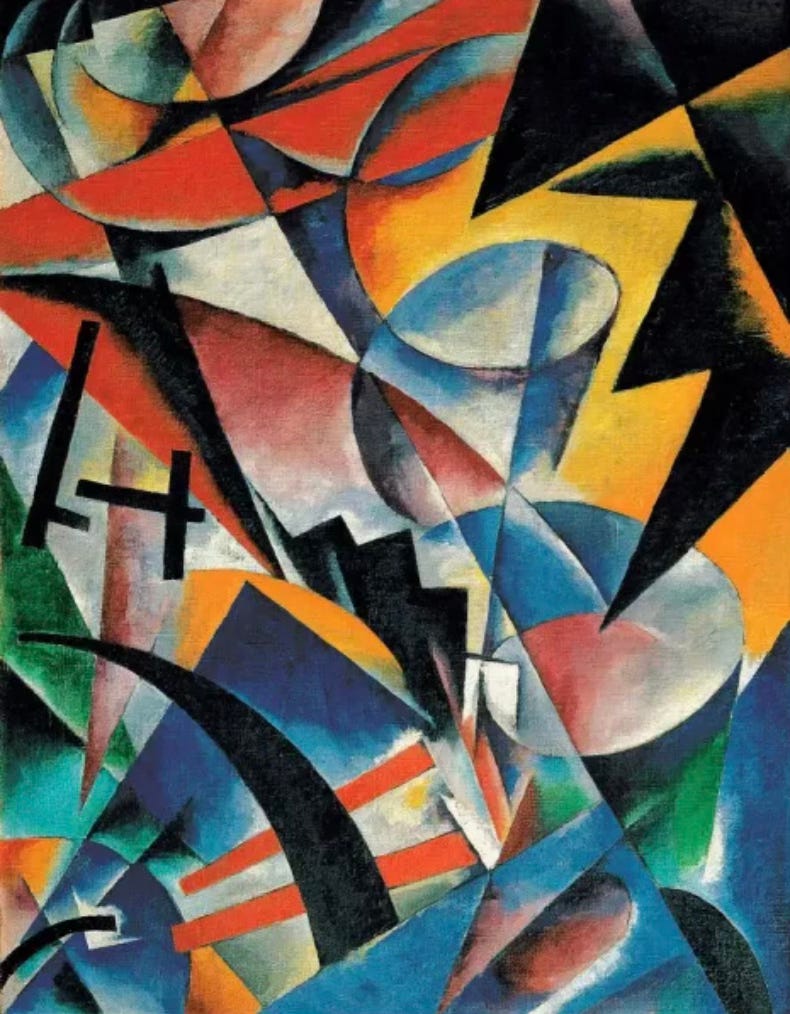
Liubov Popova. Pictorial Architectonics with a Black Triangle. 1919. Oil on canvas. 106 × 98.5 cm. Reverse side of a double-sided painting. The State Tretyakov Gallery, Moscow.
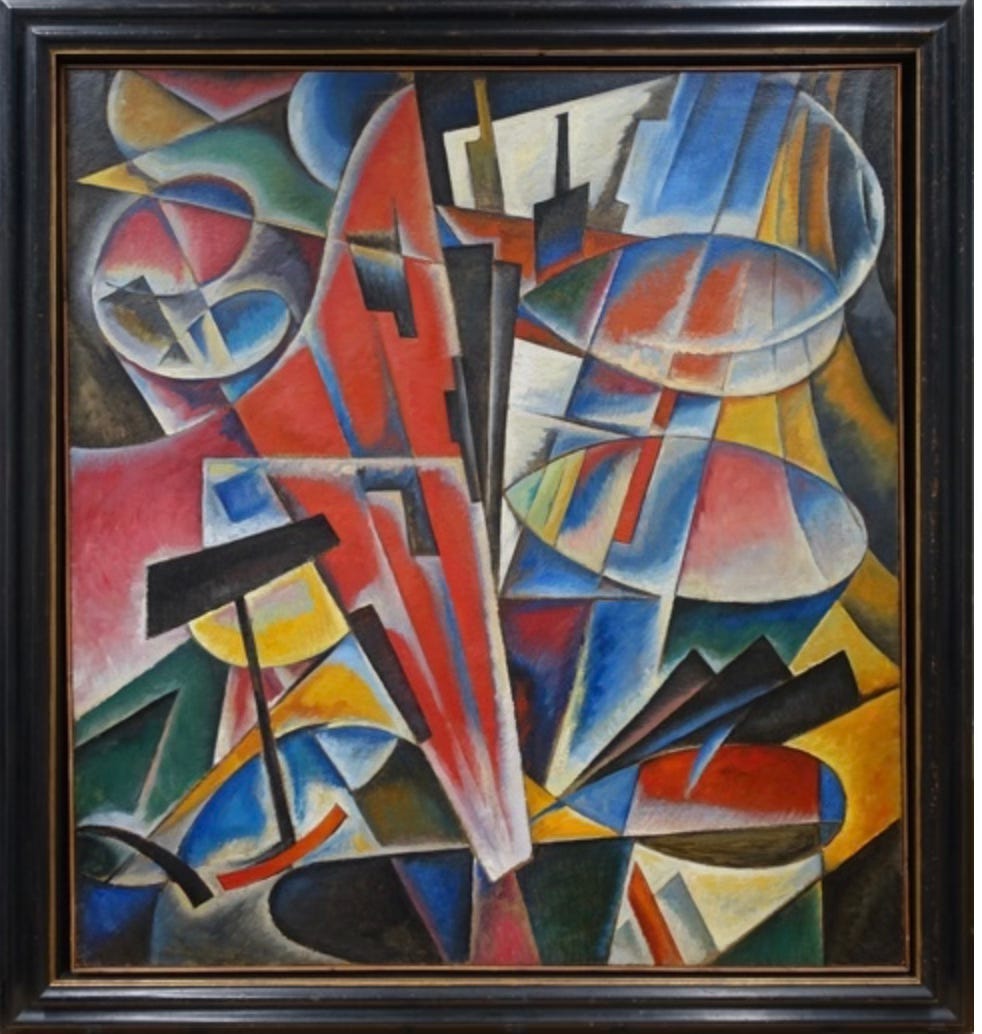
Attributed to Liubov Popova. Painterly Architectonic. Date unknown. Oil on canvas. 158 × 146 cm. Albertina, Vienna.
This did not stop the appearance of new variations of it in the slightest. One of the doppelgängers of the exposed Pictorial Architectonics is currently being offered on the European market. According to the legend, the painting was taken to Finland in the early 1960s. The authenticity of this work, unexpectedly titled Family Portrait, is confirmed by pigment analysis carried out by the Scientific and Technical Expertise Department of the Hermitage, [19] and certificates issued by Gleb Ershov, Associate Professor of Art Studies at the Saint Petersburg State University of Culture and Arts, as well as Sergey Gontar, an employee of the Krasnodar Regional Art Museum named after F.A. Kovalenko. The only differences between the doppelgängers are the sizes (Pictorial Architectonics - 158×146 cm; Family Portrait - 144×124 cm) and the quality of painting. The work from the Albertina collection is painted with greater care than its Finnish twin.
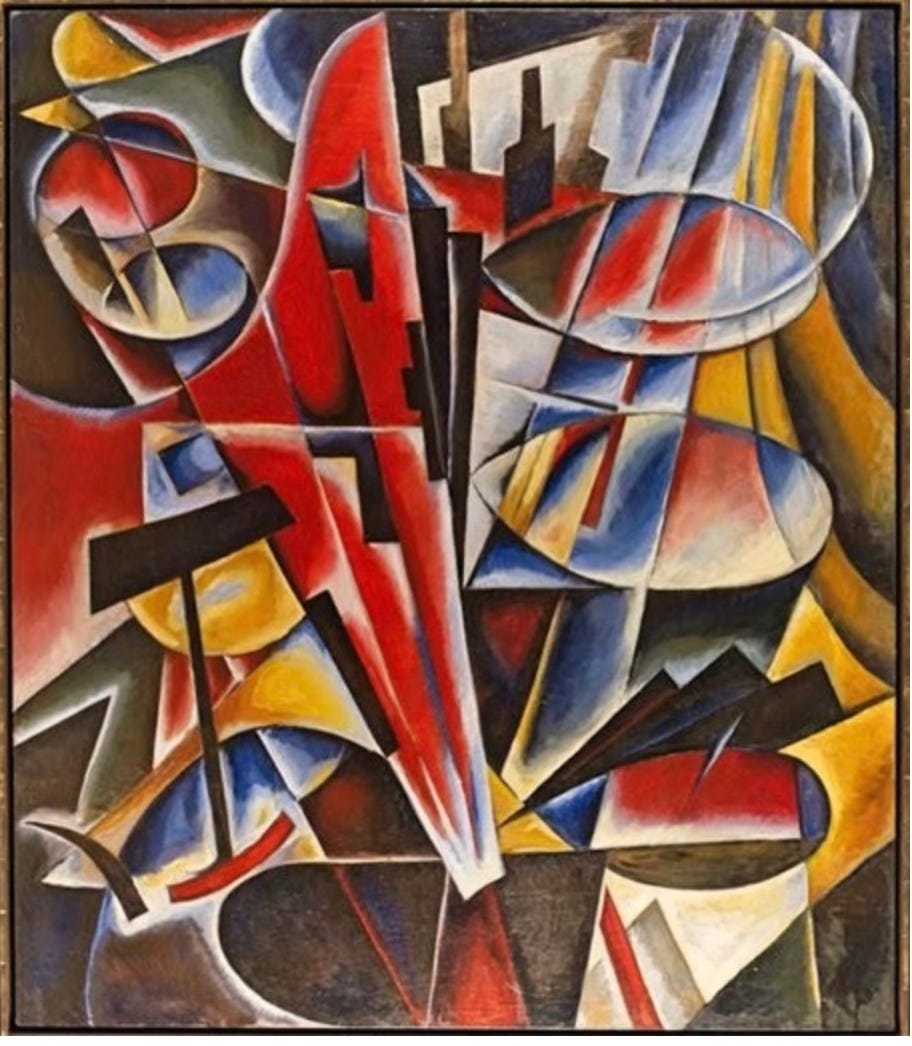
Attributed to Liubov Popova. Composition. Family Portrait. 1918 (?). Oil on canvas. 144 × 124 cm. Private collection.
The Family Portrait of Popova’s bastards would be incomplete without mentioning a third twin. As in the case of Ekster’s canvases, the late child shows obvious signs of degeneration. The forgery, made in Moscow, is painted without any inspiration and is a striking example of a careless attitude toward the forgery of Russian avant-garde art.
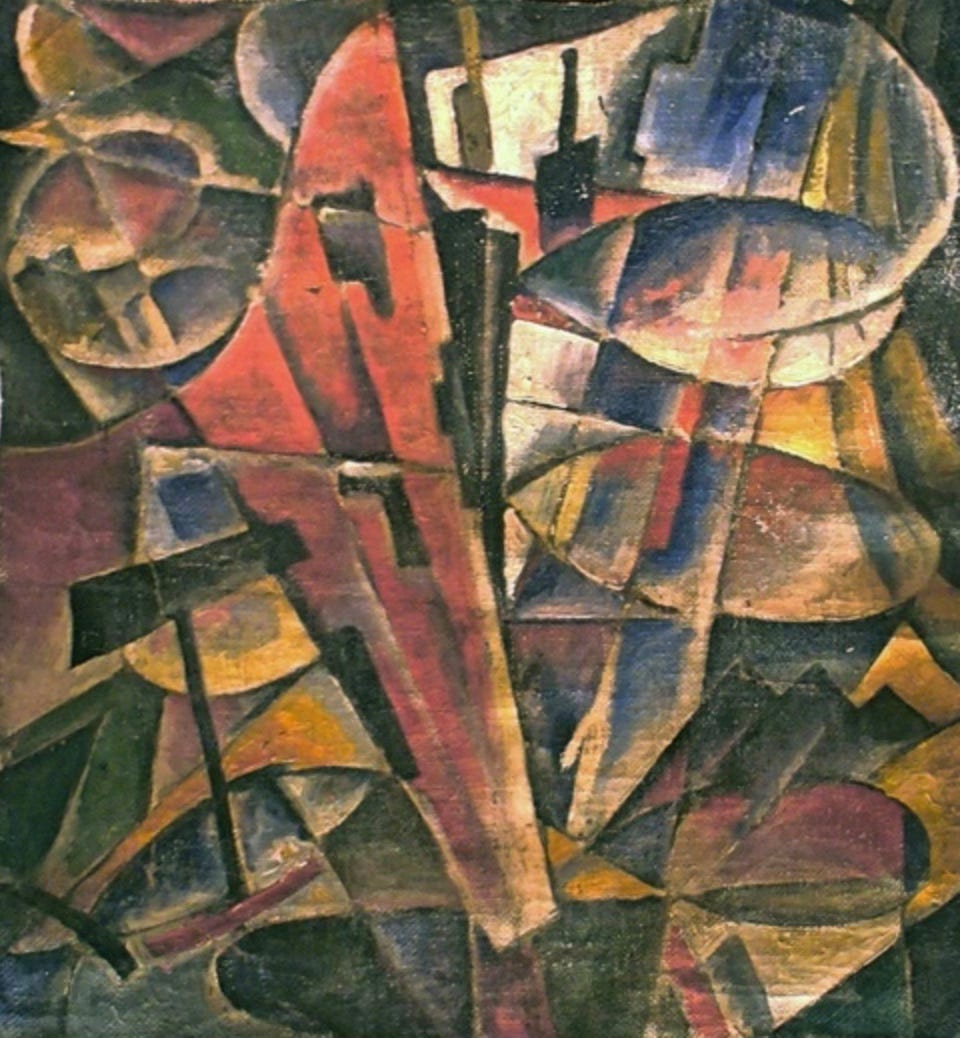
Fake work attributed to Liubov Popova. Oil on canvas. Dimensions and location unknown.
Mirror of the Russian (Art) Revolution
The dreadful doubles are not only repetitions of forgeries but sometimes become their reflections. It is quite hard to imagine that artists would paint mirror copies of their works, yet for the Russian avant-garde market, the appearance of mirror-image paintings is more than typical.
Let us return to the Composition attributed to Rodchenko and reproduced on the cover of the Viennese catalog. In 2005, this painting again appeared on the cover of an exhibition catalog, but now as a mirror image. This Composition became the pièce de résistance, the pride of the exhibition “From the Blue Rider to the Russian Avant-Garde” at the Orlando Gallery. [20] Leafing through this catalog, it is hard to resist the well-worn clichés about history “repeating itself like a farce.” One of the main differences of the “reflected” Rodchenko was the excessive craquelure, indicating serious thermal treatment of the canvas, which the creators of the Viennese pastiche had managed to avoid. The catalog compilers in Zurich not only informed readers about a certificate confirming the authenticity of the work, signed by Svetlana Dzhafarova, but also shamelessly referred to the Composition exhibited at the MAK, calling it its “pendant.” [21]
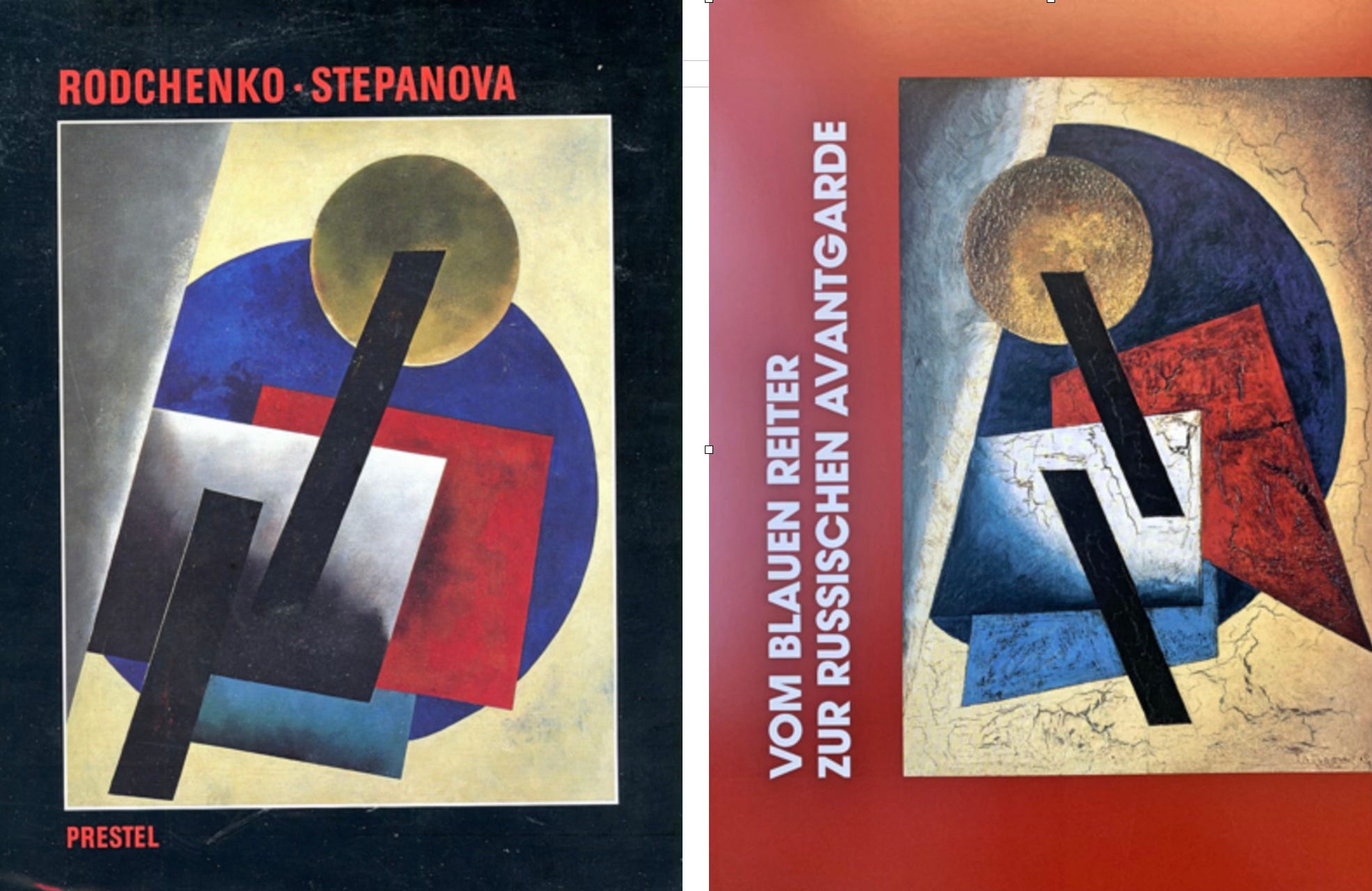
Cover of the catalogue The Future Is Our Only Goal. Aleksandr M. Rodchenko, Varvara F. Stepanova. Munich: Prestel, 1991. First edition.
Cover of the catalog Vom Blauen Reiter zur russischen Avantgarde: Berlin, Moskau, München; published on the occasion of the exhibition Vom Blauen Reiter zur Russischen Avantgarde — Berlin, Moskau, München at Galerie Orlando, Zurich, November 24, 2005 to May 27, 2006. Zurich: Galerie Orlando, 2005.
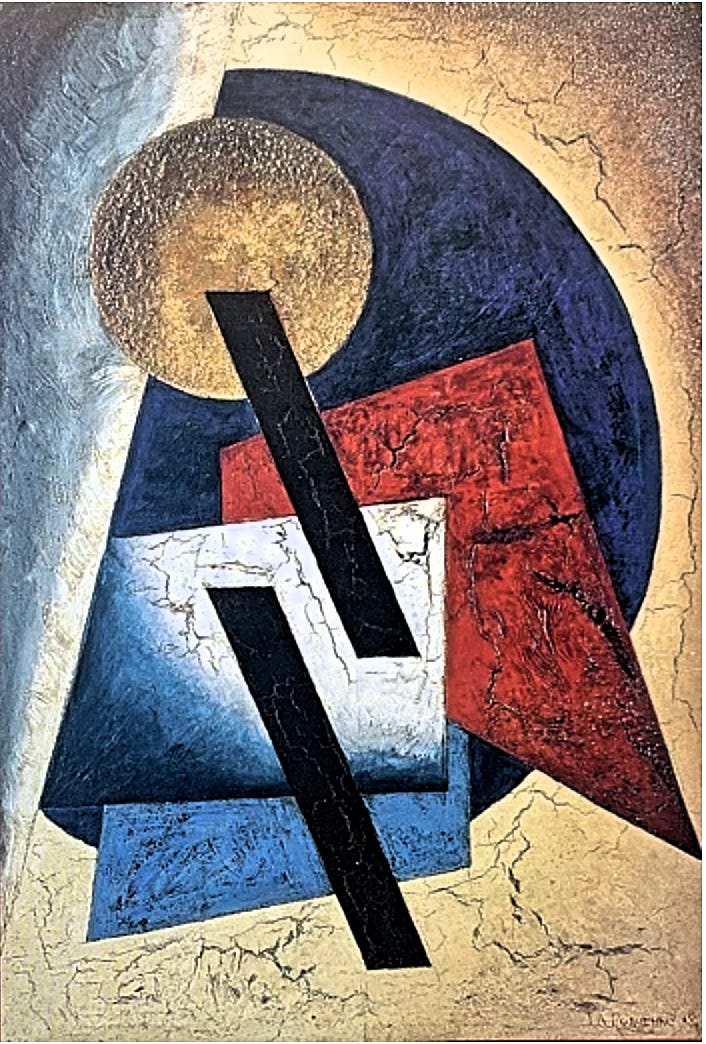
Attributed to Aleksandr Rodchenko. Composition. 1918 (?). Paper on cardboard, oil, tempera. 59.5 × 41.5 cm. Private collection.
Naturally, the mirror world of Russian avant-garde is not limited to the simplistic technique of mere reflection. Sometimes the creators of these doubles show far more impressive inventiveness. For example, the Museum Ludwig in Cologne holds a questionable canvas attributed to Ilya Chashnik (it was exhibited at the end of 2020 in the show “Russian Avant-Garde at the Museum Ludwig: Original and Fake” [22]). Its composition became the foundation for creating two barely distinguishable Chashnik doubles - a canvas from the Moscow Museum of Contemporary Art collection and an almost identical painting from the so-called “Leonid Zaks Collection.”
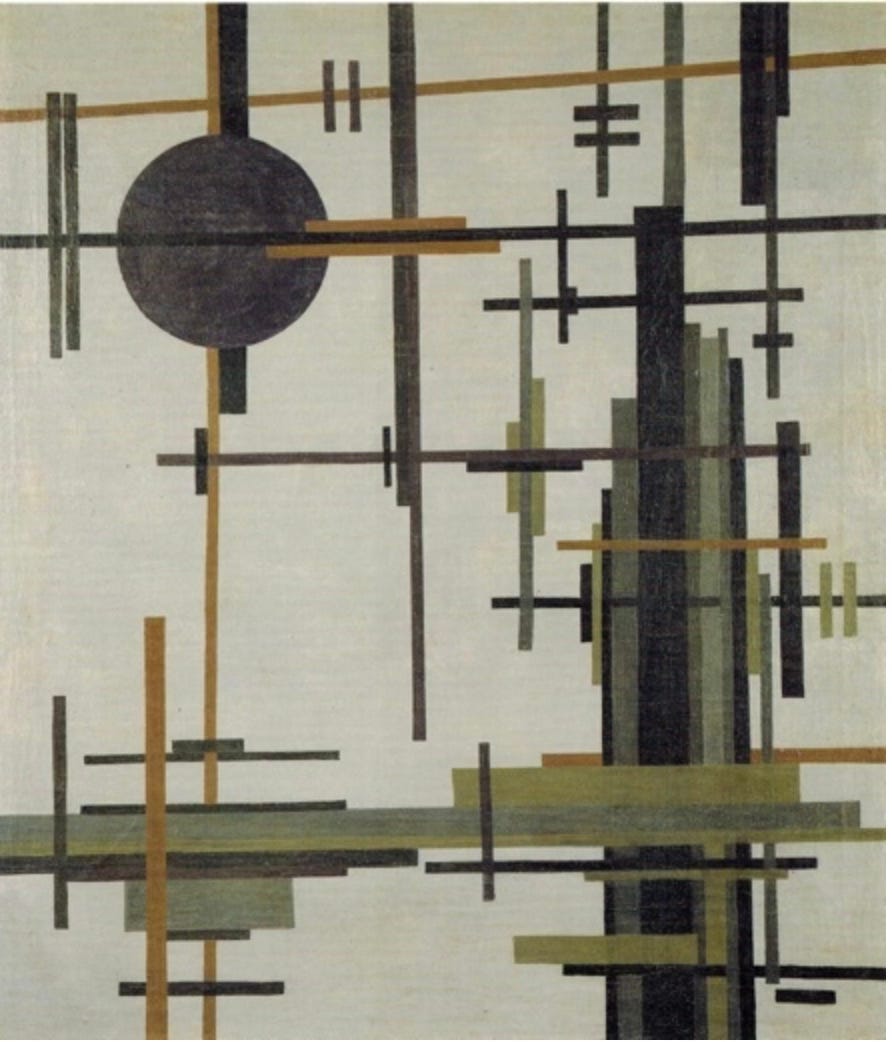
A forgery, formerly attributed to Ilya Chashnik. Suprematism. Date unknown. Oil on canvas, 85.5 × 54.5 cm. Museum Ludwig, Cologne.
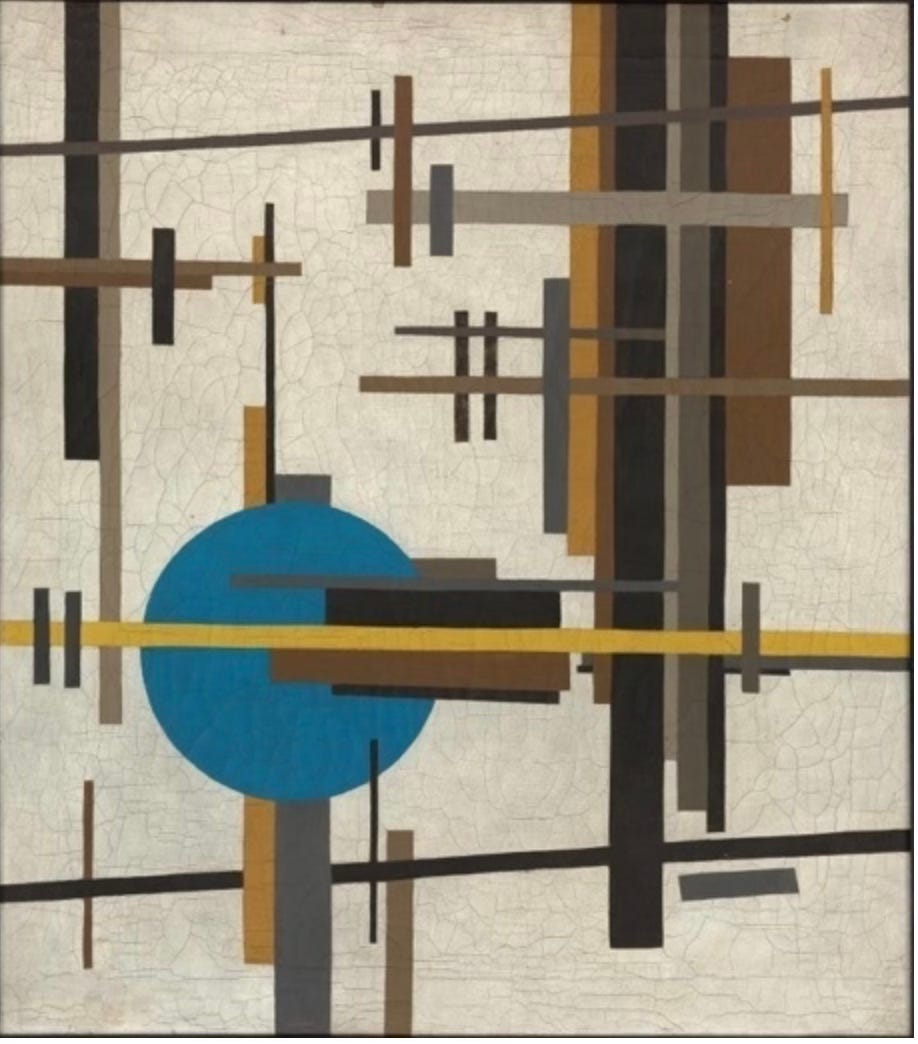
Attributed to Ilya Chashnik. Composition. 1920s (?). Oil on canvas. 79 × 70 cm. Moscow Museum of Modern Art.
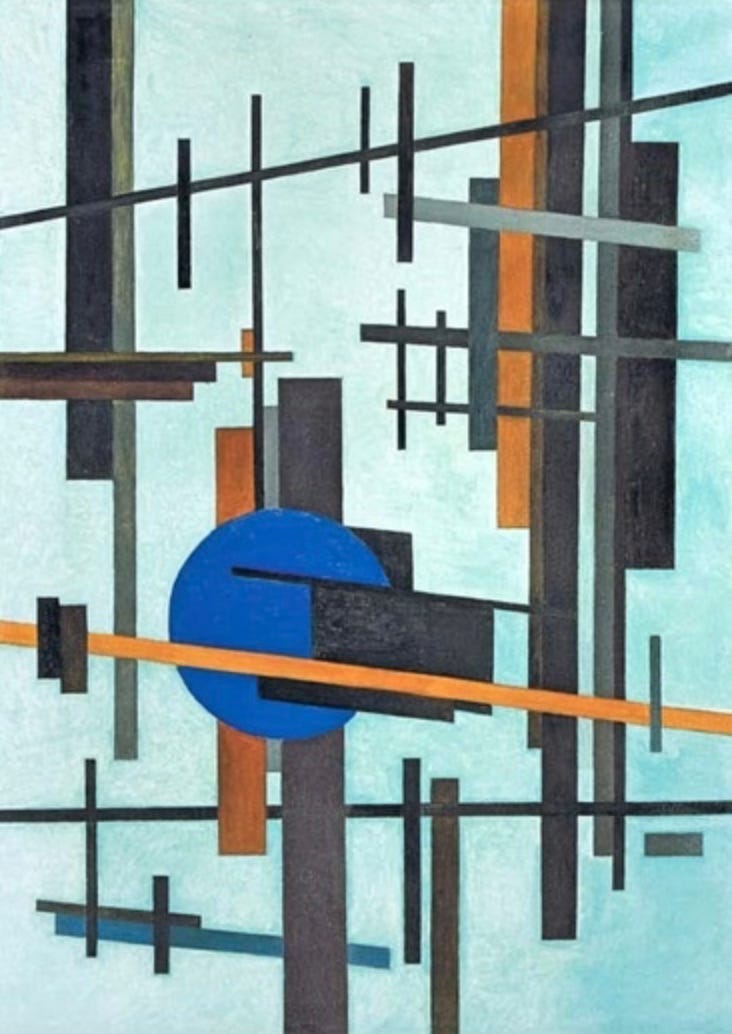
Attributed to Ilya Chashnik. Composition. 1925–1926 (?). Oil on canvas. 70 × 50 cm. Leonid Zaks Collection.
In line with the classic thesis of Soviet critics of modernism that an abstract painting can be hung upside down with no change in effect, the Suprematism from the Cologne collection was first inverted and then mirrored, capturing this in two twin canvases. Without a definite answer as to which of the twins is older, one would like to believe - on aesthetic and patriotic grounds - that the Moscow version is original, and Zaks’s “Chashnik” is secondary.
What’s in a name?
Since forgers attempt to reproduce not so much the works of famous artists as what can be defined as the brand “Russian Avant-Garde” - the characteristics of a personal style and the very names of the forged authors become increasingly secondary compared to the effectiveness of the image-template. In such a situation, any image in the Cubo-Futurist style can be called a work by Kliun, Popova, Udaltsova, while Suprematist abstraction is free to be anything from Malevich to Chashnik, Suetin, Khidekel, or Rozhdestvenskii (the list of artists can be extended in both cases).
A canvas attributed to Ivan Kliun, depicting a kerosene lamp, is held in a private collection in London. The painting, which appeared on the market in 2008, traditionally comes with a certificate from Elena Basner [23]. It was also confirmed by Svetlana Klunkova-Soloveichik, the artist’s granddaughter and author of the catalogue raisonné published in New York in 1993 by the mysterious IVK Art publishing house [24]. (This catalog was the only book released by this publisher. Apparently, the abbreviation IVK is nothing more than the initials of Ivan Vasilyevich Kliun.) Today’s owners of the Kerosene Lamp harbor no illusions about its authenticity and have even lent the painting to the British art dealer James Butterwick to use as a visual aid during his lectures on Russian avant-garde forgeries.
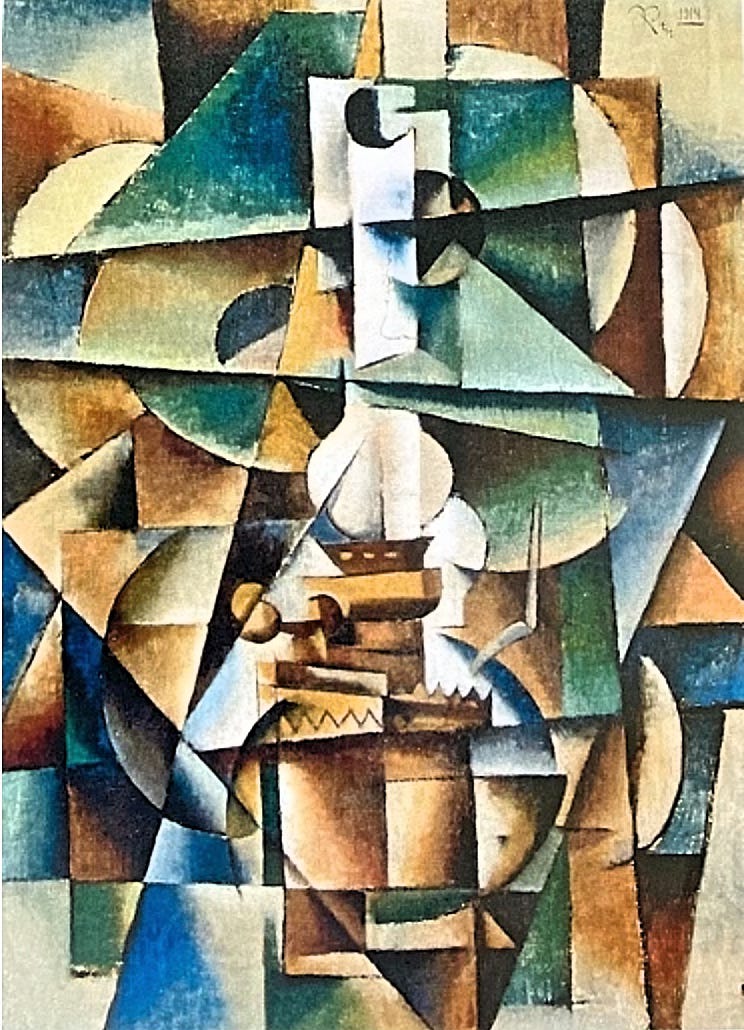
A forgery, formerly attributed to Ivan Kliun. Composition with Lamp. 1914 (?). Oil on canvas. 65.2 × 47 cm. Private collection.
If the appearance of twins is a criterion of a forgery’s success, then Kerosene Lamp is an outstanding work. In this case, the lamp itself turned out to be far more important than the attribution of the canvas to Kliun. Just one year after the painting was sold in Zurich, a large watercolor with collage elements appeared at the Hampel auction in Munich, which was an almost literal copy of the work attributed to Kliun. Although the distance between the two cities is only 311 kilometers and gallery catalogs from Zurich are accessible in Munich libraries, in the Bavarian capital the image of the popular early 20th-century lighting device not only changed medium but also gained a new, more modest and lesser-known author. The watercolor was sold as a work by Emma Gurovich—a minor student of Malevich who belonged to UNOVIS in 1920 - 1921.
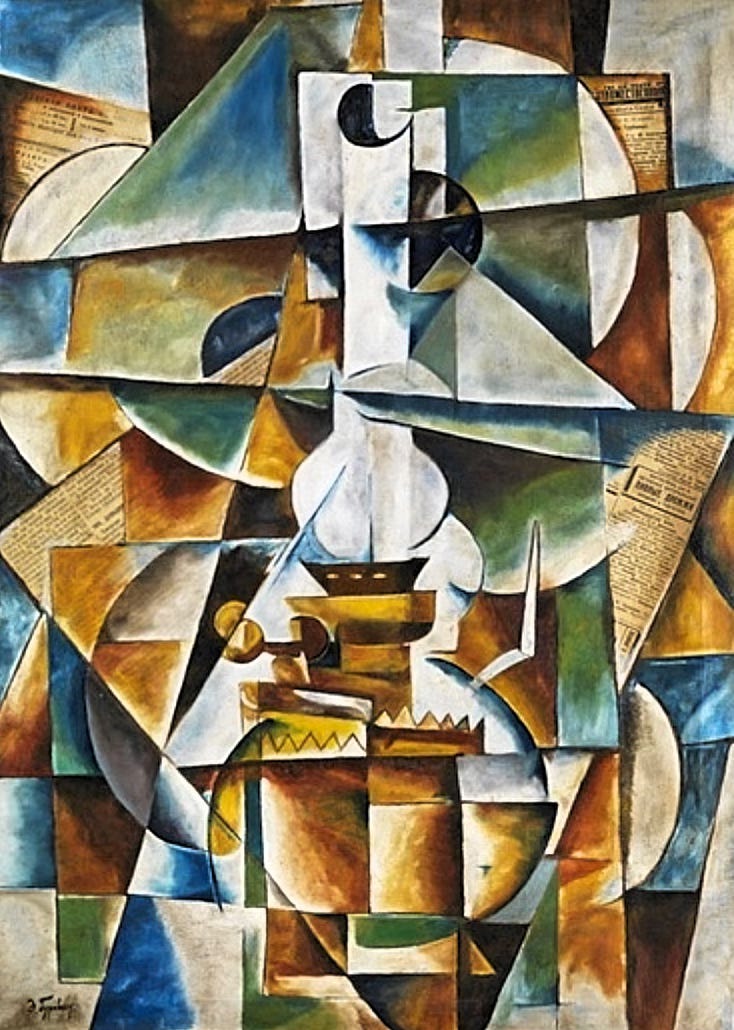
Attributed to Emma Gurovich. Composition with Kerosene Lamp. Cardboard, mixed media, collage. 69.5 × 50 cm. Private collection.
If the magical doubling of the kerosene lamp demonstrated at least a superficial knowledge of the subject (the author of the Munich twin was aware of the existence of the artist Gurovich), then in many other cases such displays of erudition prove simply unnecessary. The Constructivists’ dream of the “death of the author,” the death of art in general, and the possibility for every proletarian to express themselves aesthetically using artistic means, never came true. Today, Russian avant-garde is closer than ever to realizing a different version of the “death of the author” concept—in this case, in its postmodern form. The modern depersonalization of the avant-garde boils down to juggling interchangeable name-labels that can be stuck on any canvas without much doubt.
The exhibition Crossroads: Ukrainian Modernism, 1910–1930, shown in 2006–2007 at the Chicago Cultural Center, the Ukrainian Museum in New York, and later at the National Art Museum of Ukraine, included a work attributed to Kazimir Malevich titled Suprematist Composition [25]. The canvas, from a private collection, was attributed by Ukrainian art historian Dmytro Horbachev [26]. Painted in a casein-oil tempera technique uncharacteristic for the artist, the painting raised doubts among leading experts on Malevich’s work. Last year, an unskilled copy of this canvas was sold by a minor auction house, The Benefit Shop Foundation Inc., located in Mount Kisco, New York, as… a work by El Lissitzky [27]. The only difference between the two twins was a bold signature of Lissitzky in the lower right corner of the painting, although he almost never signed his painted works. The phrase from a classic Brooklyn joke comes to mind: “Chinese, Japanese - all the same.” In this case, it should be changed to “Malevich, Lissitzky - all the same.” This formula is perhaps the best description of modern Russian avant-garde forgeries.
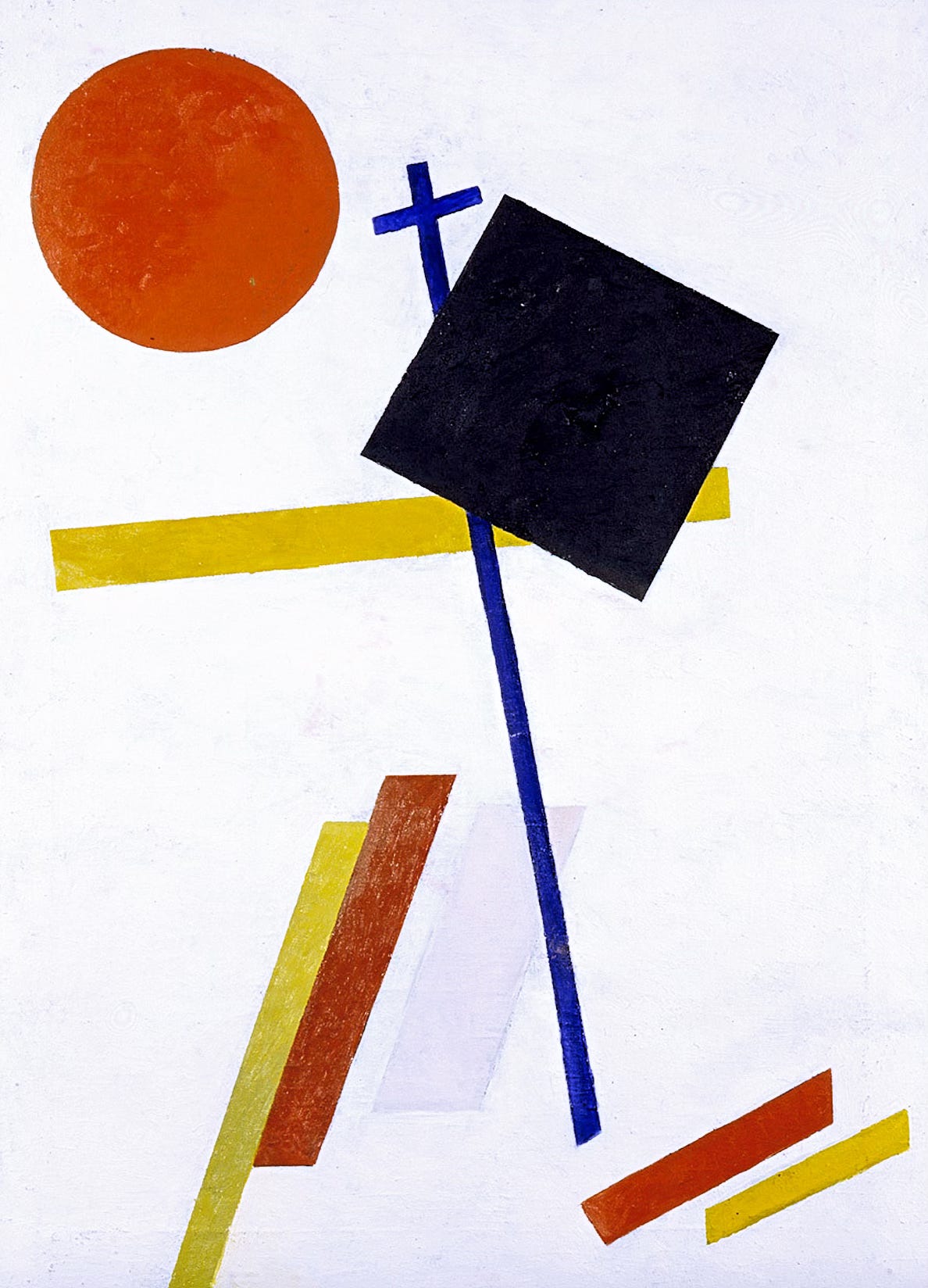
Attributed to Kazimir Malevich. Suprematist Composition. 1920s (?). Canvas, casein-oil tempera. 89.5 × 65.5 cm. Private collection.
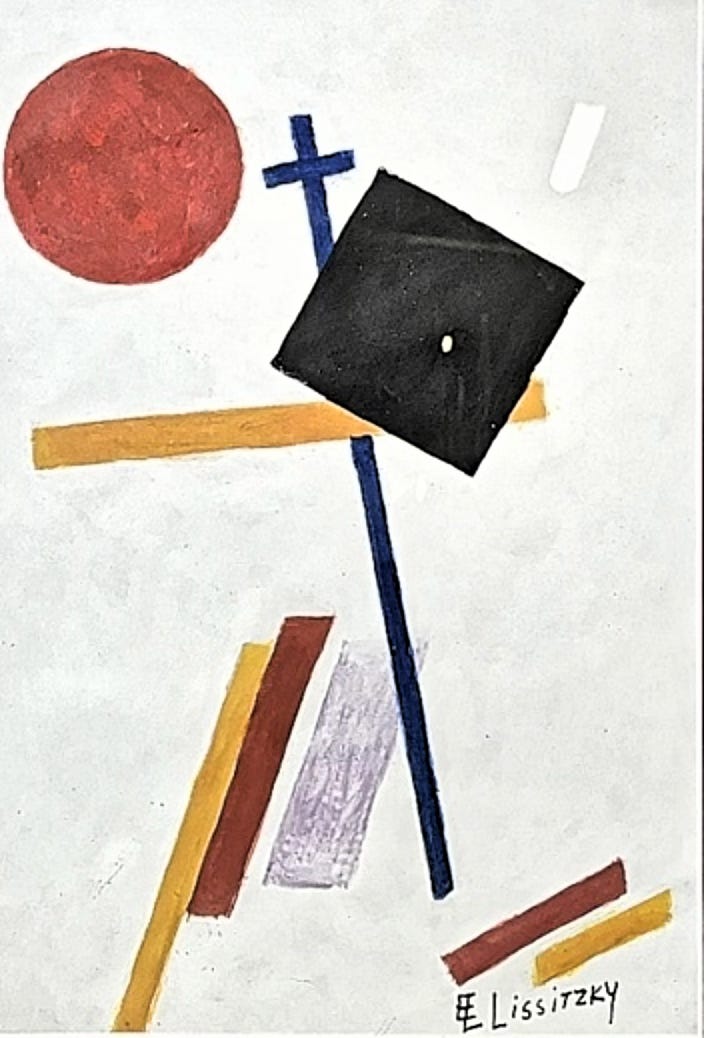
Attributed to El Lissitzky. Composition. Undated. Paper, gouache. Dimensions unknown. Private collection.
Ideas Take Hold of the Masses. The Case of Thonetomania
Twin forgeries do not necessarily have to be visually indistinguishable from one another. Sometimes, conceptual similarity becomes more important than obvious visual likeness. Iconography, a recurring - though differently interpreted - motif, and thematic proximity become a common form of conceptual decalcomania. In the article Hanging on Tails (The Daily Fake No 1), a graphic work attributed to Liubov Popova was mentioned - a still life set against the backrest of a Viennese chair, accompanied by the inscription Thonet No. 14 - missing the hard sign ъ that, according to the rules of pre-revolutionary Russian orthography, should appear at the end of the furniture company's name.
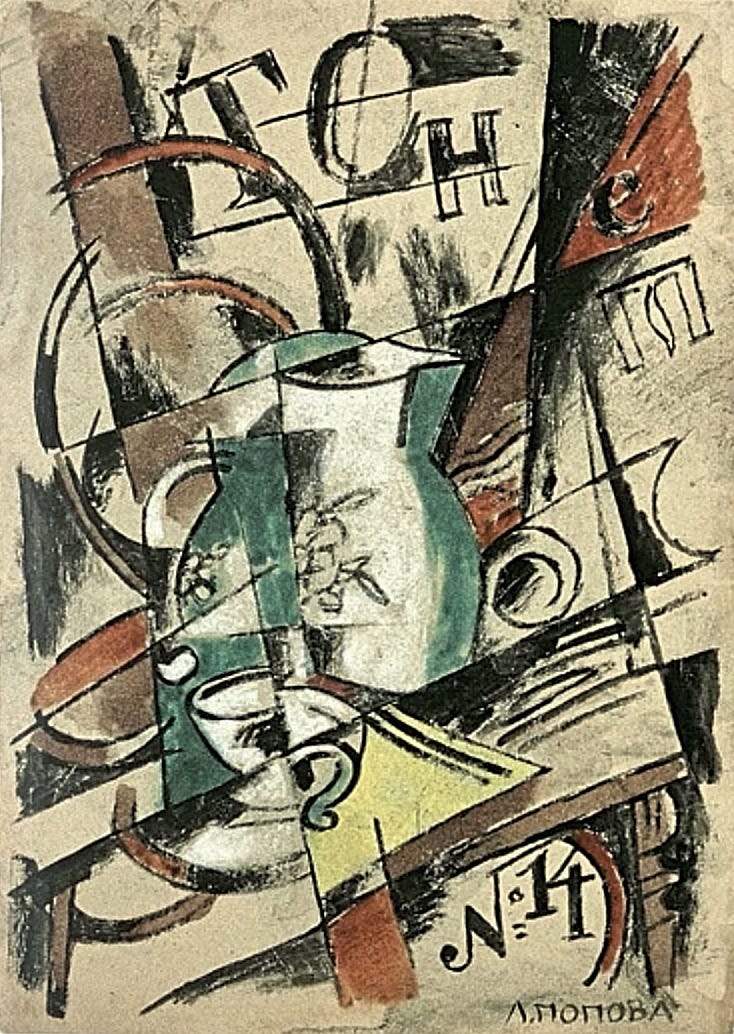
Attributed to Liubov Popova. Thonet No. 14. 1914–1915 (?). Watercolor on paper. 29.5 × 20.8 cm. Private collection
Meanwhile, in the collection of the Ludwig Museum in Cologne, there is a questionable canvas attributed to Ivan Puni. According to legend, the painting comes from the mythical collection of Igor Borisovich Merlin in Leningrad [28] (in provenance legends, this likely fictional collector is sometimes referred to simply as “Borisovich” using his patronymic instead of the family name). The canvas depicts a chair disintegrating into its component parts. The inscription Thonet No. 14 is rendered in a typeface mimicking Ivan Puni’s style. At the same time, it reproduces the same spelling mistake found in the “Popova” still life.
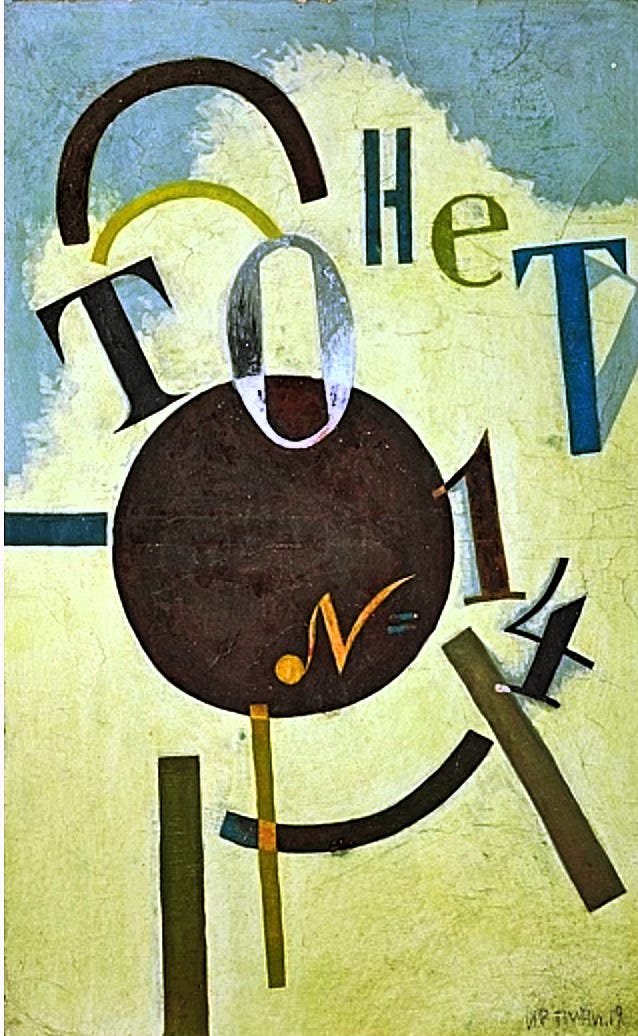
A forgery formerly attributed to Ivan Puni. Thonet No 14. Date unknown. Oil on canvas. 65 × 43 cm. Museum Ludwig, Cologne.
Why such different artists as Popova and Puni would suddenly show a keen interest specifically in the fourteenth model of chair produced by the Thonet company remains a mystery. The only thing uniting them in their treatment of the theme is a lack of knowledge of Russian orthography. Perhaps both forgeries came from the same workshop. But another possibility exists: the painting attributed to Puni was purchased by Peter Ludwig in 1993, while the “Popova” still life appeared on the market in 2008. One can assume that this successful iconographic hybrid — combining two late 20th-century collecting trends: the fashion for bentwood furniture and the Russian avant-garde - it proved attractive enough to inspire imitation and gave rise to a conceptual twin of the Viennese chair from the Cologne collection.
Nothing but Jews Everywhere…*
Forgers are highly attuned to the trends of the times: at one moment they try to meet the demand for leftist themes by turning paintings into pseudo-Soviet slogans adorned with Suprematist elements; at another, they follow the fashion for feminism, imitating the works of the "Amazons of the Avant-garde."
Naturally, the Jewish theme could not escape the attention of the forgers either. In this case, the painter Nathan Altman has arguably suffered more from their exploitation than other artists. The issue lies in the fact that, in 1913, Altman had the misfortune of painting a Portrait of an Old Jew. The painting depicts a bearded Jew in a bowler hat, seated on the edge of a sofa draped with a blanket. Thick tomes lie beside him. The portrait was frequently reproduced in publications of the 1920s [29], but the current whereabouts of it are unknown. Other portraits of Orthodox Jews painted by Altman before the outbreak of World War I were never mentioned or reproduced in early 20th-century literature.
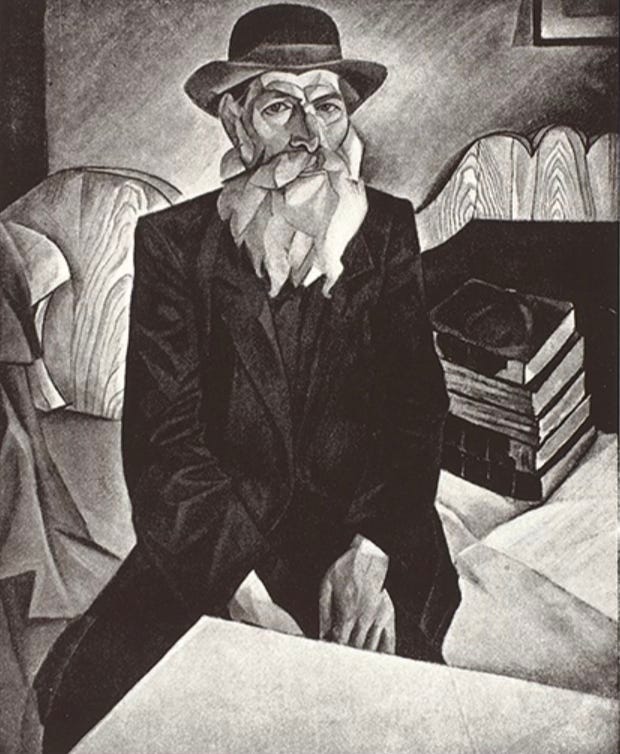
Nathan Altman. Portrait of an Old Jew. 1913 (?). Oil on canvas. Size and current location unknown.
These days, the old Jew has behaved in a more than predictable way.
Much like Tatlin’s Model, he began to move - rearranged the books onto a table and opened one of them. His facial expression changed, and he swapped his bowler hat for a far more impressive wide-brimmed one. The painting, titled Old Jew with an Open Book. Portrait of the Artist’s Uncle, was authenticated with a certificate from British art historian Anthony Parton—whose book on Natalia Goncharova was, by court ruling, banned from distribution in the Russian Federation. [30]
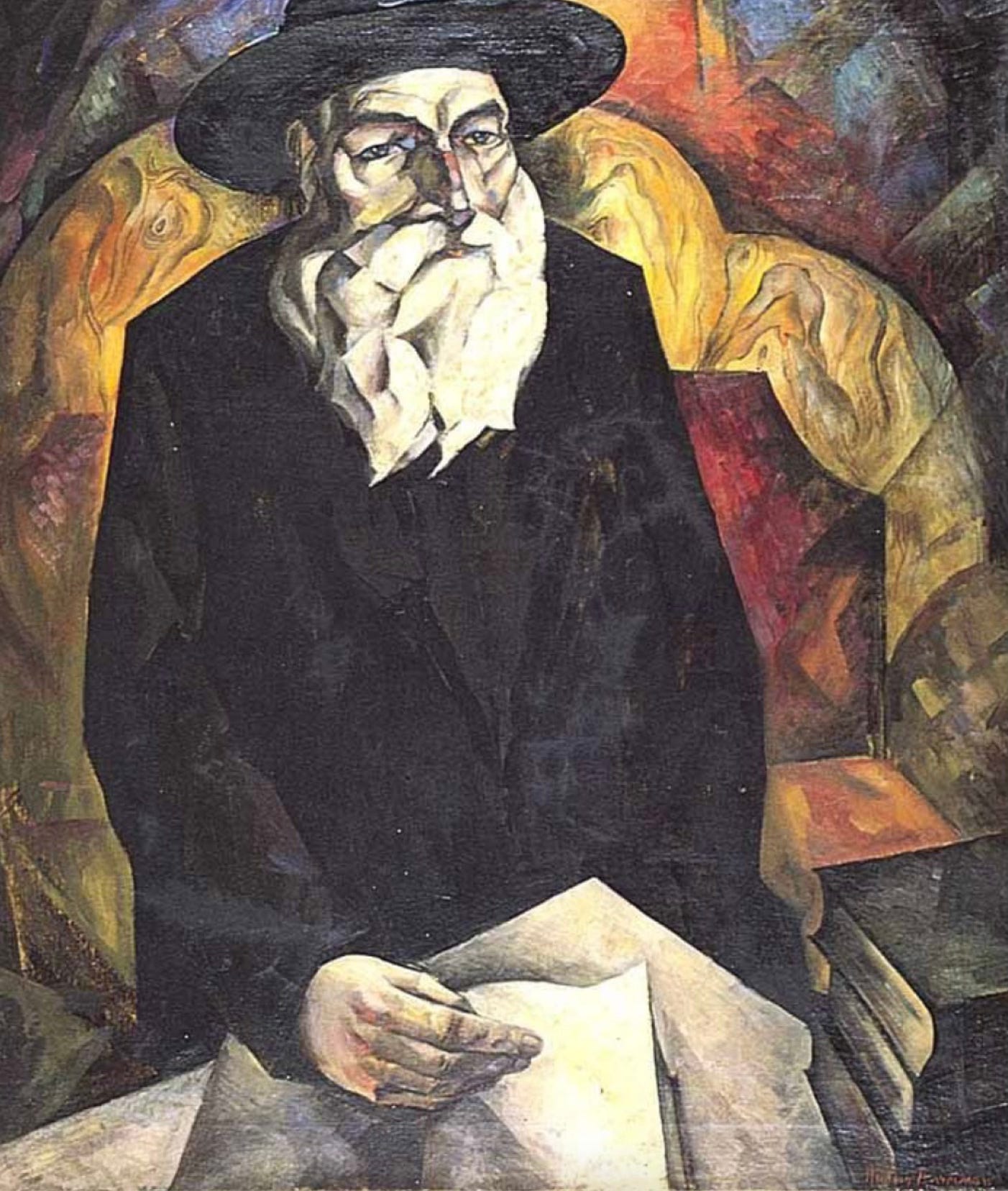
Attributed to Nathan Altman. Old Jew with an Open Book. Portrait of the Artist’s Uncle. Date unknown. 86 × 74 cm. Private collection.
Unfortunately, the adventures of the old Jew / the artist’s uncle in the sofa-lined interior didn’t end there. In 2006, the London auction house Bloomsbury offered yet another Portrait of a Jew for sale, in which the subject once again sat in a familiar room. [31] This new “uncle” had swapped his hat for a yarmulke, grown payot (side curls), and held an impressively large Kiddush cup. On the table stood two candlesticks with burning candles. The cozy Shabbat setting was completed by a wall clock hanging behind the old Jew’s back. This painterly weak pastiche was estimated at £50–70,000 but failed to attract any buyers.
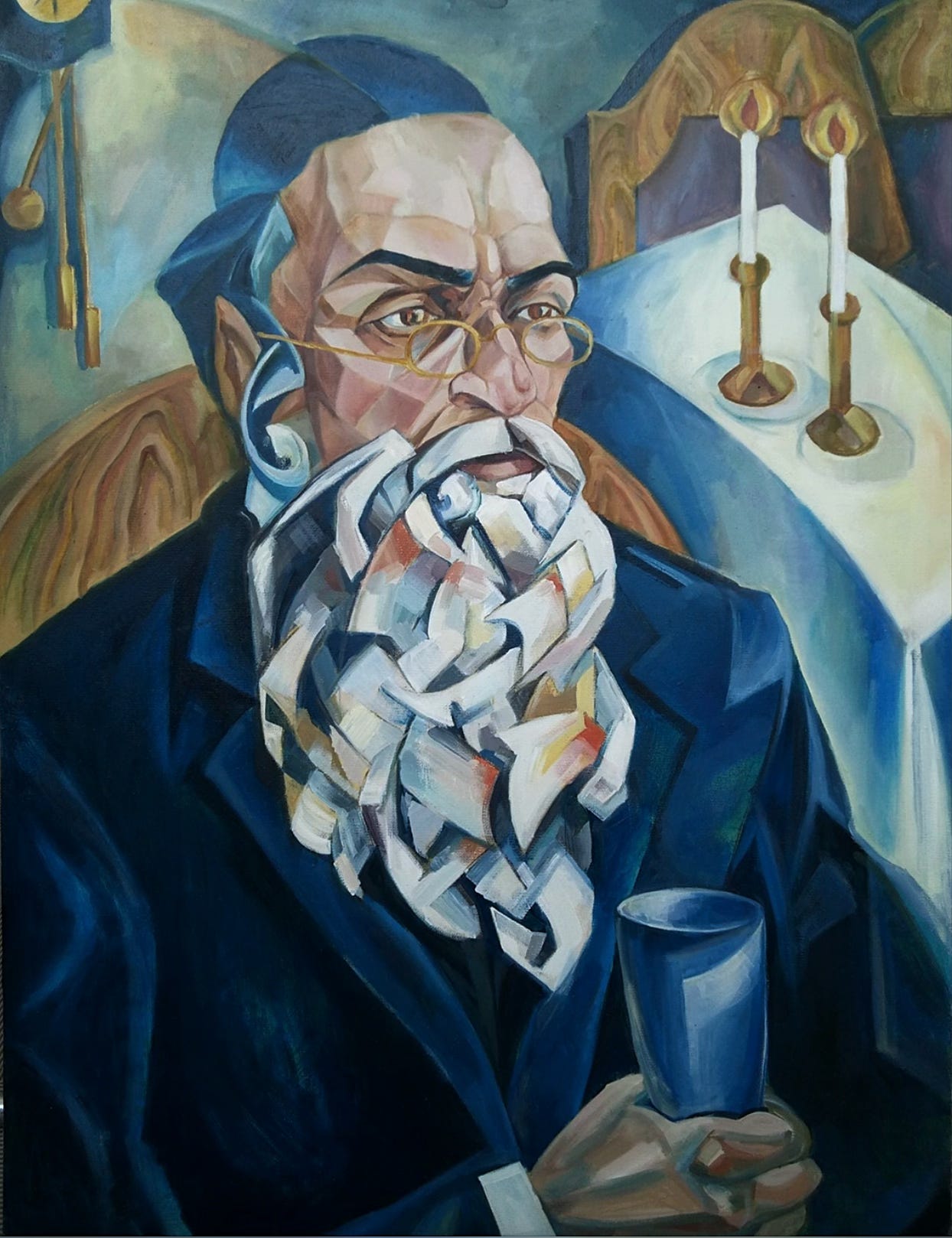
Attributed to Nathan Altman. Portrait of a Jew. Date unknown. Oil on canvas. 79 × 59 cm. Private collection.
But the attempts to turn Altman into a new Chagall did not end there.
Eventually, new twins emerged. In the same year, 2006, yet another “uncle” of the artist turned up in Paris, where the Aguttes auction house offered a canvas titled Rabbi - depicting a bearded Jew in a yarmulke, sitting beside a familiar stack of folios and gazing sadly into an open book. [32] The rabbi undoubtedly had reason for sorrow. On the page of the folio, only two words were inscribed - Shema Yisrael (“Hear, O Israel”), but the word Shema was written with a grammatical error: instead of the letter ayin, the author of the pastiche inserted the letter alef.
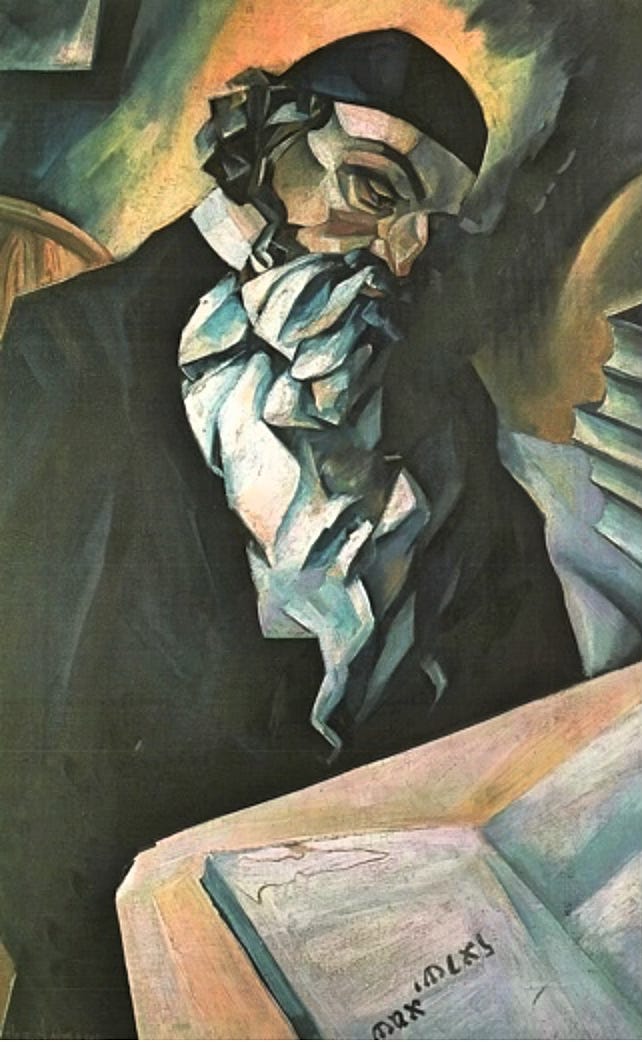
Attributed to Nathan Altman. Rabbi. Date unknown. Oil on canvas. 58 × 38 cm. Private collection.
We will encounter similar instances of “imitative” Hebrew again - reminiscent of invented Egyptian hieroglyphs used to decorate forged Roman statues during the Renaissance, aiming to enhance the illusion of authenticity. Though the painting was estimated at €70,000 - 80,000, it was not sold. Still, the persistent forgers didn’t stop there.
Another obvious twin of the Parisian Rabbi appeared in 2014 in the German town of Ahlden, at the auction house Kunstauktionshaus Schloss Ahlden GmbH, under the title Shabbat. Painted by a different hand, it nonetheless retained a striking resemblance to its predecessor.
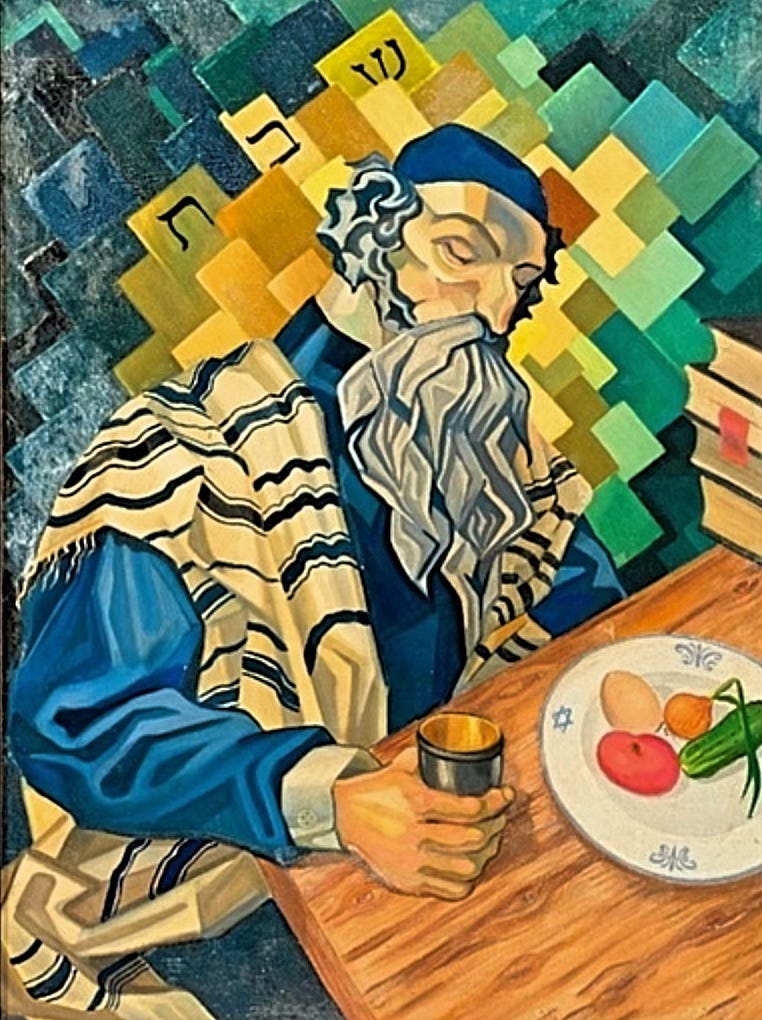
Attributed to Nathan Altman. Shabbat. Date unknown. Oil on canvas. 80 × 60 cm. Private collection.
Having pushed the books aside the rabbi prepared to welcome the Sabbath properly. Although the word Shabbat was spelled correctly this time, the food choice on the plate raised eyebrows: onion, a boiled egg, and a pickled cucumber are more fitting for a Seder than for Shabbat. And then there was the large red tomato, which ruined the scene entirely.
Today, tomatoes can be seen on Seder plates - progressive California rabbi Paula Marcus even called on her congregation to add tomatoes to the traditional bitter herbs and eggs in honor of oppressed seasonal workers. But it’s hard to believe that such humanitarian considerations would have influenced the contents of a traditional Passover meal in Vinnytsa on the eve of World War One.
The Ahlden auctioneers made two attempts to sell the painting attributed to Altman. First, it was estimated at €25–30,000, then discounted to €14,000 - but remained unsold.
But the “uncles” were not the end of it.
For the shtetl life singer, which forgers decided to turn Altman into, they invented a storyline the artist had never touched in his life. What could be more cliché than a Jewish watchmaker? A painting titled Jew Repairing a Watch, attributed to Altman, surfaced in the land of watches - Switzerland - at a Koller auction in 2006, [33] but failed to find a buyer and made its way to Italy. In 2007, it was sold at the Porro & C. auction house in Milan, at a price below its estimated value (€50–60,0000) [34] - for just €35,000. The tireless watchmaker then moved on to Germany, where the now-familiar Hampel auction house in Munich sold him the following year for €5,000 less than in Milan. [35]
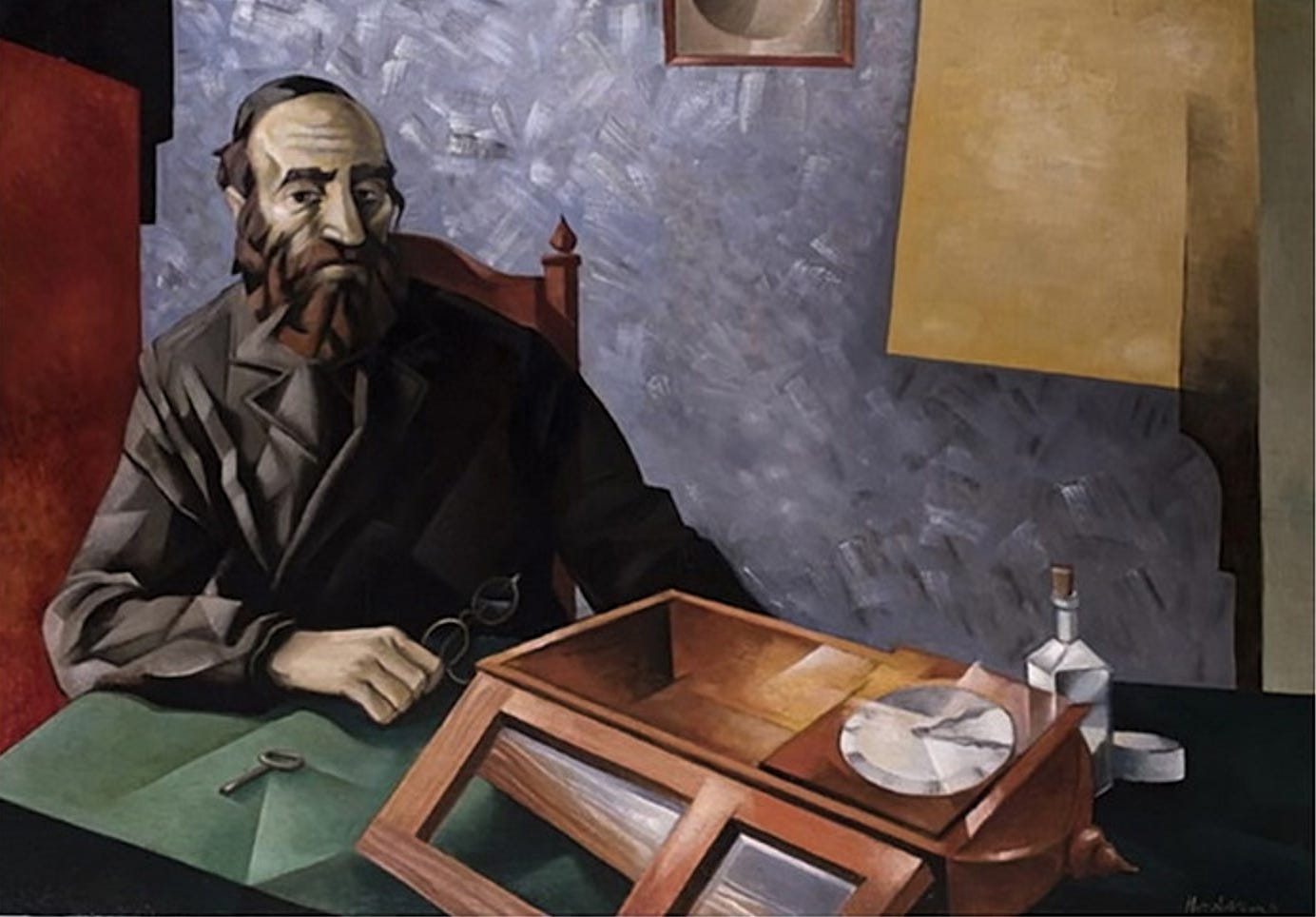
Attributed to Natan Altman. Jew Repairing a Watch. 1919 (?). Oil on canvas. 83 × 118.5 cm. Private collection.
The watchmaker’s travels did not go unnoticed. He was soon joined by a respectable twin, now residing in a European private collection.
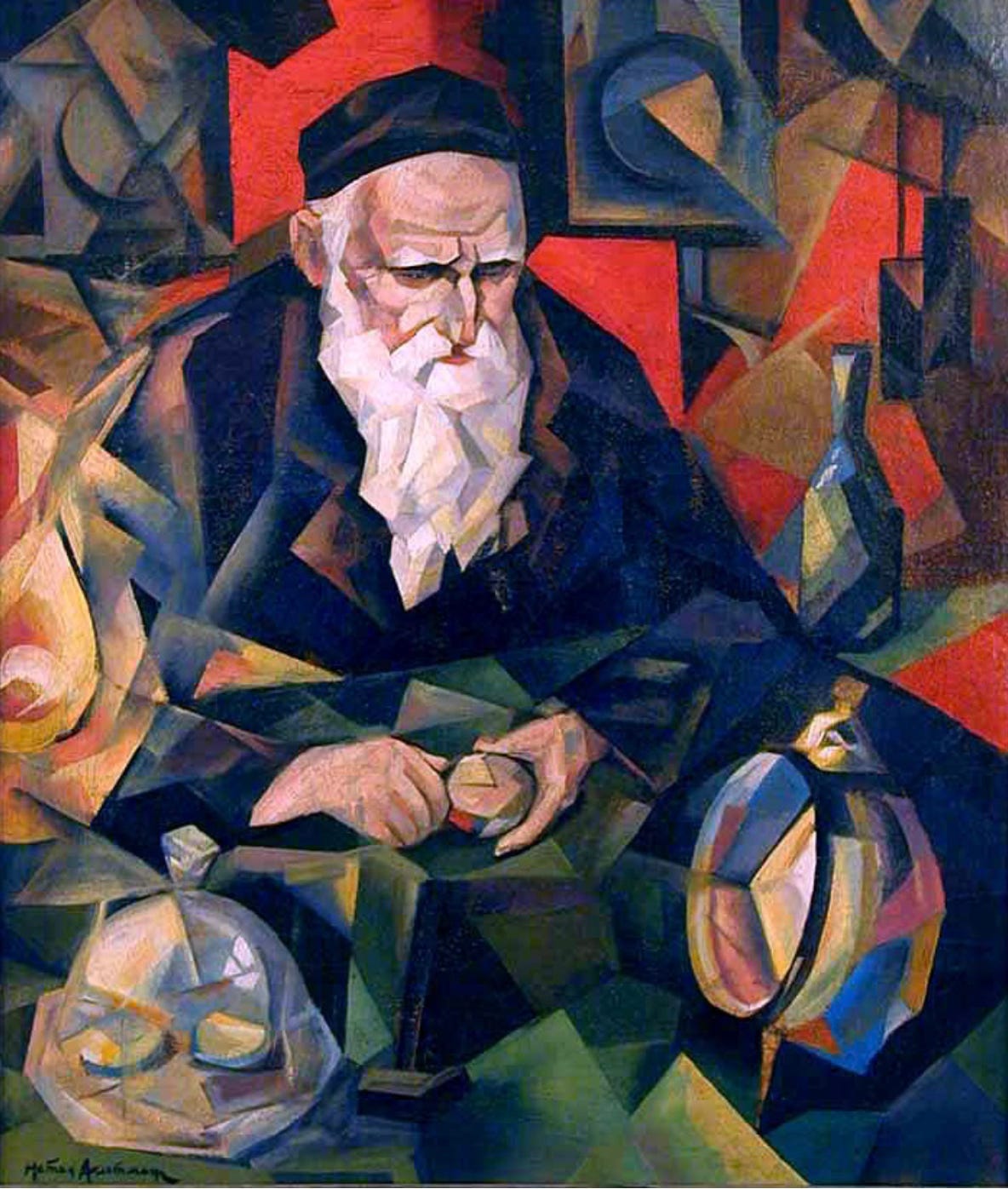
Attributed to Natan Altman. Watchmaker. 1914 (?). Oil on canvas. Private collection.
After watchmakers, only Jewish tailors could logically follow. Fortunately, the trend of Altman as an artist celebrating provincial Jewish life began to fade, and the only tailor - hastily produced in Moscow - was doomed to solitude, lacking both visual and conceptual twins.
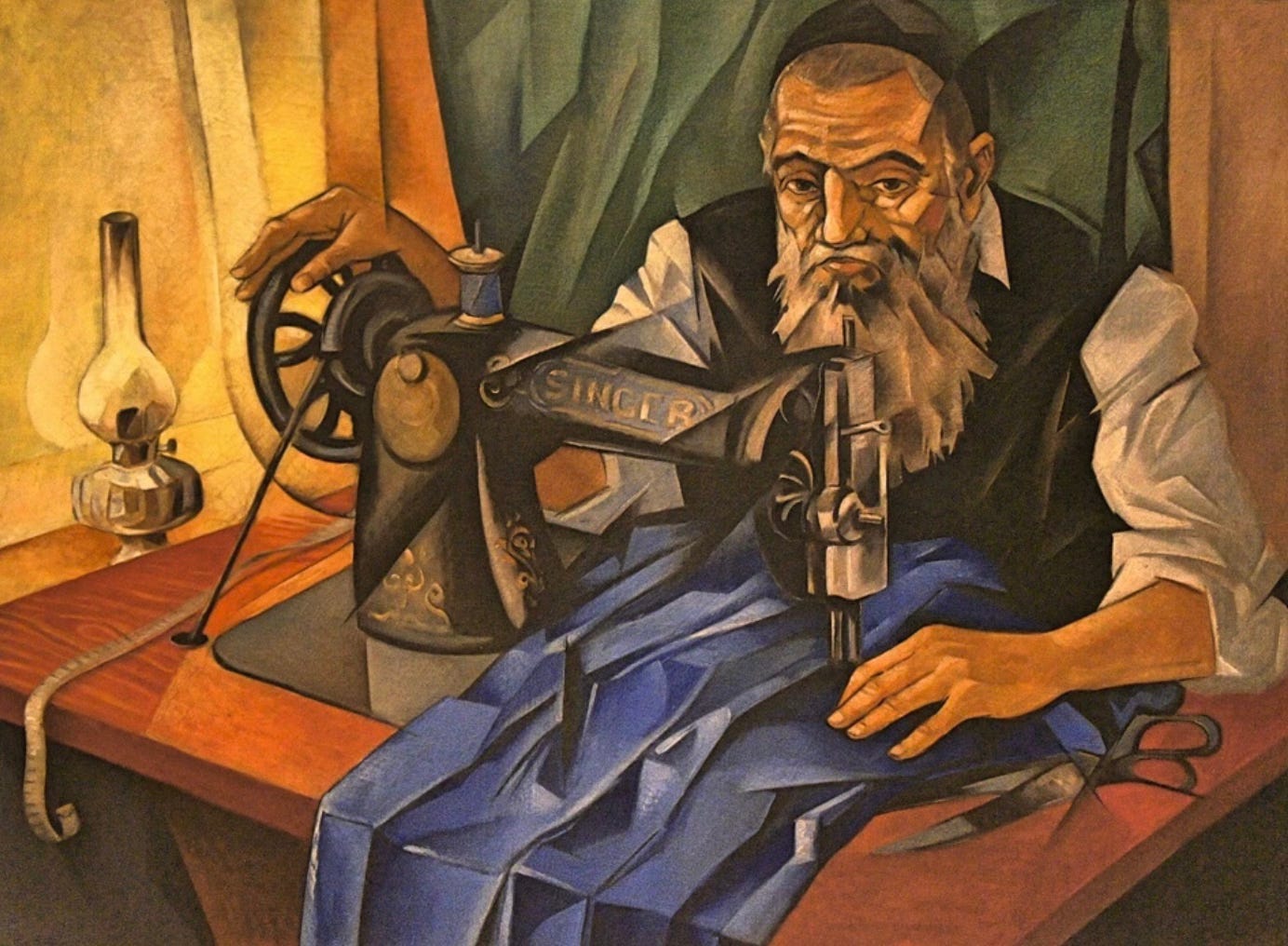
Forgery of Natan Altman. Tailor. Oil on canvas. Size and location unknown.
The role that Altman's imaginary uncle came to play in the world of counterfeit avant-garde art wasn’t confined to the work of his “nephew.”
The iconography of the “praying Jew” seemed appealing to the market, and by 2006, images of gray-haired representatives of the People of the Book began appearing under the names of various Russian avant-garde artists who could plausibly be suspected of having Jewish origins. A curious example of such thematic migration is the graphic work called Solomon. Praying Jew, dated 1938 and attributed to Nina Kogan. The drawing depicts an old Jew sitting pensively before a book, printed in an unusually large script that is presumably intended to represent biblical Hebrew (though only a couple of words are legible—most of it is more ornament than text).
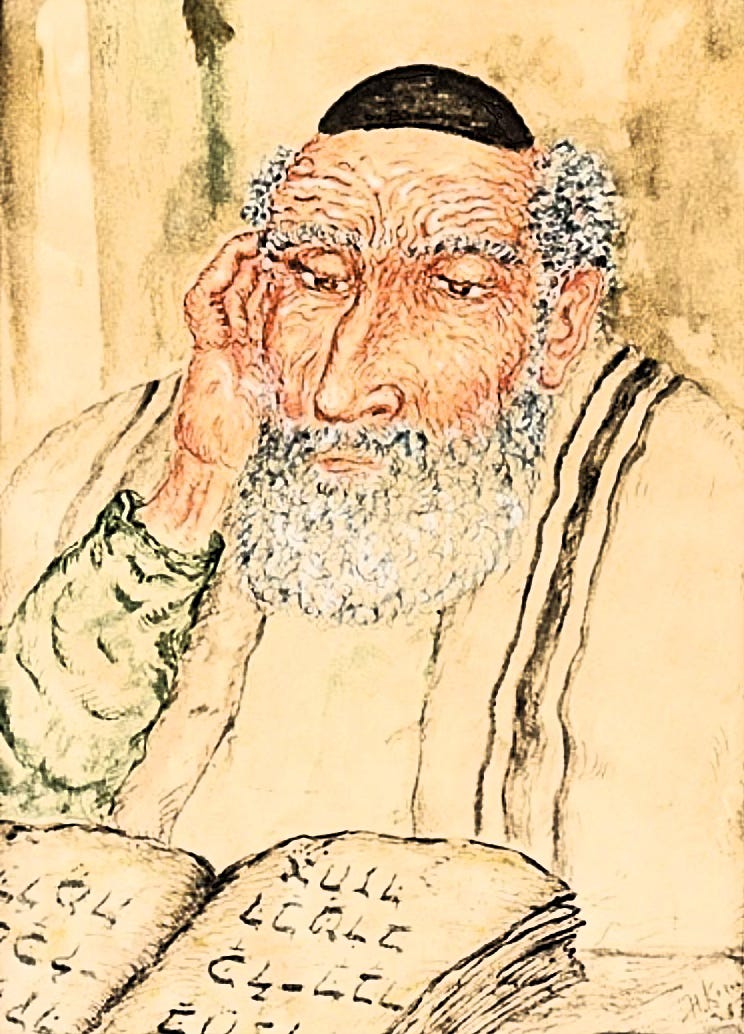
Attributed to Nina Kogan. Jew in Prayer (Solomon). 1938 (?). Paper, watercolor, ink, pen. 21 × 16 cm. Private collection.
Stylistically, Solomon has little in common with Nina Kogan’s work of the 1930s. Nevertheless, Ukrainian art historian Dmytro Horbachev, who confirmed the attribution, somehow managed to discern hidden traces of Suprematism in this astonishingly crude graphic composition. “In the drawing Jew at Prayer, what remains of former Suprematism is the black yarmulke, deliberately geometrized,” he noted. One couldn’t put it better! Indeed, all that’s left of Suprematism is the yarmulke - but what relevance does that have to Malevich’s unfortunate pupil? Who could have come up with the idea that the daughter of a Privy Councilor (A civil rank in the Table of Ranks of the Russian Empire, it was equivalent to a Lieutenant-General in the army and Vice-Admiral in the navy. Privy Councilors were addressed as "Your Excellency"), raised in an Orthodox Christian family and a graduate of the Catherine Institute for Noble Maidens, was deeply versed in the subtleties of Judaism?
Nevertheless, the Jewish theme in Nina Kogan’s “work” did not end with Solomon. The artist continued her posthumous study of Hebrew. This is confirmed by dozens of watercolors and drawings depicting matzo, dancing Jews, Stars of David, and abstract compositions with Hebrew inscriptions, which have appeared at auctions ranging from Ramat Gan in Israel to New York.
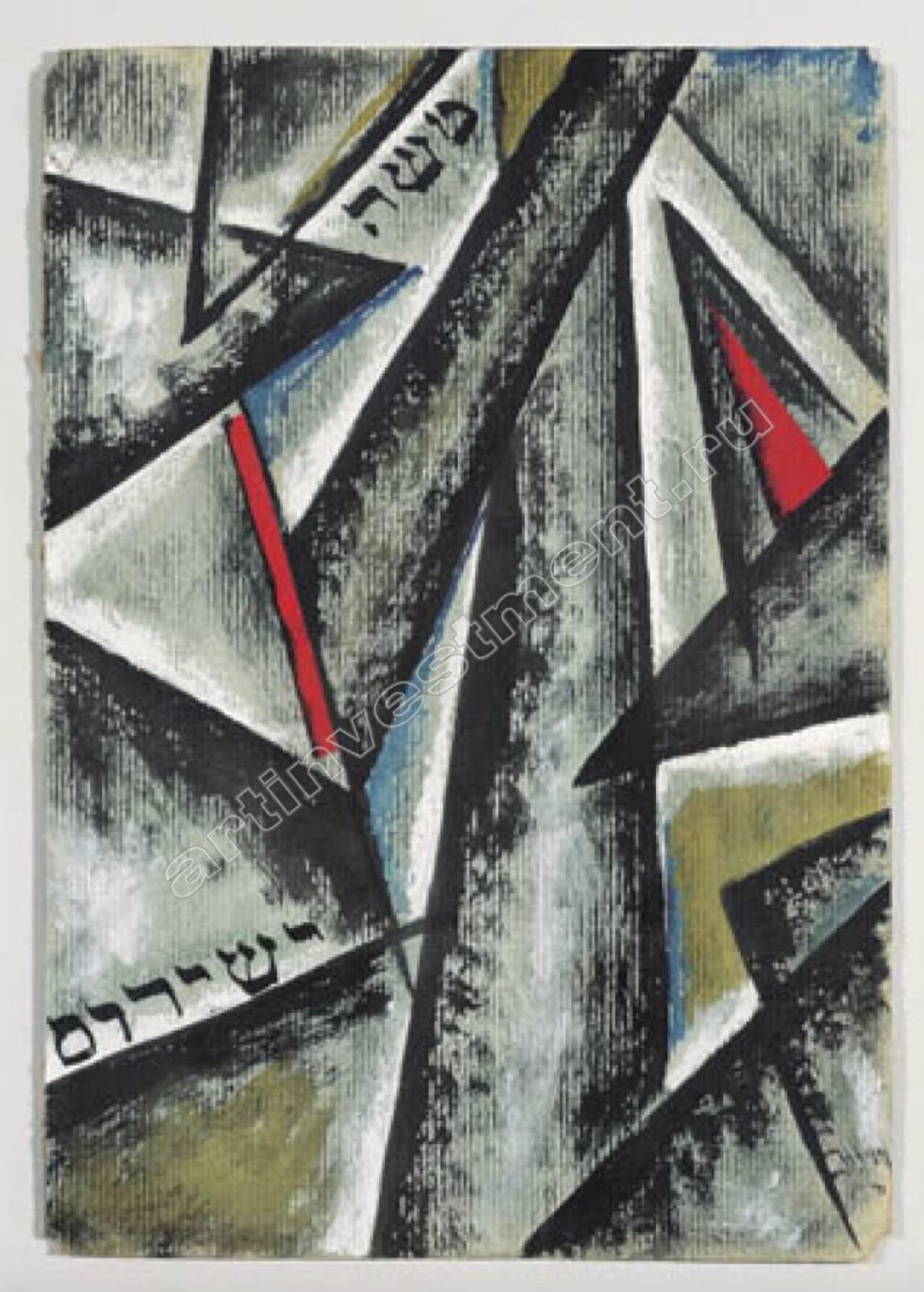
Attributed to Nina Kogan. Composition. Paper, gouache. 28.5 × 20.2 cm. Private collection.
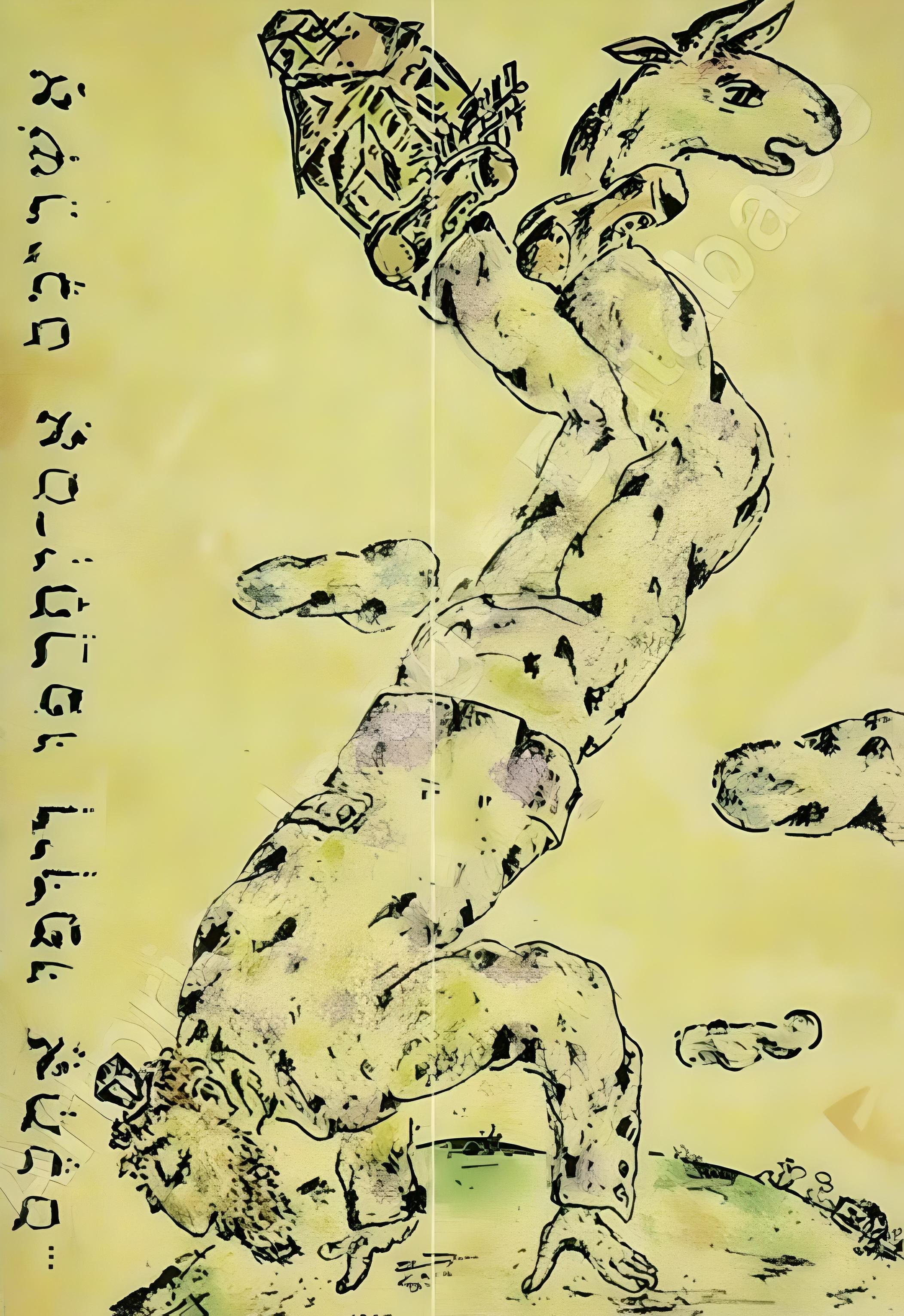
Attributed to Nina Kogan. At the Top of the World. 1925 (?). Paper, watercolor, gouache, ink. 19.5 × 13.5 cm. Private collection.
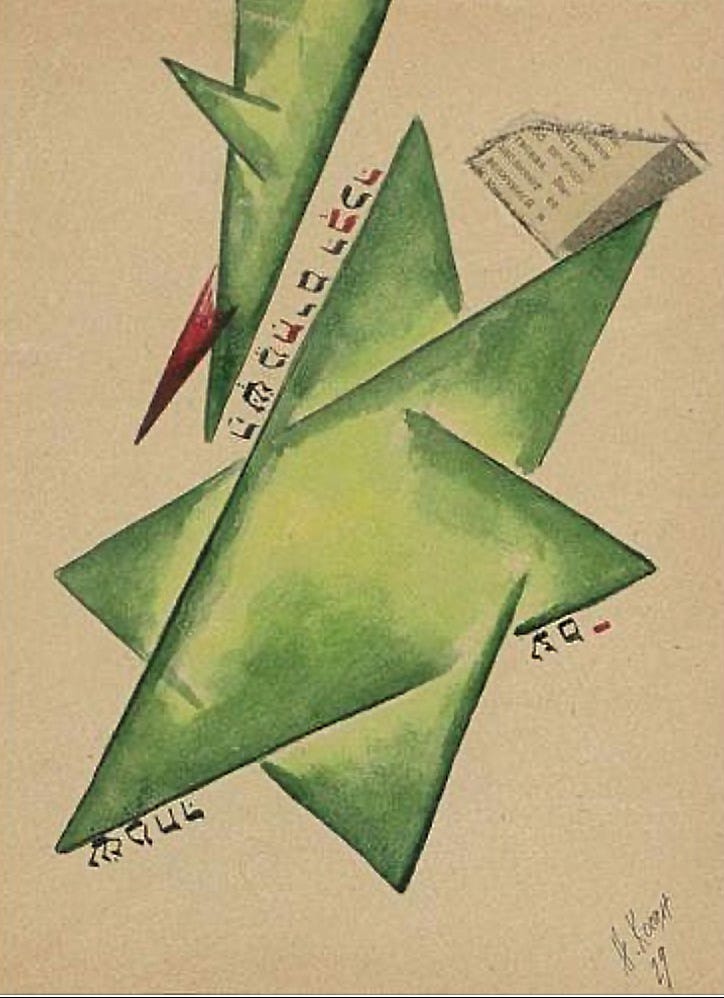
Attributed to Nina Kogan. Rejoice with Those Who Rejoice. 1929 (?). Paper, watercolor, collage. 25.5 × 19.5 cm. Private collection.
Unsurprisingly, the elderly Solomon also gained a twin, who continued reading his book, resting his head on his hand, while sitting at a table with two Shabbat candles.[36]
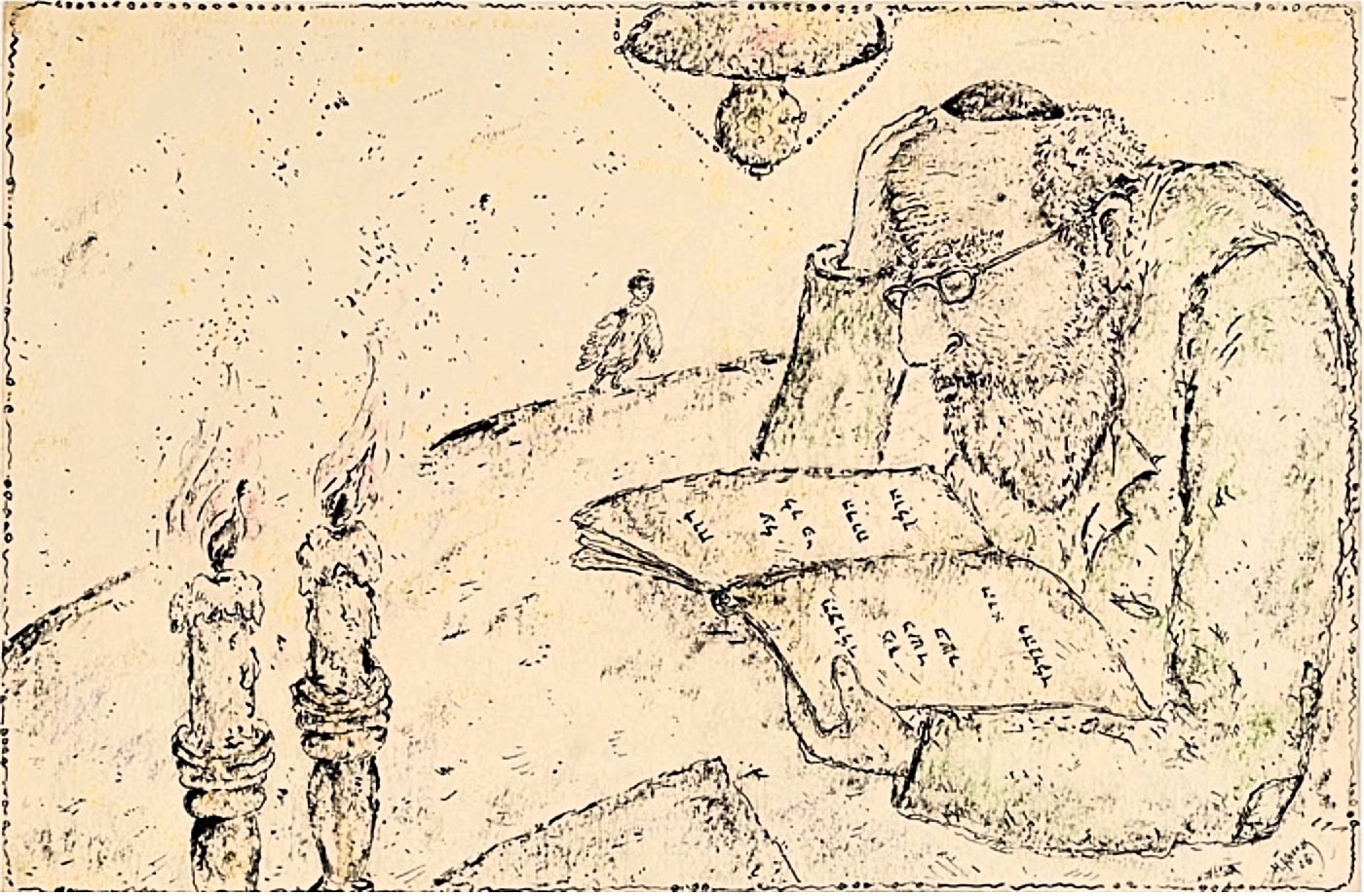
Attributed to Nina Kogan. Reader of the Talmud. 1926 (?). Paper, ink, colored pencils. 19 × 29 cm. Private collection.
Russian Avant-Garde. In Memoriam
By tradition, every article about forgeries of the Russian avant-garde must end with the sad story of Nina Kogan.
An artist for whom a biography was invented and two parallel “legacies” were created - Suprematist and Jewish - Kogan has become a symbol of what happened to the Russian avant-garde.
With the help of numerous art historians who fancy themselves academic scholars while generously issuing certificates confirming the authenticity of dubious works, the avant-garde has turned into a giant hall of distorted mirrors, populated by monstrous twins.
The Russian avant-garde’s “through the looking glass” world has become a significant cultural phenomenon of the late 20th and early 21st centuries, and today it is starting to be critically examined within global cultural discourse. A testament to this is the poem by Clive James, Nina Kogan’s Geometric Paradise:
Two of her little pictures grace my walls:
Suprematism in a special sense,
With all the usual bits and pieces flying
Through space, but carrying a pastel-tinged
Delicacy to lighten the strict forms
Of that hard school and blow them all sky-high,
Splinters and stoppers from the bombing of
An angel’s boudoir. When Malevich told
His pupils that their personalities
Should be suppressed, the maestro little knew
The state would soon require exactly that.
But Nina, trying as she might, could
Rein in her individuality,
And so she made these things that I own now
And gaze at, wondering at her sad fate.
She could have got away, but wished instead
Her gift devoted to Utopia.
She painted trams, designed official posters:
Alive until the siege of Leningrad
And then gone. Given any luck, she starved:
But the purges were still rolling, and I fear
The NKVD had her on a list,
And what she faced, there at the very end,
Was the white cold. Were there an afterlife,
We might meet up, and I could tell her then
Her sumptuous fragments still went flying on
In my last hours, when I, in a warm house,
Lay on my couch to watch them coming close,
Her proofs that any vision of eternity
Is with us in the world, and beautiful
Because a mind has found the way things fit
Purely by touch. That being said, however,
I should record that out of any five
Pictures by Kogan, at least six are fakes.
(New Statesman, 6-12 February 2015)
Footnotes
*The line from the lyrics of Russian antisemitic song.
Arne De Boever, Against Aesthetic Exceptionalism (Minneapolis, London: University of Minnesota Press, 2019), https://manifold.umn.edu/read/untitled-c18c5ee1-5c1b-4106-9656-d463543a0964/section/5dcc1d12-3299-4fd7-8df6-a111749a0957.
Ibid., 65.
Ibid., 66.
Russian Avant-Garde Works, Formerly the Property of Kurt Benedikt, Co-owner of the Galerie van Diemen, Berlin(London: Christie, Manson & Woods, 1990).
Rita Reif, “Mixed Results from the Sale of Russian Art,” The New York Times, April 13, 1990, 27.
Valentine Marcadé, L’art d’Ukraine (Lausanne: L’Age d’homme, 1990); Konstantin Akinsha, Grigorii Kozlov, and Sylvia Hochfield, “The Betrayal of the Russian Avant-Garde,” ARTnews, February 1996, 112.
Berlin – Moscow / Moscow – Berlin, 1900–1950. Fine Art, Photography, Architecture, Theater, Literature, Music, Film (Munich, New York: Prestel, 1995), Cat. III/4, 638, ill. 247.
Dos Mujeres De Vanguardia. Exter — Popova (Barcelona: Galería De Arte Manuel Barbié, 2004), 50–53, ill. 51.
Ibid., 53.
The Future Is Our Only Goal. Aleksandr M. Rodchenko, Varvara F. Stepanova, ed. Peter Noever (Munich: Prestel, 1991).
Akinsha, Kozlov, and Hochfield, “The Betrayal of the Russian Avant-Garde,” 109–10.
“Alexander Rodchenko (Russian, 1891–1956). Composition,” Heritage Auctions, https://fineart.ha.com/itm/fine-art-painting-russian/modern-1900-1949-/alexander-rodchenko-russian-1891-1956-compositionoil-on-panel50-1-2-x-24-1-2-inches-1283-x-622/a/5013-65020.s; Back to 19/20th C. American/European Art, November 17, 2012, RAGO, https://archive.ragoarts.com/auctions/2012/11/16/fine-art/117.
Dos Mujeres De Vanguardia. Exter — Popova, 82–85, ill. 83.
Ibid.
Priscilla DeGregory, “Art Gallery Wants Judge to Disclose Location of Art Worth $60 Million,” New York Post, January 1, 2021, https://nypost.com/2021/01/01/art-gallery-wants-judge-to-disclose-location-of-art-worth-60m/; Tess Thackara, “Lawsuit Claims $100M Damages in Tangled Case of Hidden Russian Art Worth $60M,” The Art Newspaper, January 7, 2021, https://www.theartnewspaper.com/news/gallery-demands-usd100m-damages-in-case-of-hidden-russian-art.
“TEFAF: From Europe with Love,” O vysokom s Mariannoy Minsker,
(see discussion from 34:40).
L.S. Popova, 1889–1924. Exhibition of Works for the 100th Anniversary of Her Birth (Moscow: State Tretyakov Gallery, 1990), Cat. 33, unpaginated.
Geburt der Moderne: Expressionismus, Kubismus, Suprematismus, Konstruktivismus (Zurich: Galerie Orlando, 2006), 78–79.
Expert opinion in possession of the editorial board.
Vom Blauen Reiter zur russischen Avantgarde: Berlin, Moskau, München (Zurich: Galerie Orlando, 2005).
Ibid., 52.
Russian Avantgarde in the Museum Ludwig. Original and Fake: Questions, Research, Explanations (Cologne: Verlag der Buchhandlung Walther König, 2020), 76–79.
Certificate in possession of the editorial board.
Svetlana Kliunkova-Soloveichik, Ivan Vassilievich Kliun (New York: IVK, 1994).
Ukrainian Modernism 1910–1930 (Kyiv: Galereia, 2006), 58.
Kazimir Malevich, Suprematist Composition, in Dmytro Horbachev, Attribution of Works of Art, http://keytoart.org.ua/russian/pictures/viewer24.htm.
“El Lissitzky (1890–1941) Signed Gouache on Paper,” LiveAuctioneers, https://www.liveauctioneers.com/item/87079960_el-lissitzky-1890-1941-signed-gouache-on-paper.
Inventory no. ML 01521.
Abram Efros, Portrait of Natan Altman (Moscow: Shipovnik, 1922), ill. 29; Boris Arvatov, Natan Altman (Berlin: Petropolis, 1924), ill. 30.
Petr Aven, “Falsifiers of History,” ArtChronika, June 1, 2011, http://artchronika.ru/gorod/%D1%84%D0%B0%D0%BB%D1%8C%D1%81%D0%B8%D1%84%D0%B8%D0%BA%D0%B0%D1%82%D0%BE%D1%80%D1%8B-%D0%B8%D1%81%D1%82%D0%BE%D1%80%D0%B8%D0%B8/; Inna Pulikova, “Genuine Passions Swirl Around Forgeries of Natalia Goncharova’s Works,” The Art Newspaper Russia, no. 14 (June 2013), http://www.theartnewspaper.ru/posts/74/; Anna Zanina, “Suspicion of Forgery Recognized as Authentic. The Ministry of Culture Wins Court Case Against British Publisher,” Kommersant, no. 117 (July 2, 2016), https://www.kommersant.ru/doc/3029148.
Impressionist & Modern Art: Including Important Russian Paintings & Works on Paper (London: Bloomsbury Auctions, 2006), 33.
Tableaux Russes, Tableaux XIXème et Belle Époque chez Aguttes (Paris: Aguttes, 2006), 141.
Moderne Kunst, Gemälde, Skulpturen, Graphik, bibliophile Editionen. Auktion: Freitag, 23. Juni 2006 (Zurich: Koller, 2006), 43.
Opere d’arte moderna e contemporanea (Milan: Porro & C., 2007), 31.
Catalogue IV. Auction of Russian Art. 19th/20th Century Paintings, Silver, Fabergé (Munich: Hampel Kunst Auktionen, 2008), 96–97.
The drawing titled Reader of the Talmud was offered for sale by Shapiro Auctions in New York in 2016 (Fine European, Russian, and Asian Art & Antiques, May 21, 2016, Lot #41)
Russian Avantgarde in the Museum Ludwig. Original and Fake: Questions, Research, Explanations (Cologne: Verlag der Buchhandlung Walther König, 2020), 76–79.
Certificate in possession of the editorial board.
Svetlana Kliunkova-Soloveichik, Ivan Vassilievich Kliun (New York: IVK, 1994).
Ukrainian Modernism 1910–1930 (Kyiv: Galereia, 2006), 58.
Kazimir Malevich, Suprematist Composition, in Dmytro Horbachev, Attribution of Works of Art, http://keytoart.org.ua/russian/pictures/viewer24.htm.
“El Lissitzky (1890–1941) Signed Gouache on Paper,” LiveAuctioneers, https://www.liveauctioneers.com/item/87079960_el-lissitzky-1890-1941-signed-gouache-on-paper.
Inventory no. ML 01521.
Abram Efros, Portrait of Natan Altman (Moscow: Shipovnik, 1922), ill. 29; Boris Arvatov, Natan Altman (Berlin: Petropolis, 1924), ill. 30.
Petr Aven, “Falsifiers of History,” ArtChronika, June 1, 2011, http://artchronika.ru/gorod/%D1%84%D0%B0%D0%BB%D1%8C%D1%81%D0%B8%D1%84%D0%B8%D0%BA%D0%B0%D1%82%D0%BE%D1%80%D1%8B-%D0%B8%D1%81%D1%82%D0%BE%D1%80%D0%B8%D0%B8/; Inna Pulikova, “Genuine Passions Swirl Around Forgeries of Natalia Goncharova’s Works,” The Art Newspaper Russia, no. 14 (June 2013), http://www.theartnewspaper.ru/posts/74/; Anna Zanina, “Suspicion of Forgery Recognized as Authentic. The Ministry of Culture Wins Court Case Against British Publisher,” Kommersant, no. 117 (July 2, 2016), https://www.kommersant.ru/doc/3029148.
Impressionist & Modern Art: Including Important Russian Paintings & Works on Paper (London: Bloomsbury Auctions, 2006), 33.
Tableaux Russes, Tableaux XIXème et Belle Époque chez Aguttes (Paris: Aguttes, 2006), 141.
Moderne Kunst, Gemälde, Skulpturen, Graphik, bibliophile Editionen. Auktion: Freitag, 23. Juni 2006 (Zurich: Koller, 2006), 43.
Opere d’arte moderna e contemporanea (Milan: Porro & C., 2007), 31.
Catalogue IV. Auction of Russian Art. 19th/20th Century Paintings, Silver, Fabergé (Munich: Hampel Kunst Auktionen, 2008), 96–97.
The drawing titled Reader of the Talmud was offered for sale by Shapiro Auctions in New York in 2016 (Fine European, Russian, and Asian Art & Antiques, May 21, 2016, Lot #41).
P.S. The author apologizes for the numerous typos in the first issue of The Daily Fake. Let us hope the publication will gradually improve.
ZAKS AFFAIR AND THE SYMPOSIUM UKRAINIAN MODERNISM IN CONTEXT, 1910 -1930
To provide context for the frequently mentioned name of Leonid Zaks, I recommend that readers watch the BBC documentary about the Zaks affair:
I would also like to recommend the video recording of my presentation at the symposium Ukrainian Modernism in Context, 1910–1930 (April 15, 2007), organized by the Ukrainian Research Institute at Harvard University. The discussion at the end of the presentation is particularly interesting.