The Emperor's Silver: How Forged Artifacts Became Multi-Million-Dollar Assets.

I am publishing an English translation of an article by Dmitry Sukharev, an investigative journalist working for Radio Liberty. The article was recently published in the independent online magazine Khroniki. (https://chronicles.media/serebro_imperatora/) Mr. Sukharev has granted permission for the publication of this translation.
A Sensation from Mariupol
In October 2023, the Spanish newspaper El Mundo published a story that read more like the script of a Hollywood thriller than a news report. According to the article, an invaluable collection of silver belonging to the last Chinese emperor, Puyi, had been offered for sale on the dark web. The sellers were allegedly linked to drug cartels. The lot consisted of 117 objects, with an asking price of nearly €480 million.
The collection’s alleged place of origin was identified with remarkable precision: Mariupol. According to a Ukrainian official interviewed by El Mundo, the relics had been removed from the city during the war and transported through a chain of intermediaries to Europe.
The story seemed almost too spectacular to be true. There were simply too many ingredients: an emperor, the dark web, clandestine auctions, criminal middlemen. It was the perfect recipe for the aura of a “great discovery”—one capable of attracting not only public attention but also the money of potential investors and collectors.
A year later, in 2024, anonymous letters began arriving at the offices of several independent Russian media outlets. Their contents closely echoed the Spanish publication: the same collection of Puyi’s silver, the same 117 objects, the same underground sale. There were no names, addresses, or verifiable details. This time, however, the legend came with what appeared to be supporting evidence: a document bearing the coat of arms of the State Hermitage Museum. According to the document, the collection of 117 objects had been valued at $402 million.
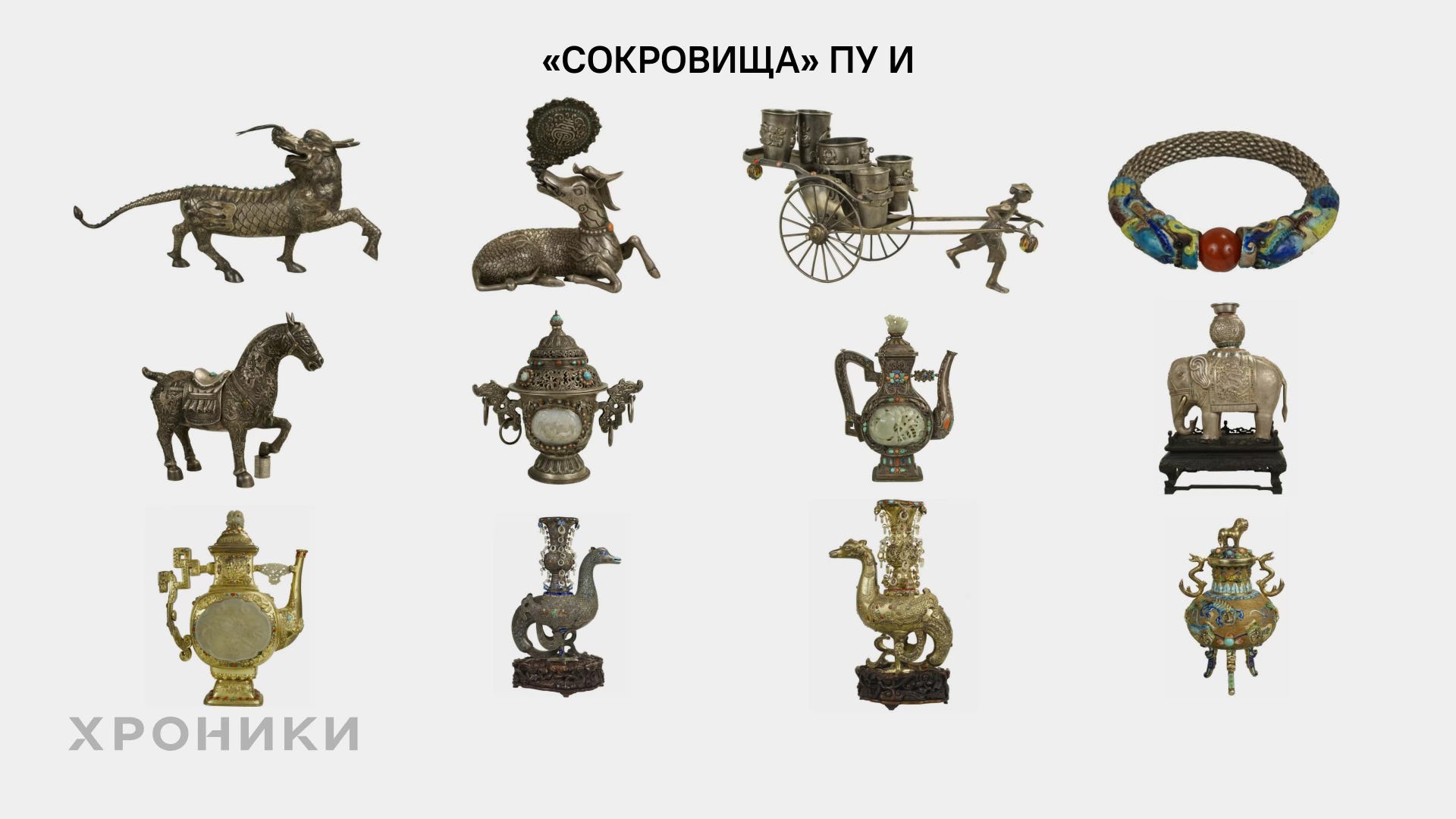
Objects from the so-called "Puyi Collection"
At first glance, the document appeared convincing. The collection was described in meticulous detail: cups, sabres, jewellery, and decorative objects, each carefully listed. The document bore the signature of a well-known art historian and the seal of the Hermitage Museum.
Yet it was precisely in these “details” that the problems lay.
The document carried neither a date nor a registration number—both mandatory elements of any official opinion issued by Russia’s largest museum.
It was signed by a scholar who had died fourteen years earlier.
The discrepancy between the valuations—€480 million in the Spanish publication and $402 million in the anonymous letters—was never explained.
Most importantly, however, the peculiarities of the document were only part of the story. It soon emerged that the valuation of the collection had been prepared by a figure already associated with cases involving dramatically inflated appraisals of artworks and museum objects: the Ukrainian professor Volodymyr Indutny.
Documents with Ghosts
In any story involving multi-million-dollar antiquities transactions, the decisive argument is not the legend but the document. It is a piece of paper bearing a seal and a signature that transforms a questionable collection into a potential asset for banks, insurers, and buyers. In the case of the “Treasures of Puyi,” such a document did indeed appear.
Attached to the anonymous letters sent to Russian media outlets was an appraisal dossier, part of which consisted of a letter on the official letterhead of the State Hermitage Museum containing a detailed description of the collection.
The inventory was carefully compiled: cups, sabres, jewellery, and household objects, each assigned an individual number, a brief description, and a market valuation. Beneath the text appeared the signature of Yevgeny Iosifovich Lubo-Lesnichenko, one of the foremost Soviet and Russian specialists in Eastern art, together with the certification of the Hermitage’s Academic Secretary, N. P. Lavrova.
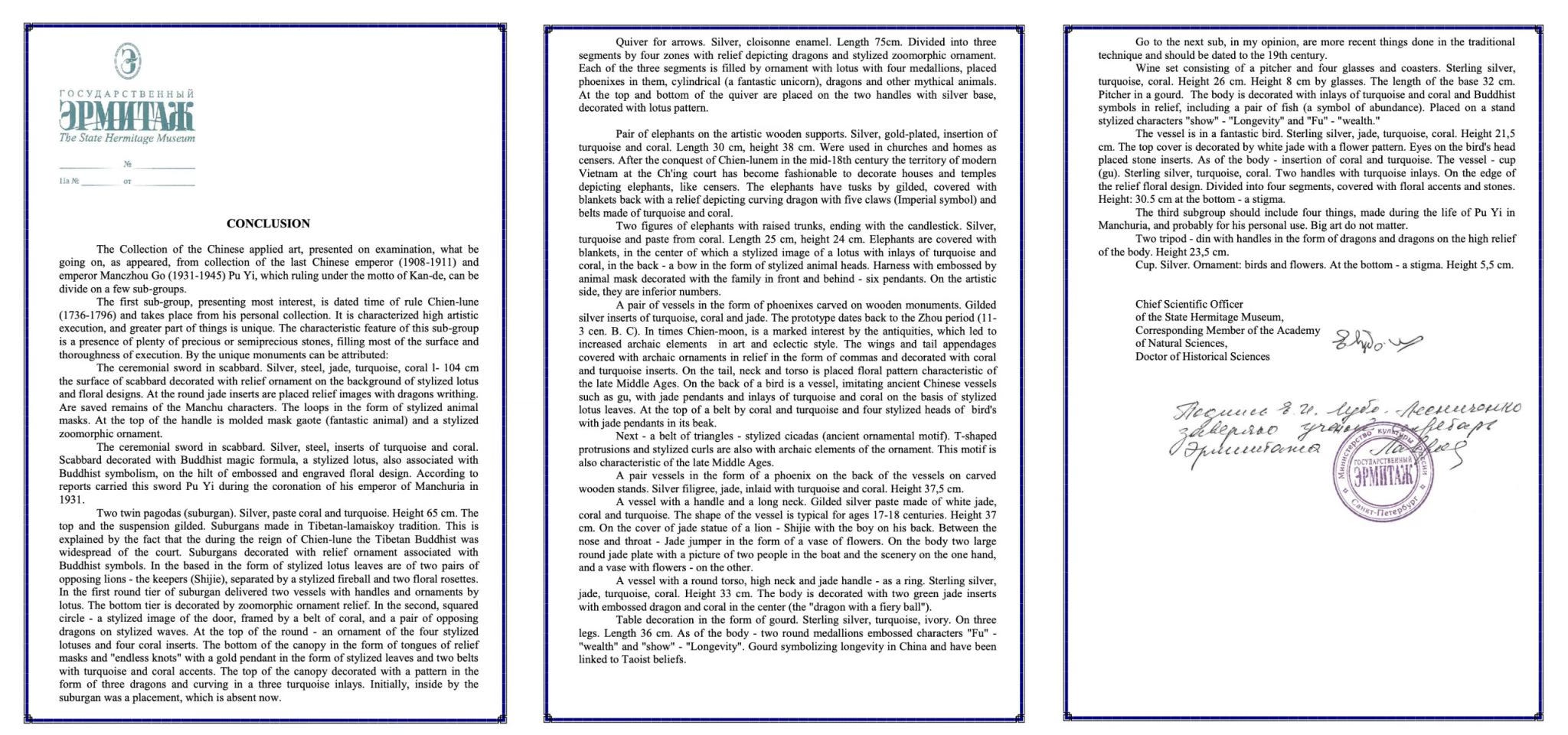
The letterhead and the stamp looked authentic, but...
At first glance, everything looked impeccable. Such a document would be capable of opening doors at any bank, insurance company, or auction house. Yet a closer examination revealed a web of inconsistencies.
Yevgeny Lubo-Lesnichenko was indeed an internationally respected authority. In the field of art history, his name carried considerable weight and was synonymous with expertise. The problem was that he had died in 2001, while the document attached to the letter was dated 2015.
The second signature belonged to N. P. Lavrova, identified as the Academic Secretary of the Hermitage. On paper, it appeared convincing: a surname, an official title, and a certification. However, the Hermitage’s press office later confirmed that no such employee worked at the museum in 2015.
Every official document issued by the Hermitage contains mandatory administrative details: the date of issue, a registration number, and incoming and outgoing reference stamps. None of these were present. The paper resembled a document assembled in a “museum style,” but lacked the very elements that would have given it legal standing.
Nevertheless, it was this document that became the foundation for valuing the so-called “Puyi Collection” at hundreds of millions of dollars.
The Professor of Questionable Valuations
Behind the “Hermitage document” bearing the signature of a deceased art historian, another name unexpectedly emerges—that of Professor
. It was Indutny who was identified as the author of the appraisal valuing the collection at $402 million.
For many years, Volodymyr Indutny’s name has surfaced in stories in which works of art and archaeological artefacts suddenly acquire valuations reaching into the hundreds of millions of dollars.
By training, Indutny is a geologist. In 1993, he defended his doctoral dissertation in geological and mineralogical sciences at the Institute of Mineralogy and Ore Formation in Kyiv. During the 1990s, he became director of the State Gemmological Centre of the Ministry of Finance of Ukraine, where he began developing his own methodologies for the appraisal of cultural property and jewellery.
For government officials and businessmen alike, this proved highly convenient: an expert carrying the seal of the Ministry of Finance could provide a justification for virtually any valuation.
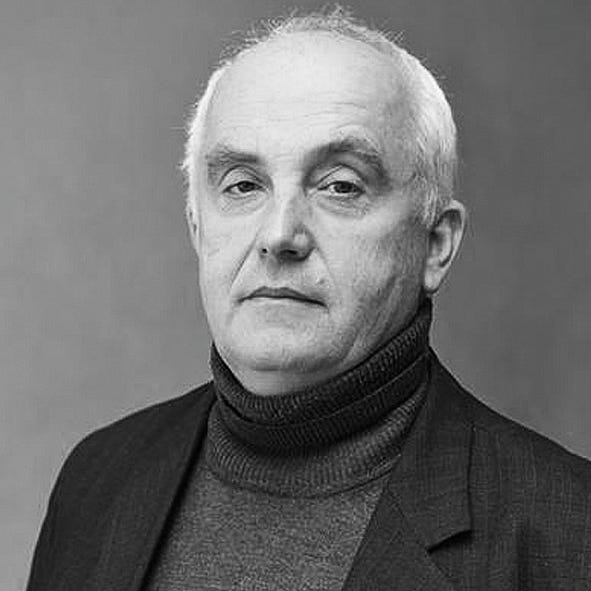
Volodymyr Indutny.
Indutny thus emerged as a universal appraiser—equally ready to assess minerals, paintings, and museum artefacts.
His name is frequently associated with the private Platar Museum in Kyiv, founded in the 1990s by two Ukrainian businessmen, Serhiy Platonov and Serhiy Taruta. The museum’s name was formed from the first syllables of their surnames: PLA-TAR.
Platar presented itself as a unique collection of antiquities comprising more than 10,000 artefacts, ranging from objects of the Trypillian culture and Scythian gold to works from the Kyivan Rus period. Yet from the very beginning the museum was surrounded by controversy. In 2008, the Polish press accused Platar of organizing an exhibition in Warsaw that included artefacts of questionable provenance. Between 2009 and 2012, an international dispute erupted over the exhibition The Glory of Ukraine, which travelled to the United States. Ukraine’s Ministry of Culture demanded the collection’s immediate return, fearing that the objects might be lost. Ukrainian archaeologists publicly argued that many of the artefacts in the Platar collection had been acquired from illicit diggers and that their authenticity and provenance were open to question.
Who Was Behind the Project?
Volodymyr Indutny proved to be a key figure in the authentication and valuation of the Platar collection. His methodologies were used to substantiate the value of the objects, provide figures for exhibition catalogues, and determine insurance valuations.
In practice, he was able to transform a dubious object acquired on the black market into an “artefact of national significance” carrying a multi-million-dollar price tag. The endorsement of such an expert opened doors for the museum, facilitating international exhibitions and lucrative transactions.
This makes Indutny a central figure in the story of the “Treasures of Puyi.” He not only participated in valuing the collection but also helped construct its financial image: a treasure purportedly worth hundreds of millions of dollars.
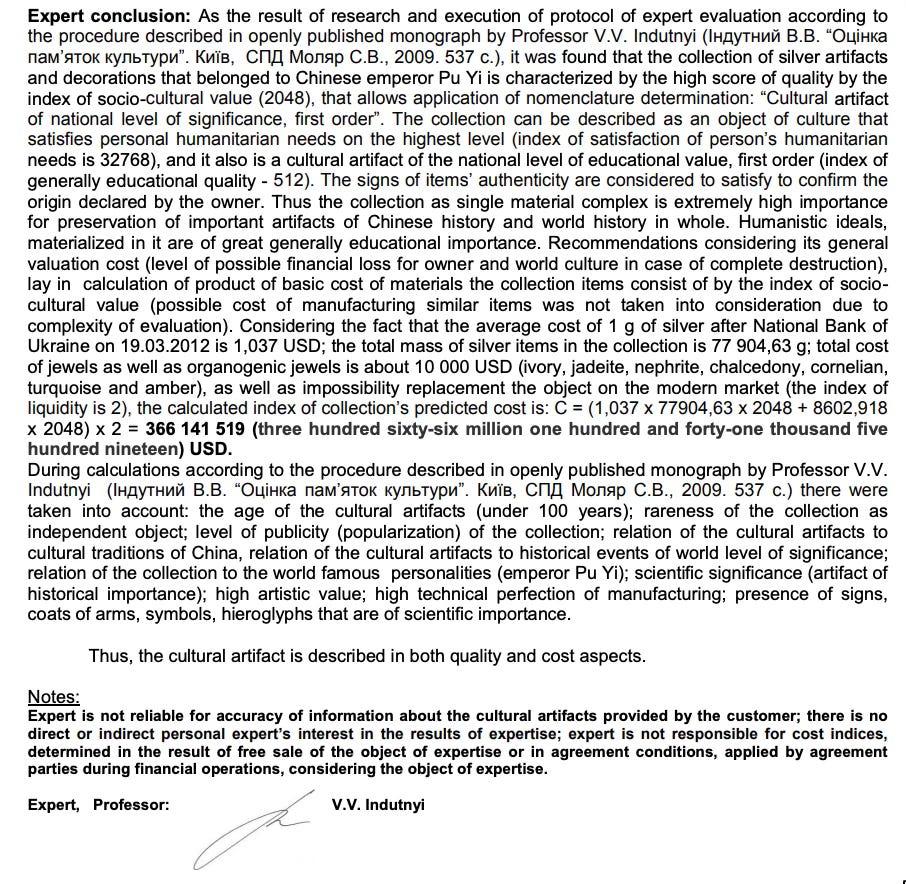
So many millions!
But this was not the first time that Indutny’s appraisals had been used as instruments in questionable schemes.
Millions Out of Thin Air
In the early 2010s, Indutny found himself at the center of a major scandal involving Tavrika Bank. The appraisal firm Art Analytics, which he headed, was tasked with valuing a collection of contemporary Ukrainian art assembled by banker Serhiy Tsiupko.
Indutny devised a methodology that seemed to mock common sense. The value of a painting was determined by its surface area. One square decimeter was assigned a fixed monetary value, which was then “indexed” annually. Whether the artist was a genius or an obscure provincial amateur made no difference—the formula remained exactly the same.
Art historian Konstantin Akinsha has described such a methodology as complete absurdity and madness. According to him, a professional appraiser studies the market value of comparable works of art by examining auction records and actual sales results. “It’s like some mythical self-propelled cart invented by the Slavic peoples,” he remarked ironically.
In 2011, one square decimeter was valued at $2.70; by 2012, the figure had risen to $4.60. As a result, the collection’s value ballooned to fantastic levels: first 5.4 billion hryvnias (approximately $675 million), then 9 billion hryvnias (approximately $1.1 billion). These valuations were used as collateral at Tavrika Bank, which proceeded to issue loans secured against the supposedly priceless collection.
The truth emerged only in 2014, when an independent appraisal valued the entire collection at just 16 million hryvnias—less than $2 million. In 2016, the works were sold for approximately that amount. By then it was too late: Tavrika had collapsed, depositors had lost their money, and Indutny, whose signature appeared on the inflated valuations, faced no consequences.
Several years later, a similar scheme resurfaced—this time involving archaeology.
In 2013, a collection of Crimean Scythian antiquities travelled to Europe for an exhibition. Following the annexation of Crimea, a lengthy legal battle began over whether the objects belonged to Ukraine or Russia. Ultimately, the Amsterdam Court of Appeal ruled in Kyiv’s favour, and in 2023 the genuine artefacts were returned to the National Museum of the History of Ukraine.
At the same time, however, an “alternative version” emerged in Spain. In 2018, objects closely resembling the Scythian artefacts were reportedly discovered in a bank vault in Madrid. They were valued at €123 million and were allegedly intended to serve as collateral for a loan. Spanish authorities hurriedly described the affair as “the theft of the century.”
Experts brought in to examine the objects quickly reached a different conclusion: every single piece was a forgery. Konstantin Akinsha, who studied the case, observed that this was evident even from photographs. He described the supposed “Scythian gold” stored in the Spanish bank as “the wild fantasies of some Odessa jeweller.”
The essence of the scheme was straightforward: legitimize a forgery through media coverage and insurance documentation, then convert it into a financial asset.
The pattern was remarkably consistent. First came a story establishing the object’s importance. Then appeared an expert appraisal assigning it a wildly inflated value. Finally, the artwork or artefact was transformed into an instrument for loans, insurance policies, and financial transactions.
It was precisely along these lines that the story of “Puyi’s silver” later began to unfold. In both cases—the paintings and the “Scythian gold”—the modus operandi was essentially the same.
First, paperwork is created: an expert opinion, an insurance valuation, a “scientific methodology.” On paper, the artefacts acquire a fantastic value. Banks, insurers, and the media become involved. Loans are obtained against objects appraised by Indutny.
When “Puyi’s silver” appears in this chain—accompanied by the fabricated signature of a deceased art historian and a valuation running into hundreds of millions—it ceases to be a sensation. It becomes the latest episode in a familiar series.
Indutny employed the same technology: a legend, a document, and a long string of zeros in the valuation column.
Yet paperwork alone is not enough. Such a scheme also requires a compelling story to which objects of uncertain origin can be attached. In this case, that story was the legend of the “treasures of the last Chinese emperor.”
The Legend of Puyi’s Treasures
Stories about the “Treasures of Puyi” have circulated for decades. They have accumulated layers of rumor and conspiracy theory, but they all trace back to a single source: the emperor’s own autobiography, From Emperor to Citizen (published in the late 1960s; often translated as The First Half of My Life).
In it, Puyi recounts his extraordinary journey from the Dragon Throne to a re-education camp. He ascended the throne as a three-year-old child, was deposed by the revolution in 1912, and later became the puppet ruler of the Japanese-controlled state of Manchukuo. In 1945, Soviet forces arrested him while he was attempting to flee to Japan. He spent several years in the Soviet Union before being returned to China, where he underwent political “re-education” and eventually worked as a gardener and librarian.
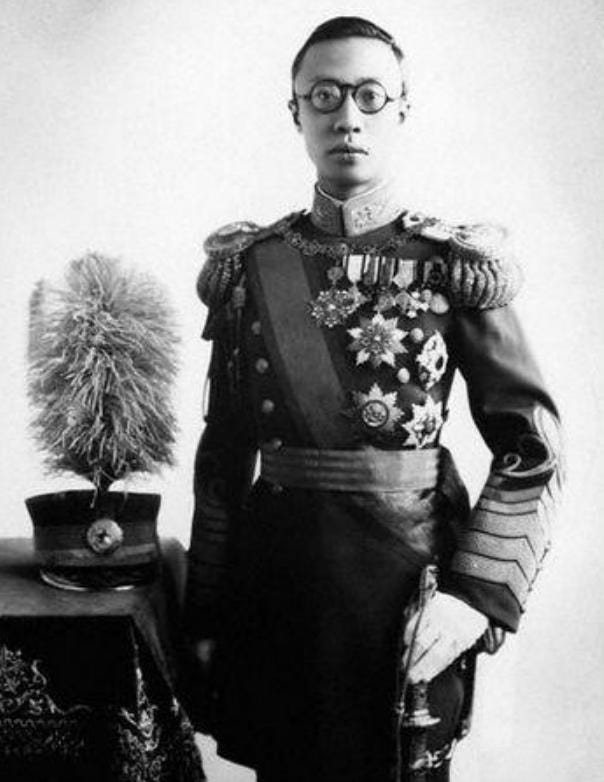
The last emperor.
The most persistent version of the story, repeated from article to article, claims that Puyi did not fall into Soviet captivity empty-handed. According to the legend, his luggage contained suitcases and briefcases filled with silver and valuables. From there, the narrative takes on the quality of a fairy tale: some of the objects were supposedly hidden by the emperor on the grounds of a detention camp near Khabarovsk and, years later, found their way into the hands of antiquities dealers. Thus, the “lost collection” was gradually “reconstructed” by collectors.
The story surfaced repeatedly in Soviet-era magazines such as Rodina and, in the twenty-first century, migrated into blogs and pseudo-historical articles. Traces of the same legend can be found in the “appraisal document” later attached to anonymous letters sent to media outlets. There, the objects were described as if they had genuinely formed part of Puyi’s personal luggage.
Scholars view the story with considerable skepticism. In a conversation with Khroniki.Media, a senior researcher at the Institute of Oriental Studies of the Russian Academy of Sciences observed:
“On the one hand, Puyi was indeed a collector and a man of refined tastes. He may have been interested in silver, although that would be somewhat unusual in the Chinese tradition. On the other hand, he was arrested aboard an aircraft while attempting to flee. It is highly unlikely that he was travelling with a collection; his luggage would have been minimal.”
Art historian Konstantin Akinsha is even more blunt: “Can you imagine it? The Chinese emperor running around a prison camp hiding treasures like a squirrel burying nuts?”
Both experts agree on the essential point: the story of the “suitcases” is appealing but impossible to substantiate. It serves those seeking to legitimize a collection of uncertain provenance.
This is the crucial point. The myth of the treasure is not merely folklore. It functions as a universal justification. Any group of silver objects, any collection lacking a clear provenance, can be attached to the name of Puyi. The very brand of the last emperor becomes a certificate of authenticity.
Thus the illusion is created: instead of a miscellaneous group of objects dating from the 1950s, we are presented with “relics of the Qing dynasty.” From there, only one further step is required—attach the signature of a respected expert and assign a valuation with six or seven zeros.
In 2023, however, this legend collided with reality—not in newspaper articles or expert reports, but at the Ukrainian-Polish border.
The Expert Examination of a Myth
In the summer of 2023, the story of the “silver of the last emperor” entered a new phase. Officers of the Security Service of Ukraine (SBU) and the State Customs Service intercepted a shipment bound for an exhibition in Prague. The shipping documents described the contents as “museum objects.” The customs declaration went even further, classifying them simply as “not cultural property.” Such wording eliminated the need to obtain an export permit from the Ministry of Culture.
Yet the crates contained the very same “imperial collection” that various intermediaries had valued at anywhere between $400 million and €480 million.
This discovery effectively destroyed the Mariupol provenance story. Rather than being hidden in caches removed from the occupied city, the collection was found in Kyiv’s Platar Museum.
The Platar Museum, associated with businessman and politician Serhiy Taruta, insisted that everything had been conducted legally. The documentation package included an agreement with the Czech Galerie Gema, an expert opinion issued by the Borys Voznytsky Lviv National Art Gallery, and certificates from the Ministry of Internal Affairs. The latter stated that the sabres in the collection did not qualify as weapons and could therefore be exported freely.
The official version appeared persuasive. Yet the contrast between artefacts declared to customs as having no cultural significance and the hundreds of millions of dollars assigned to them in the appraisal documents was difficult to ignore.
The SBU ordered a new expert examination. It became the turning point in the entire affair.
Khroniki.Media obtained access to the results. The findings were devastating. The majority of the objects turned out to be products of the mid-twentieth century. The sabres, cups, and ornaments had largely been manufactured in the 1950s, often incorporating synthetic materials.
The collection was highly heterogeneous. It included objects from mainland China, Tuva, Minusinsk, and the Pacific coast. Only five items were ultimately recognized by specialists as cultural property.
The conclusion was unequivocal: the objects had no connection whatsoever to Emperor Puyi or the Qing dynasty. The astronomical valuations reflected inflated appraisals rather than genuine historical or artistic significance.
Yet one central question remained. If the Puyi collection was a myth, why had documents, articles, rumours, and exhibitions been produced around it for decades? The answer lies not in museum display cases but in bank vaults and the offices of valuation experts.
It remains unclear who continued to circulate the story of the “Puyi Collection” after Ukrainian experts had already called it into question, and for what purpose. It is entirely possible that the legend was being used to attract buyers, investors, or intermediaries outside Ukraine.
The Price of a Legend
The significance of the Puyi silver affair extends beyond the fact that Ukrainian experts challenged the collection’s provenance. It demonstrates how the market for questionable cultural property functions.
Across the post-Soviet world, similar schemes have for decades transformed legends, expert opinions, and prestigious names into assets supposedly worth hundreds of millions of dollars.
Within this system, the artefacts themselves are often less important than the documents certifying their “value.” Those documents provide access to loans, insurance policies, exhibitions, and potential buyers.
And although Ukrainian experts effectively dismantled the myth of the “Treasures of the Last Emperor,” the underlying mechanism appears, judging by all available evidence, to remain very much alive.
Highly informative and entertaining. Amazing to see such industriousness to produce forgeries in order to collect millions. Anything is possible. An age-old story but worth re)telling.